

318
7 THE SUBSURFACE ENVIRONMENT
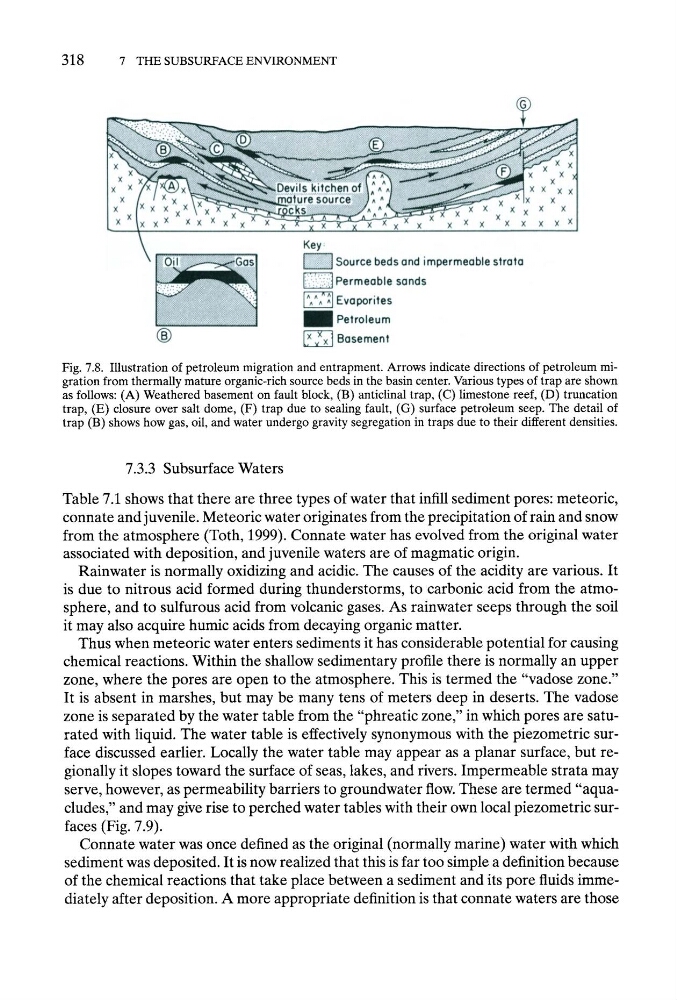
Fig. 7.8. Illustration of petroleum migration and entrapment. Arrows indicate directions of petroleum migration from thermally mature organic-rich source beds in the basin center. Various types of trap are shown
as follows: (A) Weathered basement on fault block, (B) anticlinal trap, (C) limestone reef, (D) truncation
trap, (E) closure over salt dome, (F) trap due to sealing fault, (G) surface petroleum seep. The detail of
trap (B) shows how gas, oil, and water undergo gravity segregation in traps due to their different densities.
7.3.3 Subsurface Waters
Table 7.1 shows that there are three types of water that infill sediment pores: meteoric,
connate and juvenile. Meteoric water originates from the precipitation of rain and snow
from the atmosphere (Toth, 1999). Connate water has evolved from the original water
associated with deposition, and juvenile waters are of magmatic origin.
Rainwater is normally oxidizing and acidic. The causes of the acidity are various. It
is due to nitrous acid formed during thunderstorms, to carbonic acid from the atmosphere, and to sulfurous acid from volcanic gases. As rainwater seeps through the soil
it may also acquire humic acids from decaying organic matter.
Thus when meteoric water enters sediments it has considerable potential for causing
chemical reactions. Within the shallow sedimentary profile there is normally an upper
zone, where the pores are open to the atmosphere. This is termed the "vadose zone."
It is absent in marshes, but may be many tens of meters deep in deserts. The vadose
zone is separated by the water table from the "phreatic zone," in which pores are saturated with liquid. The water table is effectively synonymous with the piezometric surface discussed earlier. Locally the water table may appear as a planar surface, but regionally it slopes toward the surface of seas, lakes, and rivers. Impermeable strata may
serve, however, as permeability barriers to groundwater flow. These are termed "aquacludes," and may give rise to perched water tables with their own local piezometric surfaces (Fig. 7.9).
Connate water was once defined as the original (normally marine) water with which
sediment was deposited. It is now realized that this is far too simple a definition because
of the chemical reactions that take place between a sediment and its pore fluids immediately after deposition. A more appropriate definition is that connate waters are those
7 THE SUBSURFACE ENVIRONMENT
Fig. 7.8. Illustration of petroleum migration and entrapment. Arrows indicate directions of petroleum migration from thermally mature organic-rich source beds in the basin center. Various types of trap are shown
as follows: (A) Weathered basement on fault block, (B) anticlinal trap, (C) limestone reef, (D) truncation
trap, (E) closure over salt dome, (F) trap due to sealing fault, (G) surface petroleum seep. The detail of
trap (B) shows how gas, oil, and water undergo gravity segregation in traps due to their different densities.
7.3.3 Subsurface Waters
Table 7.1 shows that there are three types of water that infill sediment pores: meteoric,
connate and juvenile. Meteoric water originates from the precipitation of rain and snow
from the atmosphere (Toth, 1999). Connate water has evolved from the original water
associated with deposition, and juvenile waters are of magmatic origin.
Rainwater is normally oxidizing and acidic. The causes of the acidity are various. It
is due to nitrous acid formed during thunderstorms, to carbonic acid from the atmosphere, and to sulfurous acid from volcanic gases. As rainwater seeps through the soil
it may also acquire humic acids from decaying organic matter.
Thus when meteoric water enters sediments it has considerable potential for causing
chemical reactions. Within the shallow sedimentary profile there is normally an upper
zone, where the pores are open to the atmosphere. This is termed the "vadose zone."
It is absent in marshes, but may be many tens of meters deep in deserts. The vadose
zone is separated by the water table from the "phreatic zone," in which pores are saturated with liquid. The water table is effectively synonymous with the piezometric surface discussed earlier. Locally the water table may appear as a planar surface, but regionally it slopes toward the surface of seas, lakes, and rivers. Impermeable strata may
serve, however, as permeability barriers to groundwater flow. These are termed "aquacludes," and may give rise to perched water tables with their own local piezometric surfaces (Fig. 7.9).
Connate water was once defined as the original (normally marine) water with which
sediment was deposited. It is now realized that this is far too simple a definition because
of the chemical reactions that take place between a sediment and its pore fluids immediately after deposition. A more appropriate definition is that connate waters are those