

314
7 THE SUBSURFACE ENVIRONMENT
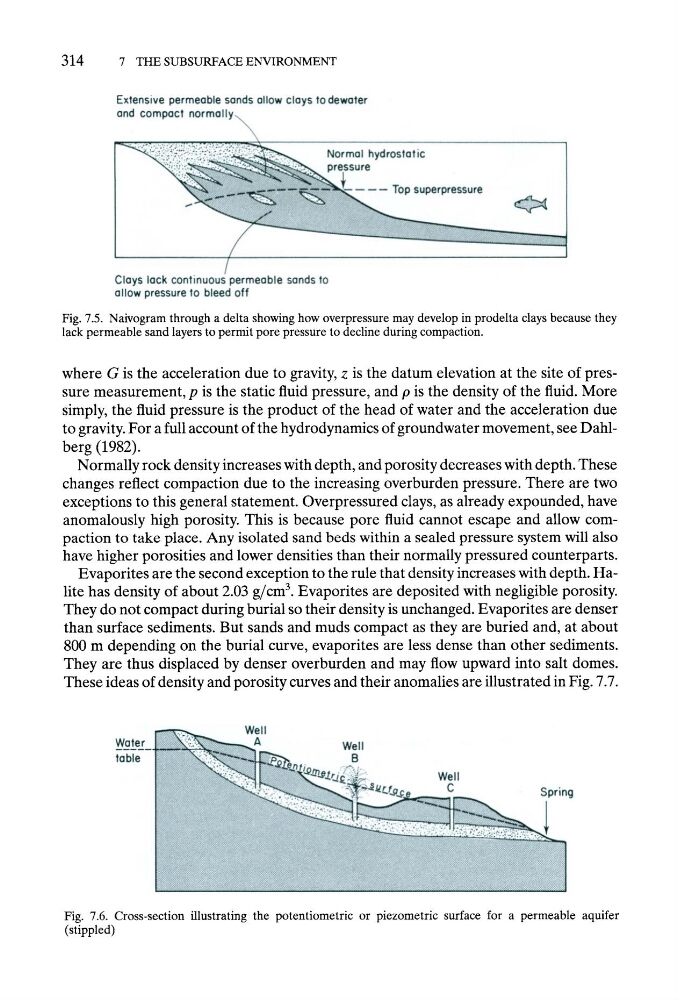
Fig. 7.5. Naivogram through a delta showing how overpressure may develop in prodelta clays because they
lack permeable sand layers to permit pore pressure to decline during compaction.
where G is the acceleration due to gravity, z is the datum elevation at the site of pressure measurement, p is the static fluid pressure, and p is the density of the fluid. More
simply, the fluid pressure is the product of the head of water and the acceleration due
to gravity. For a full account of the hydrodynamics of groundwater movement, see Dahlberg (1982).
Normally rock density increases with depth, and porosity decreases with depth. These
changes reflect compaction due to the increasing overburden pressure. There are two
exceptions to this general statement. Overpressured clays, as already expounded, have
anomalously high porosity. This is because pore fluid cannot escape and allow compaction to take place. Any isolated sand beds within a sealed pressure system will also
have higher porosities and lower densities than their normally pressured counterparts.
Evaporites are the second exception to the rule that density increases with depth. Halite has density of about 2.03 g/cm 3. Evaporites are deposited with negligible porosity.
They do not compact during burial so their density is unchanged. Evaporites are denser
than surface sediments. But sands and muds compact as they are buried and, at about
800 m depending on the burial curve, evaporites are less dense than other sediments.
They are thus displaced by denser overburden and may flow upward into salt domes.
These ideas of density and porosity curves and their anomalies are illustrated in Fig. 7.7.
Fig. 7.6. Cross-section illustrating the potentiometric or piezometric surface for a permeable aquifer
(stippled)
7 THE SUBSURFACE ENVIRONMENT
Fig. 7.5. Naivogram through a delta showing how overpressure may develop in prodelta clays because they
lack permeable sand layers to permit pore pressure to decline during compaction.
where G is the acceleration due to gravity, z is the datum elevation at the site of pressure measurement, p is the static fluid pressure, and p is the density of the fluid. More
simply, the fluid pressure is the product of the head of water and the acceleration due
to gravity. For a full account of the hydrodynamics of groundwater movement, see Dahlberg (1982).
Normally rock density increases with depth, and porosity decreases with depth. These
changes reflect compaction due to the increasing overburden pressure. There are two
exceptions to this general statement. Overpressured clays, as already expounded, have
anomalously high porosity. This is because pore fluid cannot escape and allow compaction to take place. Any isolated sand beds within a sealed pressure system will also
have higher porosities and lower densities than their normally pressured counterparts.
Evaporites are the second exception to the rule that density increases with depth. Halite has density of about 2.03 g/cm 3. Evaporites are deposited with negligible porosity.
They do not compact during burial so their density is unchanged. Evaporites are denser
than surface sediments. But sands and muds compact as they are buried and, at about
800 m depending on the burial curve, evaporites are less dense than other sediments.
They are thus displaced by denser overburden and may flow upward into salt domes.
These ideas of density and porosity curves and their anomalies are illustrated in Fig. 7.7.
Fig. 7.6. Cross-section illustrating the potentiometric or piezometric surface for a permeable aquifer
(stippled)