

7.2 SUBSURFACE PRESSURES
313
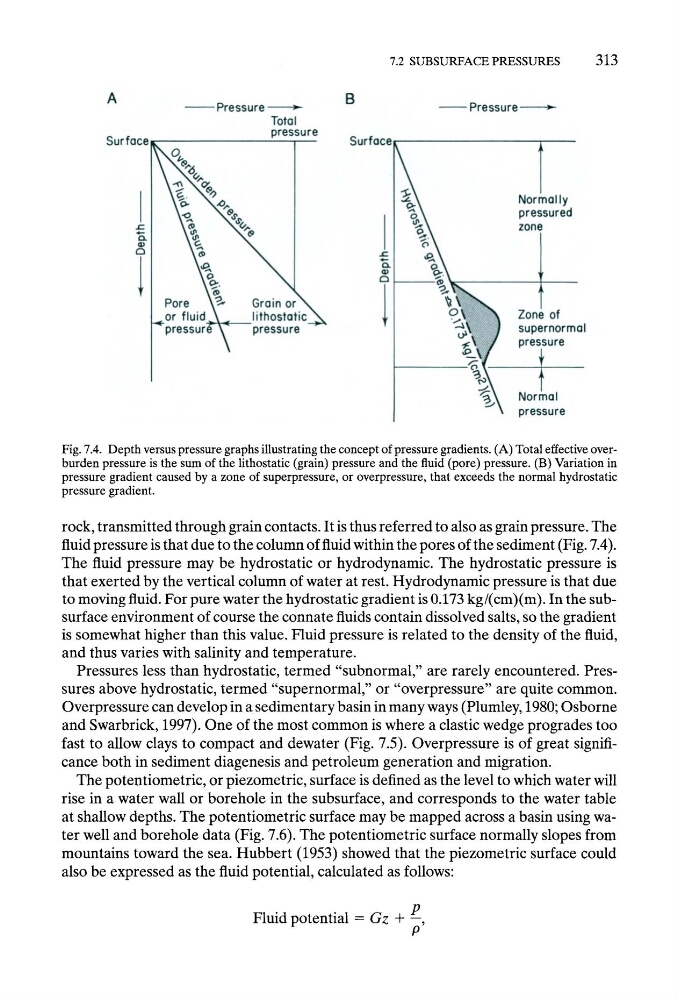
Fig. 7.4. Depth versus pressure graphs illustrating the concept of pressure gradients. (A) Total effective overburden pressure is the sum of the lithostatic (grain) pressure and the fluid (pore) pressure. (B) Variation in
pressure gradient caused by a zone of superpressure, or overpressure, that exceeds the normal hydrostatic
pressure gradient.
rock, transmitted through grain contacts. It is thus referred to also as grain pressure. The
fluid pressure is that due to the column of fluid within the pores of the sediment (Fig. 7.4).
The fluid pressure may be hydrostatic or hydrodynamic. The hydrostatic pressure is
that exerted by the vertical column of water at rest. Hydrodynamic pressure is that due
to moving fluid. For pure water the hydrostatic gradient is 0.173 kg/(cm)(m). In the subsurface environment of course the connate fluids contain dissolved salts, so the gradient
is somewhat higher than this value. Fluid pressure is related to the density of the fluid,
and thus varies with salinity and temperature.
Pressures less than hydrostatic, termed "subnormal," are rarely encountered. Pressures above hydrostatic, termed "supernormal," or "overpressure" are quite common.
Overpressure can develop in a sedimentary basin in many ways (Plumley, 1980; Osborne
and Swarbrick, 1997). One of the most common is where a clastic wedge progrades too
fast to allow clays to compact and dewater (Fig. 7.5). Overpressure is of great significance both in sediment diagenesis and petroleum generation and migration.
The potentiometric, or piezometric, surface is defined as the level to which water will
rise in a water wall or borehole in the subsurface, and corresponds to the water table
at shallow depths. The potentiometric surface may be mapped across a basin using water well and borehole data (Fig. 7.6). The potentiometric surface normally slopes from
mountains toward the sea. Hubbert (1953) showed that the piezometric surface could
also be expressed as the fluid potential, calculated as follows:
Fluid potential = Gz +
P
p'
313
Fig. 7.4. Depth versus pressure graphs illustrating the concept of pressure gradients. (A) Total effective overburden pressure is the sum of the lithostatic (grain) pressure and the fluid (pore) pressure. (B) Variation in
pressure gradient caused by a zone of superpressure, or overpressure, that exceeds the normal hydrostatic
pressure gradient.
rock, transmitted through grain contacts. It is thus referred to also as grain pressure. The
fluid pressure is that due to the column of fluid within the pores of the sediment (Fig. 7.4).
The fluid pressure may be hydrostatic or hydrodynamic. The hydrostatic pressure is
that exerted by the vertical column of water at rest. Hydrodynamic pressure is that due
to moving fluid. For pure water the hydrostatic gradient is 0.173 kg/(cm)(m). In the subsurface environment of course the connate fluids contain dissolved salts, so the gradient
is somewhat higher than this value. Fluid pressure is related to the density of the fluid,
and thus varies with salinity and temperature.
Pressures less than hydrostatic, termed "subnormal," are rarely encountered. Pressures above hydrostatic, termed "supernormal," or "overpressure" are quite common.
Overpressure can develop in a sedimentary basin in many ways (Plumley, 1980; Osborne
and Swarbrick, 1997). One of the most common is where a clastic wedge progrades too
fast to allow clays to compact and dewater (Fig. 7.5). Overpressure is of great significance both in sediment diagenesis and petroleum generation and migration.
The potentiometric, or piezometric, surface is defined as the level to which water will
rise in a water wall or borehole in the subsurface, and corresponds to the water table
at shallow depths. The potentiometric surface may be mapped across a basin using water well and borehole data (Fig. 7.6). The potentiometric surface normally slopes from
mountains toward the sea. Hubbert (1953) showed that the piezometric surface could
also be expressed as the fluid potential, calculated as follows:
Fluid potential = Gz +
P
p'