

7.1 SUBSURFACE TEMPERATURES
311
Temperature, t ( o C)
o
I
loo
1
I
,4
tca
to
i lg
\o~
Surface
s
q)
Temperature ~~
L ow~con d u c t ivi ty
layer=high
geothermal
gradient
High "~ conductivity
layer = low
geothermal
gradient
Low~c-onductivity
layer = high
geothermal
gradient
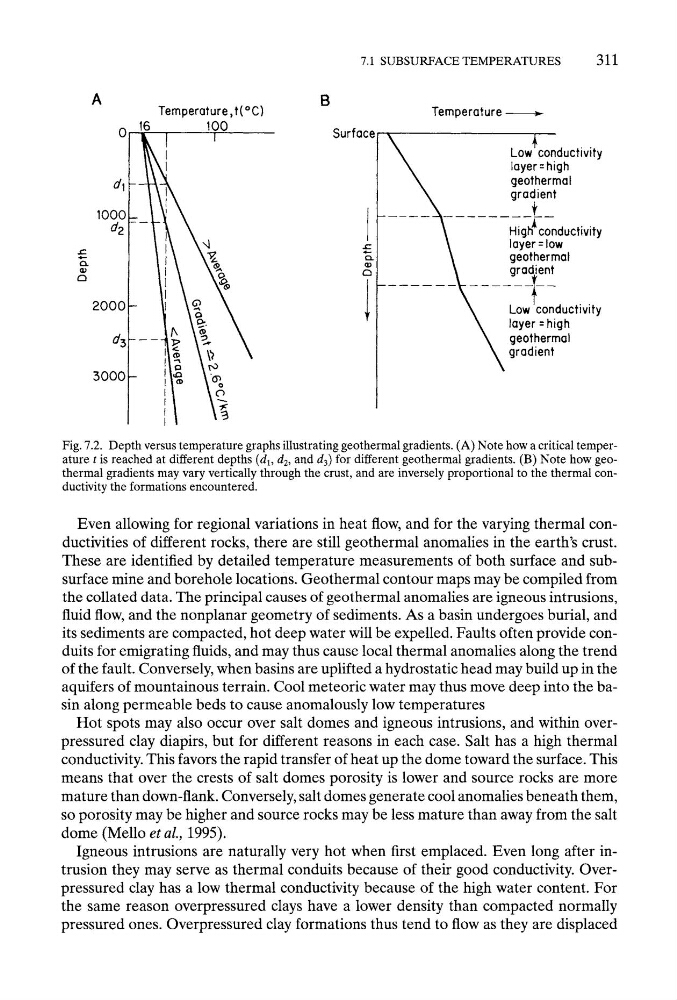
Fig. 7.2. Depth versus temperature graphs illustrating geothermal gradients. (A) Note how a critical temperature t is reached at different depths (dl, d2, and d3) for different geothermal gradients. (B) Note how geothermal gradients may vary vertically through the crust, and are inversely proportional to the thermal conductivity the formations encountered.
Even allowing for regional variations in heat flow, and for the varying thermal conductivities of different rocks, there are still geothermal anomalies in the earth's crust.
These are identified by detailed temperature measurements of both surface and subsurface mine and borehole locations. Geothermal contour maps may be compiled from
the collated data. The principal causes of geothermal anomalies are igneous intrusions,
fluid flow, and the nonplanar geometry of sediments. As a basin undergoes burial, and
its sediments are compacted, hot deep water will be expelled. Faults often provide conduits for emigrating fluids, and may thus cause local thermal anomalies along the trend
of the fault. Conversely, when basins are uplifted a hydrostatic head may build up in the
aquifers of mountainous terrain. Cool meteoric water may thus move deep into the basin along permeable beds to cause anomalously low temperatures
Hot spots may also occur over salt domes and igneous intrusions, and within overpressured clay diapirs, but for different reasons in each case. Salt has a high thermal
conductivity. This favors the rapid transfer of heat up the dome toward the surface. This
means that over the crests of salt domes porosity is lower and source rocks are more
mature than down-flank. Conversely, salt domes generate cool anomalies beneath them,
so porosity may be higher and source rocks may be less mature than away from the salt
dome (Mello et al., 1995).
Igneous intrusions are naturally very hot when first emplaced. Even long after intrusion they may serve as thermal conduits because of their good conductivity. Overpressured clay has a low thermal conductivity because of the high water content. For
the same reason overpressured clays have a lower density than compacted normally
pressured ones. Overpressured clay formations thus tend to flow as they are displaced
311
Temperature, t ( o C)
o
I
loo
1
I
,4
tca
to
i lg
\o~
Surface
s
q)
Temperature ~~
L ow~con d u c t ivi ty
layer=high
geothermal
gradient
High "~ conductivity
layer = low
geothermal
gradient
Low~c-onductivity
layer = high
geothermal
gradient
Fig. 7.2. Depth versus temperature graphs illustrating geothermal gradients. (A) Note how a critical temperature t is reached at different depths (dl, d2, and d3) for different geothermal gradients. (B) Note how geothermal gradients may vary vertically through the crust, and are inversely proportional to the thermal conductivity the formations encountered.
Even allowing for regional variations in heat flow, and for the varying thermal conductivities of different rocks, there are still geothermal anomalies in the earth's crust.
These are identified by detailed temperature measurements of both surface and subsurface mine and borehole locations. Geothermal contour maps may be compiled from
the collated data. The principal causes of geothermal anomalies are igneous intrusions,
fluid flow, and the nonplanar geometry of sediments. As a basin undergoes burial, and
its sediments are compacted, hot deep water will be expelled. Faults often provide conduits for emigrating fluids, and may thus cause local thermal anomalies along the trend
of the fault. Conversely, when basins are uplifted a hydrostatic head may build up in the
aquifers of mountainous terrain. Cool meteoric water may thus move deep into the basin along permeable beds to cause anomalously low temperatures
Hot spots may also occur over salt domes and igneous intrusions, and within overpressured clay diapirs, but for different reasons in each case. Salt has a high thermal
conductivity. This favors the rapid transfer of heat up the dome toward the surface. This
means that over the crests of salt domes porosity is lower and source rocks are more
mature than down-flank. Conversely, salt domes generate cool anomalies beneath them,
so porosity may be higher and source rocks may be less mature than away from the salt
dome (Mello et al., 1995).
Igneous intrusions are naturally very hot when first emplaced. Even long after intrusion they may serve as thermal conduits because of their good conductivity. Overpressured clay has a low thermal conductivity because of the high water content. For
the same reason overpressured clays have a lower density than compacted normally
pressured ones. Overpressured clay formations thus tend to flow as they are displaced