

310
7 THE SUBSURFACE ENVIRONMENT
;9 6
o
.
,I salt
9 r,
"
~
'= 4i'
~ 3~
limestone
I,,
~
f basalt
9
=
....
i
-
-
9
-J i
....
I
....
I
"
"
""
I
....
i
....
0
100
200
300
400
Temperature (~
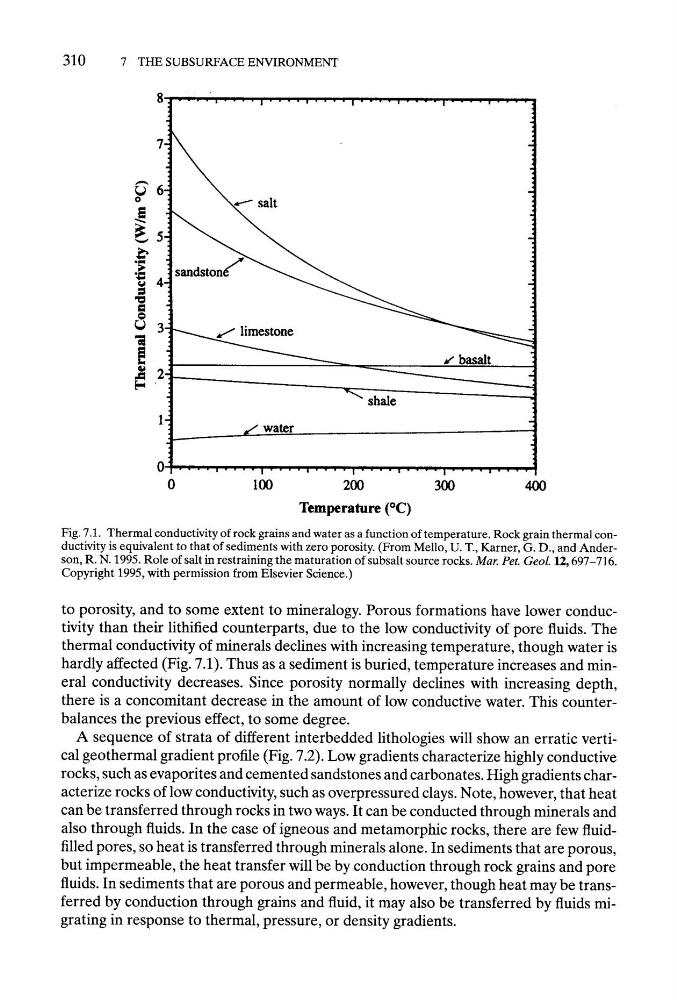
Fig. 7.1. Thermal conductivity of rock grains and water as a function of temperature. Rock grain thermal conductivity is equivalent to that of sediments with zero porosity. (From Mello, U. T., Karner, G. D., and Anderson, R. N. 1995. Role of salt in restraining the maturation of subsalt source rocks. Mar. Pet. Geol. 12, 697-716.
Copyright 1995, with permission from Elsevier Science.)
to porosity, and to some extent to mineralogy. Porous formations have lower conductivity than their lithified counterparts, due to the low conductivity of pore fluids. The
thermal conductivity of minerals declines with increasing temperature, though water is
hardly affected (Fig. 7.1). Thus as a sediment is buried, temperature increases and mineral conductivity decreases. Since porosity normally declines with increasing depth,
there is a concomitant decrease in the amount of low conductive water. This counterbalances the previous effect, to some degree.
A sequence of strata of different interbedded lithologies will show an erratic vertical geothermal gradient profile (Fig. 7.2). Low gradients characterize highly conductive
rocks, such as evaporites and cemented sandstones and carbonates. High gradients characterize rocks of low conductivity, such as overpressured clays. Note, however, that heat
can be transferred through rocks in two ways. It can be conducted through minerals and
also through fluids. In the case of igneous and metamorphic rocks, there are few fluidfilled pores, so heat is transferred through minerals alone. In sediments that are porous,
but impermeable, the heat transfer will be by conduction through rock grains and pore
fluids. In sediments that are porous and permeable, however, though heat may be transferred by conduction through grains and fluid, it may also be transferred by fluids migrating in response to thermal, pressure, or density gradients.
7 THE SUBSURFACE ENVIRONMENT
;9 6
o
.
,I salt
9 r,
"
~
'= 4i'
~ 3~
limestone
I,,
~
f basalt
9
=
....
i
-
-
9
-J i
....
I
....
I
"
"
""
I
....
i
....
0
100
200
300
400
Temperature (~
Fig. 7.1. Thermal conductivity of rock grains and water as a function of temperature. Rock grain thermal conductivity is equivalent to that of sediments with zero porosity. (From Mello, U. T., Karner, G. D., and Anderson, R. N. 1995. Role of salt in restraining the maturation of subsalt source rocks. Mar. Pet. Geol. 12, 697-716.
Copyright 1995, with permission from Elsevier Science.)
to porosity, and to some extent to mineralogy. Porous formations have lower conductivity than their lithified counterparts, due to the low conductivity of pore fluids. The
thermal conductivity of minerals declines with increasing temperature, though water is
hardly affected (Fig. 7.1). Thus as a sediment is buried, temperature increases and mineral conductivity decreases. Since porosity normally declines with increasing depth,
there is a concomitant decrease in the amount of low conductive water. This counterbalances the previous effect, to some degree.
A sequence of strata of different interbedded lithologies will show an erratic vertical geothermal gradient profile (Fig. 7.2). Low gradients characterize highly conductive
rocks, such as evaporites and cemented sandstones and carbonates. High gradients characterize rocks of low conductivity, such as overpressured clays. Note, however, that heat
can be transferred through rocks in two ways. It can be conducted through minerals and
also through fluids. In the case of igneous and metamorphic rocks, there are few fluidfilled pores, so heat is transferred through minerals alone. In sediments that are porous,
but impermeable, the heat transfer will be by conduction through rock grains and pore
fluids. In sediments that are porous and permeable, however, though heat may be transferred by conduction through grains and fluid, it may also be transferred by fluids migrating in response to thermal, pressure, or density gradients.