

288
6 DEPOSITIONAL SYSTEMS
This reveals the number of times that beds overlie other bed types more often than
would be expected if sedimentation took place randomly (Selley, 1970). Thus can any
regular sedimentary cycle be identified. This technique has both stimulated and irritated
geologists for many years (Harper, 1984; Walker, 1984a). One of the main problems
is that, when measuring sedimentary sections, few geologists record the same facies
overlying itself, except perhaps multistory channel sands. Thus the diagonals in the matrix array record zeros, something that disturbs the mathematical mind. This problem
is simply overcome by recording bed types at regular vertical intervals down the sequence, and recording the resultant transitions accordingly.
In recent years studies of cyclicity in sedimentary successions has led to the establishment of what is termed cydostratigraphy (Schwarzacher, 1993; de Boer and Smith,
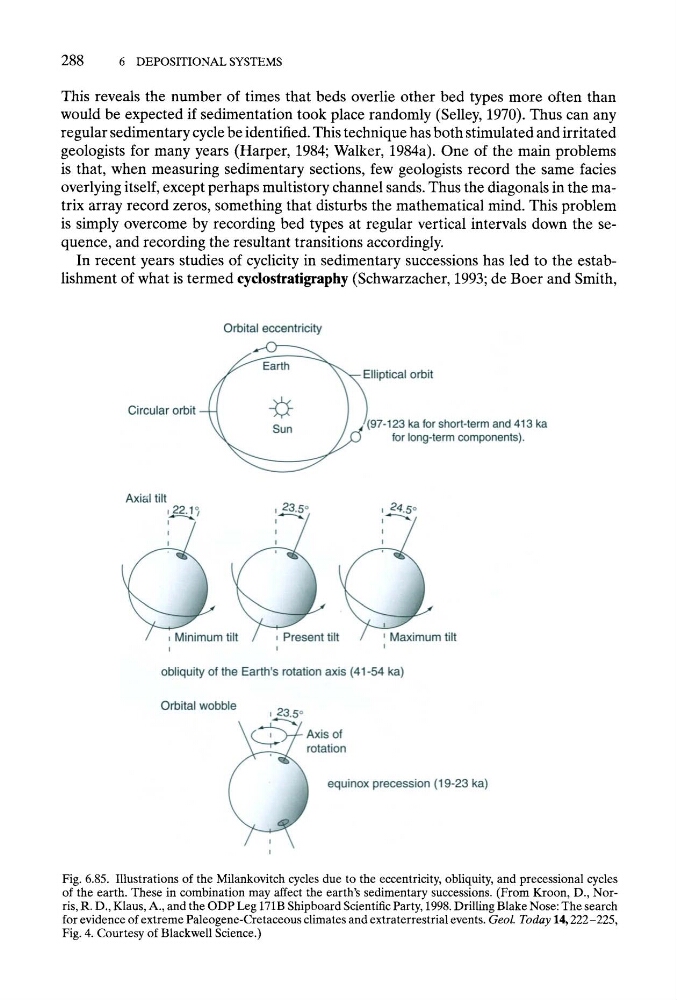
Fig. 6.85. Illustrations of the Milankovitch cycles due to the eccentricity, obliquity, and precessional cycles
of the earth. These in combination may affect the earth's sedimentary successions. (From Kroon, D., Norris, R. D., Klaus, A., and the ODP Leg 171B Shipboard Scientific Party, 1998. Drilling Blake Nose: The search
for evidence of extreme Paleogene-Cretaceous climates and extraterrestrial events. Geol. Today 14, 222-225,
Fig. 4. Courtesy of Blackwell Science.)
6 DEPOSITIONAL SYSTEMS
This reveals the number of times that beds overlie other bed types more often than
would be expected if sedimentation took place randomly (Selley, 1970). Thus can any
regular sedimentary cycle be identified. This technique has both stimulated and irritated
geologists for many years (Harper, 1984; Walker, 1984a). One of the main problems
is that, when measuring sedimentary sections, few geologists record the same facies
overlying itself, except perhaps multistory channel sands. Thus the diagonals in the matrix array record zeros, something that disturbs the mathematical mind. This problem
is simply overcome by recording bed types at regular vertical intervals down the sequence, and recording the resultant transitions accordingly.
In recent years studies of cyclicity in sedimentary successions has led to the establishment of what is termed cydostratigraphy (Schwarzacher, 1993; de Boer and Smith,
Fig. 6.85. Illustrations of the Milankovitch cycles due to the eccentricity, obliquity, and precessional cycles
of the earth. These in combination may affect the earth's sedimentary successions. (From Kroon, D., Norris, R. D., Klaus, A., and the ODP Leg 171B Shipboard Scientific Party, 1998. Drilling Blake Nose: The search
for evidence of extreme Paleogene-Cretaceous climates and extraterrestrial events. Geol. Today 14, 222-225,
Fig. 4. Courtesy of Blackwell Science.)