

6.4 SEDIMENTARY MODELS, INCREMENTS, AND CYCLES
287
instance of cyclicity. Furthermore, as at the present time, several cycle mechanisms may
operate simultaneously. In deltaic deposits there will be local autocyclic motifs due to
delta switching, on which may be superimposed more extensive cycles due to allocyclic
mechanisms.
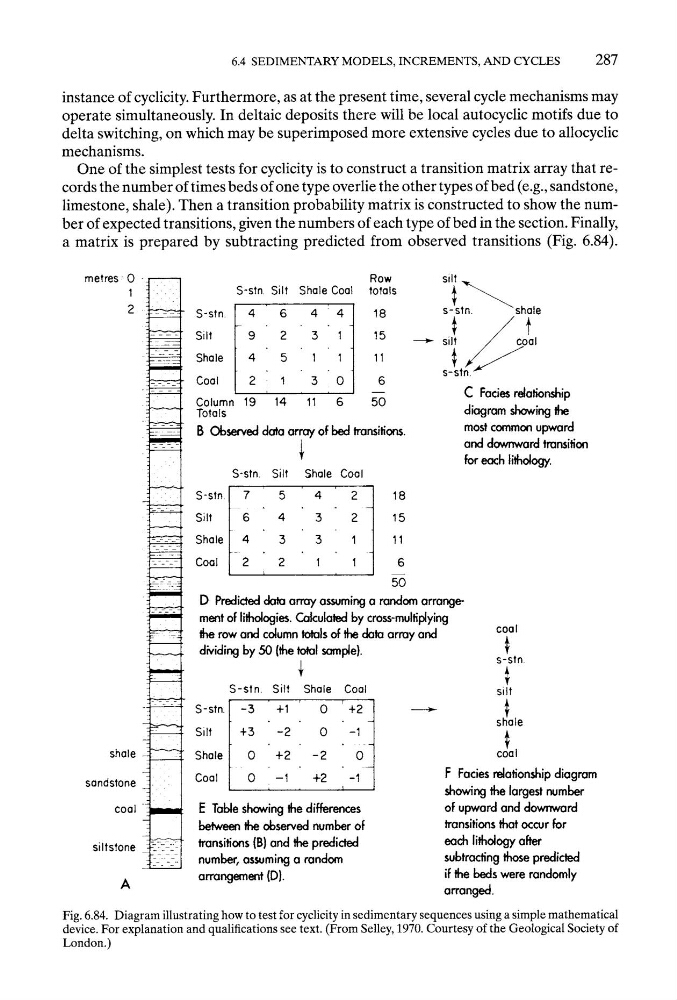
One of the simplest tests for cyclicity is to construct a transition matrix array that records the number of times beds of one type overlie the other types of bed (e.g., sandstone,
limestone, shale). Then a transition probability matrix is constructed to show the number of expected transitions, given the numbers of each type of bed in the section. Finally,
a matrix is prepared by subtracting predicted from observed transitions (Fig. 6.84).
metres: 0
1
2
shale -
_
sandstone
coal
siltstone
A
Row
silt .._
S-stn. Silt Shale Cool totals
I
i
'
"
'
'
tn.
~ h '
S-stn. / 4
6
4 : 4 /
18
s-s n.
.s ale
Silt
~-9'
2" 3" 11
15
~ si! /co~al
~
Shale /4 i 5 i I i 1 ]
11
~ /~
i
Coal I 2 1 3 0 ] 6
s-stn.
...
/,,
, ,,, , ,, ; ,, J ~
C Facies relationship
bolumn 1~ I~
11
I0
OU
~
~
.
Totals
aiagram mowing
B Observed data array of bed transitions,
most common upward
],
and downward transition
9
for each lithology.
S-stn. Silt Shale Coal
S-stn. L7 1 5 ' 4 ' 2 _! 18
Silt / 6" 4 " 3 " 2 I 15
Shale[_4' 5t" 3 " 1 ~
-j 11
Coal 1-2 i z "1"
1-j 6
D Predicted data army assuming a random arrange
merit of lithologies. Calculated by cross-multiplying
the row and column totals of the data array and
coal
dividing by 50 (the total sample).
II
S-stn. Silt
S-stn. -3
Silt
+3
Shale
0
Coal
0
Shale Coal
r
r
r
+1
0
+2
-2
0
-1
'+2 -2 io
-1
+2 ' -1
4
1
E Table showing the differences
between the observed number of
transitions (B) and the predicted
number, assuming a random
arrangement (D).
silt
s~le
coal
F Facies relationship diagram
showing the largest number
of upward and dowmvard
transitions that occur for
each lithology after
subtracting those predicted
if the beds were randomly
arranged.
Fig. 6.84. Diagram illustrating how to test for cyclicity in sedimentary sequences using a simple mathematical
device. For explanation and qualifications see text. (From Selley, 1970. Courtesy of the Geological Society of
London.)
287
instance of cyclicity. Furthermore, as at the present time, several cycle mechanisms may
operate simultaneously. In deltaic deposits there will be local autocyclic motifs due to
delta switching, on which may be superimposed more extensive cycles due to allocyclic
mechanisms.
One of the simplest tests for cyclicity is to construct a transition matrix array that records the number of times beds of one type overlie the other types of bed (e.g., sandstone,
limestone, shale). Then a transition probability matrix is constructed to show the number of expected transitions, given the numbers of each type of bed in the section. Finally,
a matrix is prepared by subtracting predicted from observed transitions (Fig. 6.84).
metres: 0
1
2
shale -
_
sandstone
coal
siltstone
A
Row
silt .._
S-stn. Silt Shale Cool totals
I
i
'
"
'
'
tn.
~ h '
S-stn. / 4
6
4 : 4 /
18
s-s n.
.s ale
Silt
~-9'
2" 3" 11
15
~ si! /co~al
~
Shale /4 i 5 i I i 1 ]
11
~ /~
i
Coal I 2 1 3 0 ] 6
s-stn.
...
/,,
, ,,, , ,, ; ,, J ~
C Facies relationship
bolumn 1~ I~
11
I0
OU
~
~
.
Totals
aiagram mowing
B Observed data array of bed transitions,
most common upward
],
and downward transition
9
for each lithology.
S-stn. Silt Shale Coal
S-stn. L7 1 5 ' 4 ' 2 _! 18
Silt / 6" 4 " 3 " 2 I 15
Shale[_4' 5t" 3 " 1 ~
-j 11
Coal 1-2 i z "1"
1-j 6
D Predicted data army assuming a random arrange
merit of lithologies. Calculated by cross-multiplying
the row and column totals of the data array and
coal
dividing by 50 (the total sample).
II
S-stn. Silt
S-stn. -3
Silt
+3
Shale
0
Coal
0
Shale Coal
r
r
r
+1
0
+2
-2
0
-1
'+2 -2 io
-1
+2 ' -1
4
1
E Table showing the differences
between the observed number of
transitions (B) and the predicted
number, assuming a random
arrangement (D).
silt
s~le
coal
F Facies relationship diagram
showing the largest number
of upward and dowmvard
transitions that occur for
each lithology after
subtracting those predicted
if the beds were randomly
arranged.
Fig. 6.84. Diagram illustrating how to test for cyclicity in sedimentary sequences using a simple mathematical
device. For explanation and qualifications see text. (From Selley, 1970. Courtesy of the Geological Society of
London.)