

6.4 SEDIMENTARY MODELS, INCREMENTS, AND CYCLES
285
-,,lAGES
z
BARREMIAN
-
~;
HAUTERIVIAN
Cr
C:~
,
o
VALANGINIAN
r
i..z.I
z
BERRIASIAN
TITHONIAN/VOLGIAN
I,.aJ
KIMMERIDGIAN
.=,;
OXFORDIAN
CALLOVIAN
~ _
BATHONIAN
,~
=E
...
==
=
BAJOCIAN
......
AALENIAN
TOARCIAN
PLIENSBACHIAN
SINEMURIAN
HETTANGIAN
RHAETIAN
NORIAN
u
RELATIVE CHANGES OF
COASTAL ONLAP
LANo_w~o
s~w_.=o
.5
0
l
l
l
1 l
l
I
l
-~
-1262
K1.2
K1.]
--131
1
1..~ .................................... J3.3
--133- 3
J3.2 ~'~,__
--141- 1
....
J3.1e ~
--143- 2
J3.1A
~
-
.......
>-- --150
--1492
~,~
J2.3 cz~
-
--1561
J2.2 ~ -,
........
r_~ -
--1662
J2.1
,,==: _
1741
1791
_
--1891
TR3.2
_
9
.~- .................................... TR
--198- 3
~200
,iP ie~, #,1 ,li i,~
............................. !..n~..!.u
-2033
UNCON -
u_, ~ SCALE
FORMITY
.~
(MA)
r
AGE TYPE
,,,
Ka
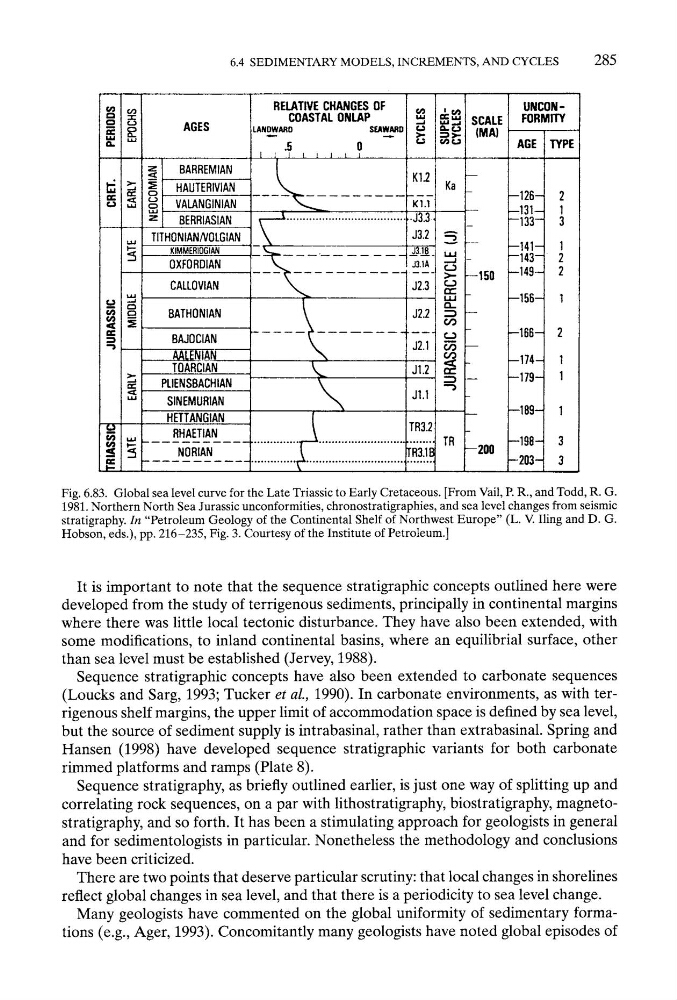
Fig. 6.83. Global sea level curve for the Late Triassic to Early Cretaceous. [From Vail, R R., and Todd, R. G.
1981. Northern North Sea Jurassic unconformities, chronostratigraphies, and sea level changes from seismic
stratigraphy. In "Petroleum Geology of the Continental Shelf of Northwest Europe" (L. V. Iling and D. G.
Hobson, eds.), pp. 216-235, Fig. 3. Courtesy of the Institute of Petroleum.]
It is important to note that the sequence stratigraphic concepts outlined here were
developed from the study of terrigenous sediments, principally in continental margins
where there was little local tectonic disturbance. They have also been extended, with
some modifications, to inland continental basins, where an equilibrial surface, other
than sea level must be established (Jervey, 1988).
Sequence stratigraphic concepts have also been extended to carbonate sequences
(Loucks and Sarg, 1993; Tucker et al., 1990). In carbonate environments, as with terrigenous shelf margins, the upper limit of accommodation space is defined by sea level,
but the source of sediment supply is intrabasinal, rather than extrabasinal. Spring and
Hansen (1998) have developed sequence stratigraphic variants for both carbonate
rimmed platforms and ramps (Plate 8).
Sequence stratigraphy, as briefly outlined earlier, is just one way of splitting up and
correlating rock sequences, on a par with lithostratigraphy, biostratigraphy, magnetostratigraphy, and so forth. It has been a stimulating approach for geologists in general
and for sedimentologists in particular. Nonetheless the methodology and conclusions
have been criticized.
There are two points that deserve particular scrutiny: that local changes in shorelines
reflect global changes in sea level, and that there is a periodicity to sea level change.
Many geologists have commented on the global uniformity of sedimentary formations (e.g., Ager, 1993). Concomitantly many geologists have noted global episodes of
285
-,,lAGES
z
BARREMIAN
-
~;
HAUTERIVIAN
Cr
C:~
,
o
VALANGINIAN
r
i..z.I
z
BERRIASIAN
TITHONIAN/VOLGIAN
I,.aJ
KIMMERIDGIAN
.=,;
OXFORDIAN
CALLOVIAN
~ _
BATHONIAN
,~
=E
...
==
=
BAJOCIAN
......
AALENIAN
TOARCIAN
PLIENSBACHIAN
SINEMURIAN
HETTANGIAN
RHAETIAN
NORIAN
u
RELATIVE CHANGES OF
COASTAL ONLAP
LANo_w~o
s~w_.=o
.5
0
l
l
l
1 l
l
I
l
-~
-1262
K1.2
K1.]
--131
1
1..~ .................................... J3.3
--133- 3
J3.2 ~'~,__
--141- 1
....
J3.1e ~
--143- 2
J3.1A
~
-
.......
>-- --150
--1492
~,~
J2.3 cz~
-
--1561
J2.2 ~ -,
........
r_~ -
--1662
J2.1
,,==: _
1741
1791
_
--1891
TR3.2
_
9
.~- .................................... TR
--198- 3
~200
,iP ie~, #,1 ,li i,~
............................. !..n~..!.u
-2033
UNCON -
u_, ~ SCALE
FORMITY
.~
(MA)
r
AGE TYPE
,,,
Ka
Fig. 6.83. Global sea level curve for the Late Triassic to Early Cretaceous. [From Vail, R R., and Todd, R. G.
1981. Northern North Sea Jurassic unconformities, chronostratigraphies, and sea level changes from seismic
stratigraphy. In "Petroleum Geology of the Continental Shelf of Northwest Europe" (L. V. Iling and D. G.
Hobson, eds.), pp. 216-235, Fig. 3. Courtesy of the Institute of Petroleum.]
It is important to note that the sequence stratigraphic concepts outlined here were
developed from the study of terrigenous sediments, principally in continental margins
where there was little local tectonic disturbance. They have also been extended, with
some modifications, to inland continental basins, where an equilibrial surface, other
than sea level must be established (Jervey, 1988).
Sequence stratigraphic concepts have also been extended to carbonate sequences
(Loucks and Sarg, 1993; Tucker et al., 1990). In carbonate environments, as with terrigenous shelf margins, the upper limit of accommodation space is defined by sea level,
but the source of sediment supply is intrabasinal, rather than extrabasinal. Spring and
Hansen (1998) have developed sequence stratigraphic variants for both carbonate
rimmed platforms and ramps (Plate 8).
Sequence stratigraphy, as briefly outlined earlier, is just one way of splitting up and
correlating rock sequences, on a par with lithostratigraphy, biostratigraphy, magnetostratigraphy, and so forth. It has been a stimulating approach for geologists in general
and for sedimentologists in particular. Nonetheless the methodology and conclusions
have been criticized.
There are two points that deserve particular scrutiny: that local changes in shorelines
reflect global changes in sea level, and that there is a periodicity to sea level change.
Many geologists have commented on the global uniformity of sedimentary formations (e.g., Ager, 1993). Concomitantly many geologists have noted global episodes of