

280
6 DEPOSITIONAL SYSTEMS
genetically related facies. Walther distinguished environments of erosion, equilibrium,
and deposition and included intraformational erosional intervals as an integral part of a
facies tract. Walther realized the significance of this arrangement, writing (1894, p. 979):
The various deposits of the same facies area and similarly, the sum of the rocks of different facies areas, were formed beside each other in space, but in a crustal profile we see them lying on
top of each other.., it is a basic statement of far-reaching significance that only those facies
and facies areas can be superimposed, primarily, that can be observed beside each other at the
present time. (translation from Blatt et al., 1980, p. 187)
This principle is termed Walther's law, and may be succinctly stated as "a conformable
vertical sequence of facies was generated by a lateral sequence of environments." This
principle is a vital one in environmental analysis. One of the ways of identifying the environment of a facies is by analyzing the environments of the facies above and below to
come up with the most logical sequence of events.
6.4.2 Genetic Increments and Sequences of Sedimentation
Walther's concept of "faciesbezirk" has been widely used in facies analysis, though it
has been renamed systems tract (Brown and Fisher, 1977). This idea can be usefully extended to consider not just a vertical sequence, but a whole body of rock; what has been
termed a genetic increment of strata (Busch, 1971).
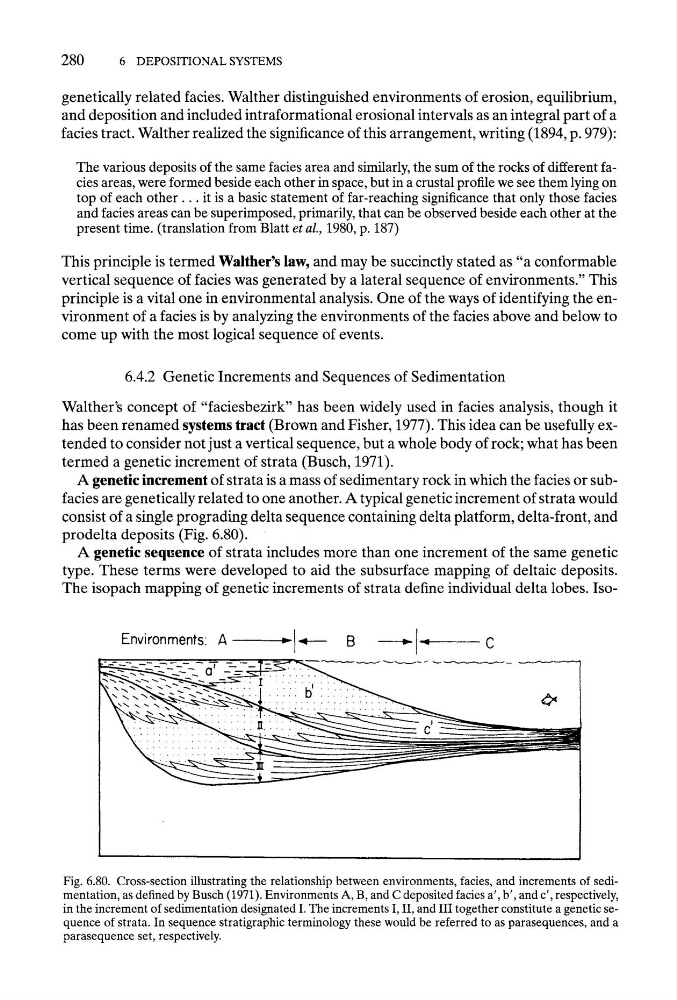
A genetic increment of strata is a mass of sedimentary rock in which the facies or subfacies are genetically related to one another. A typical genetic increment of strata would
consist of a single prograding delta sequence containing delta platform, delta-front, and
prodelta deposits (Fig. 6.80).
A genetic sequence of strata includes more than one increment of the same genetic
type. These terms were developed to aid the subsurface mapping of deltaic deposits.
The isopach mapping of genetic increments of strata define individual delta lobes. IsoEnvironrnen, s: A
=I.~-- B ~I~
C
!
.~
~
~
.........
I
.......
Fig. 6.80. Cross-section illustrating the relationship between environments, facies, and increments of sedimentation, as defined by Busch (1971). Environments A, B, and C deposited facies a', b', and c', respectively,
in the increment of sedimentation designated I. The increments I, II, and III together constitute a genetic sequence of strata. In sequence stratigraphic terminology these would be referred to as parasequences, and a
parasequence set, respectively.
6 DEPOSITIONAL SYSTEMS
genetically related facies. Walther distinguished environments of erosion, equilibrium,
and deposition and included intraformational erosional intervals as an integral part of a
facies tract. Walther realized the significance of this arrangement, writing (1894, p. 979):
The various deposits of the same facies area and similarly, the sum of the rocks of different facies areas, were formed beside each other in space, but in a crustal profile we see them lying on
top of each other.., it is a basic statement of far-reaching significance that only those facies
and facies areas can be superimposed, primarily, that can be observed beside each other at the
present time. (translation from Blatt et al., 1980, p. 187)
This principle is termed Walther's law, and may be succinctly stated as "a conformable
vertical sequence of facies was generated by a lateral sequence of environments." This
principle is a vital one in environmental analysis. One of the ways of identifying the environment of a facies is by analyzing the environments of the facies above and below to
come up with the most logical sequence of events.
6.4.2 Genetic Increments and Sequences of Sedimentation
Walther's concept of "faciesbezirk" has been widely used in facies analysis, though it
has been renamed systems tract (Brown and Fisher, 1977). This idea can be usefully extended to consider not just a vertical sequence, but a whole body of rock; what has been
termed a genetic increment of strata (Busch, 1971).
A genetic increment of strata is a mass of sedimentary rock in which the facies or subfacies are genetically related to one another. A typical genetic increment of strata would
consist of a single prograding delta sequence containing delta platform, delta-front, and
prodelta deposits (Fig. 6.80).
A genetic sequence of strata includes more than one increment of the same genetic
type. These terms were developed to aid the subsurface mapping of deltaic deposits.
The isopach mapping of genetic increments of strata define individual delta lobes. IsoEnvironrnen, s: A
=I.~-- B ~I~
C
!
.~
~
~
.........
I
.......
Fig. 6.80. Cross-section illustrating the relationship between environments, facies, and increments of sedimentation, as defined by Busch (1971). Environments A, B, and C deposited facies a', b', and c', respectively,
in the increment of sedimentation designated I. The increments I, II, and III together constitute a genetic sequence of strata. In sequence stratigraphic terminology these would be referred to as parasequences, and a
parasequence set, respectively.