

256
6 DEPOSITIONAL SYSTEMS
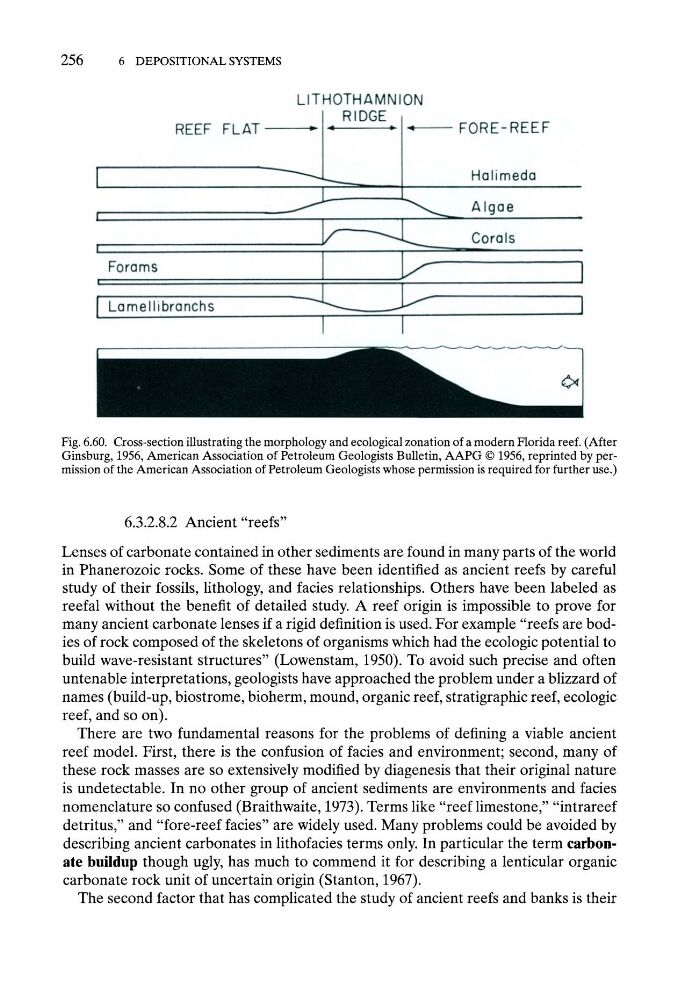
Fig. 6.60. Cross-section illustrating the morphology and ecological zonation of a modern Florida reef. (After
Ginsburg, 1956, American Association of Petroleum Geologists Bulletin, A A P G 9 1956, reprinted by permission of the American Association of Petroleum Geologists whose permission is required for further use.)
6.3.2.8.2 Ancient "reefs"
Lenses of carbonate contained in other sediments are found in many parts of the world
in Phanerozoic rocks. Some of these have been identified as ancient reefs by careful
study of their fossils, lithology, and facies relationships. Others have been labeled as
reefal without the benefit of detailed study. A reef origin is impossible to prove for
many ancient carbonate lenses if a rigid definition is used. For example "reefs are bodies of rock composed of the skeletons of organisms which had the ecologic potential to
build wave-resistant structures" (Lowenstam, 1950). To avoid such precise and often
untenable interpretations, geologists have approached the problem under a blizzard of
names (build-up, biostrome, bioherm, mound, organic reef, stratigraphic reef, ecologic
reef, and so on).
There are two fundamental reasons for the problems of defining a viable ancient
reef model. First, there is the confusion of facies and environment; second, many of
these rock masses are so extensively modified by diagenesis that their original nature
is undetectable. In no other group of ancient sediments are environments and facies
nomenclature so confused (Braithwaite, 1973). Terms like "reef limestone," "intrareef
detritus," and "fore-reef facies" are widely used. Many problems could be avoided by
describing ancient carbonates in lithofacies terms only. In particular the term carbonate buildup though ugly, has much to commend it for describing a lenticular organic
carbonate rock unit of uncertain origin (Stanton, 1967).
The second factor that has complicated the study of ancient reefs and banks is their
6 DEPOSITIONAL SYSTEMS
Fig. 6.60. Cross-section illustrating the morphology and ecological zonation of a modern Florida reef. (After
Ginsburg, 1956, American Association of Petroleum Geologists Bulletin, A A P G 9 1956, reprinted by permission of the American Association of Petroleum Geologists whose permission is required for further use.)
6.3.2.8.2 Ancient "reefs"
Lenses of carbonate contained in other sediments are found in many parts of the world
in Phanerozoic rocks. Some of these have been identified as ancient reefs by careful
study of their fossils, lithology, and facies relationships. Others have been labeled as
reefal without the benefit of detailed study. A reef origin is impossible to prove for
many ancient carbonate lenses if a rigid definition is used. For example "reefs are bodies of rock composed of the skeletons of organisms which had the ecologic potential to
build wave-resistant structures" (Lowenstam, 1950). To avoid such precise and often
untenable interpretations, geologists have approached the problem under a blizzard of
names (build-up, biostrome, bioherm, mound, organic reef, stratigraphic reef, ecologic
reef, and so on).
There are two fundamental reasons for the problems of defining a viable ancient
reef model. First, there is the confusion of facies and environment; second, many of
these rock masses are so extensively modified by diagenesis that their original nature
is undetectable. In no other group of ancient sediments are environments and facies
nomenclature so confused (Braithwaite, 1973). Terms like "reef limestone," "intrareef
detritus," and "fore-reef facies" are widely used. Many problems could be avoided by
describing ancient carbonates in lithofacies terms only. In particular the term carbonate buildup though ugly, has much to commend it for describing a lenticular organic
carbonate rock unit of uncertain origin (Stanton, 1967).
The second factor that has complicated the study of ancient reefs and banks is their