

240
6 DEPOSITIONAL SYSTEMS
q.
"\\\
I
~o
:3
,I
Legend:
Monozite-bearing shelf sar
Modern end raised beach mol
Pre-Cambrian metamorphi
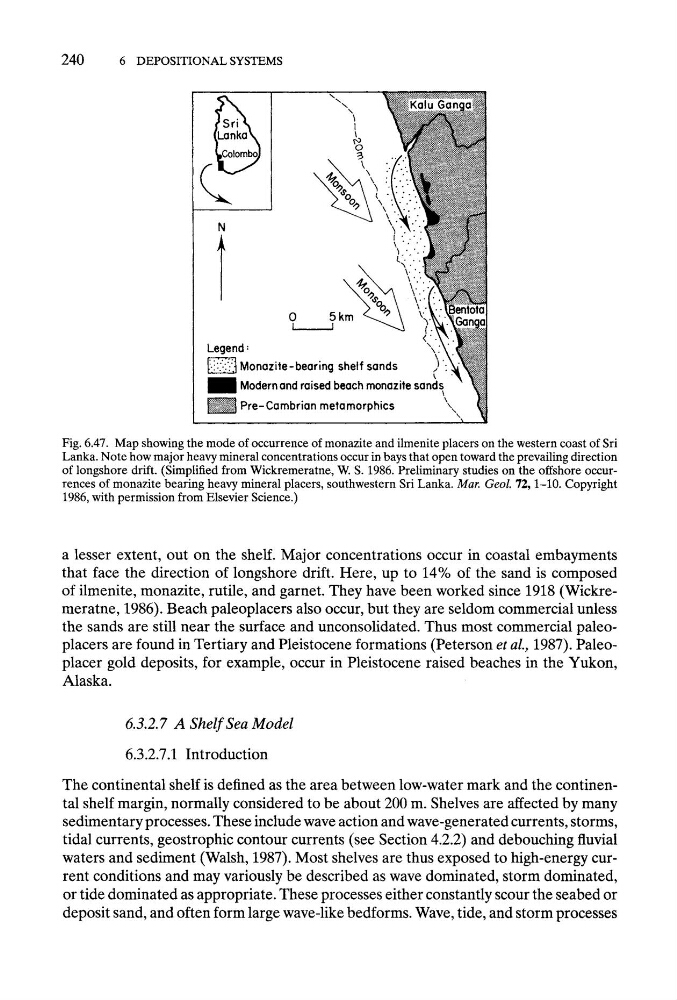
Fig. 6.47. Map showing the mode of occurrence of monazite and ilmenite placers on the western coast of Sri
Lanka. Note how major heavy mineral concentrations occur in bays that open toward the prevailing direction
of longshore drift. (Simplified from Wickremeratne, W. S. 1986. Preliminary studies on the offshore occurrences of monazite bearing heavy mineral placers, southwestern Sri Lanka. Mar. Geol. 72, 1-10. Copyright
1986, with permission from Elsevier Science.)
a lesser extent, out on the shelf. Major concentrations occur in coastal embayments
that face the direction of longshore drift. Here, up to 14% of the sand is composed
of ilmenite, monazite, rutile, and garnet. They have been worked since 1918 (Wickremeratne, 1986). Beach paleoplacers also occur, but they are seldom commercial unless
the sands are still near the surface and unconsolidated. Thus most commercial paleoplacers are found in Tertiary and Pleistocene formations (Peterson et al., 1987). Paleoplacer gold deposits, for example, occur in Pleistocene raised beaches in the Yukon,
Alaska.
6.3.2. 7 A Shelf Sea Model
6.3.2.7.1 Introduction
The continental shelf is defined as the area between low-water mark and the continental shelf margin, normally considered to be about 200 m. Shelves are affected by many
sedimentary processes. These include wave action and wave-generated currents, storms,
tidal currents, geostrophic contour currents (see Section 4.2.2) and debouching fluvial
waters and sediment (Walsh, 1987). Most shelves are thus exposed to high-energy current conditions and may variously be described as wave dominated, storm dominated,
or tide dominated as appropriate. These processes either constantly scour the seabed or
deposit sand, and often form large wave-like bedforms. Wave, tide, and storm processes
6 DEPOSITIONAL SYSTEMS
q.
"\\\
I
~o
:3
,I
Legend:
Monozite-bearing shelf sar
Modern end raised beach mol
Pre-Cambrian metamorphi
Fig. 6.47. Map showing the mode of occurrence of monazite and ilmenite placers on the western coast of Sri
Lanka. Note how major heavy mineral concentrations occur in bays that open toward the prevailing direction
of longshore drift. (Simplified from Wickremeratne, W. S. 1986. Preliminary studies on the offshore occurrences of monazite bearing heavy mineral placers, southwestern Sri Lanka. Mar. Geol. 72, 1-10. Copyright
1986, with permission from Elsevier Science.)
a lesser extent, out on the shelf. Major concentrations occur in coastal embayments
that face the direction of longshore drift. Here, up to 14% of the sand is composed
of ilmenite, monazite, rutile, and garnet. They have been worked since 1918 (Wickremeratne, 1986). Beach paleoplacers also occur, but they are seldom commercial unless
the sands are still near the surface and unconsolidated. Thus most commercial paleoplacers are found in Tertiary and Pleistocene formations (Peterson et al., 1987). Paleoplacer gold deposits, for example, occur in Pleistocene raised beaches in the Yukon,
Alaska.
6.3.2. 7 A Shelf Sea Model
6.3.2.7.1 Introduction
The continental shelf is defined as the area between low-water mark and the continental shelf margin, normally considered to be about 200 m. Shelves are affected by many
sedimentary processes. These include wave action and wave-generated currents, storms,
tidal currents, geostrophic contour currents (see Section 4.2.2) and debouching fluvial
waters and sediment (Walsh, 1987). Most shelves are thus exposed to high-energy current conditions and may variously be described as wave dominated, storm dominated,
or tide dominated as appropriate. These processes either constantly scour the seabed or
deposit sand, and often form large wave-like bedforms. Wave, tide, and storm processes