

6.3 SEDIMENTARY MODELS
239
~.~ GRAIN SIZE
10m.
II I I /
I I I
!
\\\
...
///,,
I I I /
I I
/
NON-RESERVOIR
LIMESTONE & SHALE
CROSS-BEDDED
CHANNEL SAND
FLAT-BEDDED, BIOTURBATED
SHORELINE SAND
NON-RESERVOIR
LIMESTONE & SHALE
Fig. 6.45--Continued
Shoreline processes also favor the segregation of heavy minerals to form placer
ores (Macdonald, 1983, pp. 139-156). Modern beach placers consist of gold, monazite,
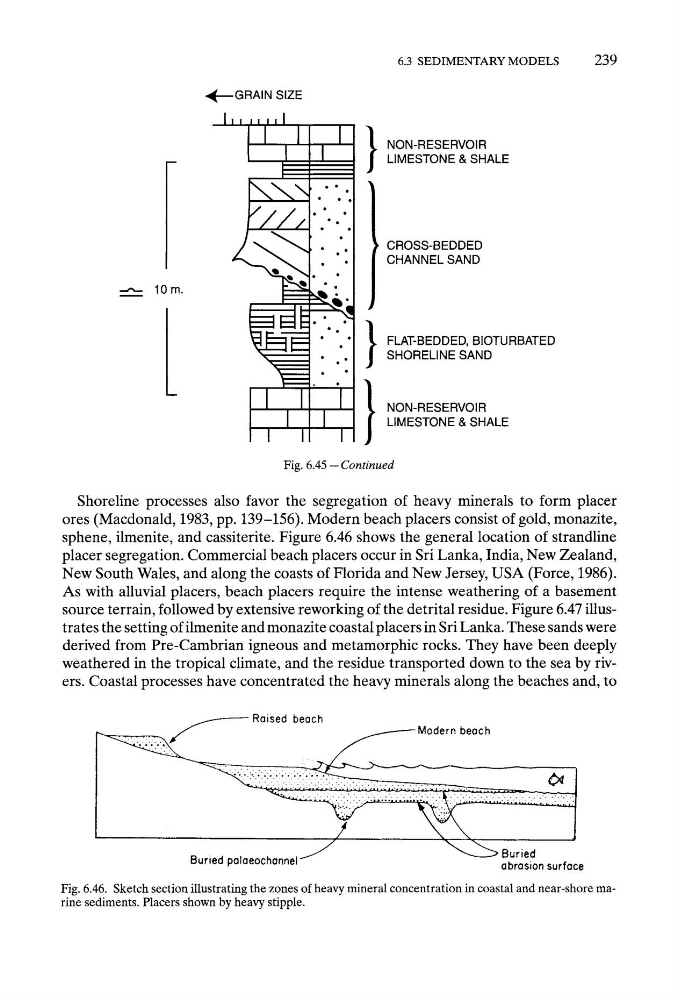
sphene, ilmenite, and cassiterite. Figure 6.46 shows the general location of strandline
placer segregation. Commercial beach placers occur in Sri Lanka, India, New Zealand,
New South Wales, and along the coasts of Florida and New Jersey, USA (Force, 1986).
As with alluvial placers, beach placers require the intense weathering of a basement
source terrain, followed by extensive reworking of the detrital residue. Figure 6.47 illustrates the setting of ilmenite and monazite coastal placers in Sri Lanka. These sands were
derived from Pre-Cambrian igneous and metamorphic rocks. They have been deeply
weathered in the tropical climate, and the residue transported down to the sea by rivers. Coastal processes have concentrated the heavy minerals along the beaches and, to
Raised beach
v
abrasion surface
Fig. 6.46. Sketch section illustrating the zones of heavy mineral concentration in coastal and near-shore marine sediments. Placers shown by heavy stipple.
239
~.~ GRAIN SIZE
10m.
II I I /
I I I
!
\\\
...
///,,
I I I /
I I
/
NON-RESERVOIR
LIMESTONE & SHALE
CROSS-BEDDED
CHANNEL SAND
FLAT-BEDDED, BIOTURBATED
SHORELINE SAND
NON-RESERVOIR
LIMESTONE & SHALE
Fig. 6.45--Continued
Shoreline processes also favor the segregation of heavy minerals to form placer
ores (Macdonald, 1983, pp. 139-156). Modern beach placers consist of gold, monazite,
sphene, ilmenite, and cassiterite. Figure 6.46 shows the general location of strandline
placer segregation. Commercial beach placers occur in Sri Lanka, India, New Zealand,
New South Wales, and along the coasts of Florida and New Jersey, USA (Force, 1986).
As with alluvial placers, beach placers require the intense weathering of a basement
source terrain, followed by extensive reworking of the detrital residue. Figure 6.47 illustrates the setting of ilmenite and monazite coastal placers in Sri Lanka. These sands were
derived from Pre-Cambrian igneous and metamorphic rocks. They have been deeply
weathered in the tropical climate, and the residue transported down to the sea by rivers. Coastal processes have concentrated the heavy minerals along the beaches and, to
Raised beach
v
abrasion surface
Fig. 6.46. Sketch section illustrating the zones of heavy mineral concentration in coastal and near-shore marine sediments. Placers shown by heavy stipple.