

6.3 SEDIMENTARY MODELS
227
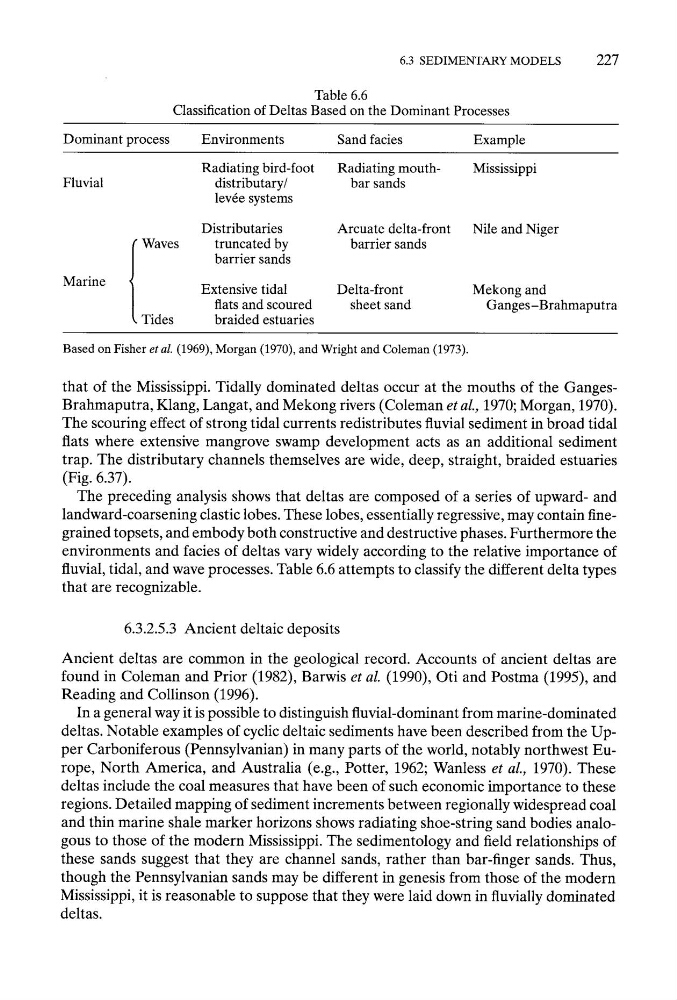
Table 6.6
Classification of Deltas Based on the Dominant Processes
Dominant process
Environments
Sand facies
Example
Fluvial
Marine
Waves
Tides
Radiating bird-foot
Radiating mouthdistributary/
bar sands
lev6e systems
Distributaries
truncated by
barrier sands
Arcuate delta-front
barrier sands
Extensive tidal
Delta-front
flats and scoured
sheet sand
braided estuaries
Mississippi
Nile and Niger
Mekong and
Ganges-Brahmaputra
Based on Fisher et al. (1969), Morgan (1970), and Wright and Coleman (1973).
that of the Mississippi. Tidally dominated deltas occur at the mouths of the GangesBrahmaputra, Klang, Langat, and Mekong rivers (Coleman et al., 1970; Morgan, 1970).
The scouring effect of strong tidal currents redistributes fluvial sediment in broad tidal
fiats where extensive mangrove swamp development acts as an additional sediment
trap. The distributary channels themselves are wide, deep, straight, braided estuaries
(Fig. 6.37).
The preceding analysis shows that deltas are composed of a series of upward- and
landward-coarsening clastic lobes. These lobes, essentially regressive, may contain finegrained topsets, and embody both constructive and destructive phases. Furthermore the
environments and facies of deltas vary widely according to the relative importance of
fluvial, tidal, and wave processes. Table 6.6 attempts to classify the different delta types
that are recognizable.
6.3.2.5.3 Ancient deltaic deposits
Ancient deltas are common in the geological record. Accounts of ancient deltas are
found in Coleman and Prior (1982), Barwis et al. (1990), Oti and Postma (1995), and
Reading and Collinson (1996).
In a general way it is possible to distinguish fluvial-dominant from marine-dominated
deltas. Notable examples of cyclic deltaic sediments have been described from the Upper Carboniferous (Pennsylvanian) in many parts of the world, notably northwest Europe, North America, and Australia (e.g., Potter, 1962; Wanless et al., 1970). These
deltas include the coal measures that have been of such economic importance to these
regions. Detailed mapping of sediment increments between regionally widespread coal
and thin marine shale marker horizons shows radiating shoe-string sand bodies analogous to those of the modern Mississippi. The sedimentology and field relationships of
these sands suggest that they are channel sands, rather than bar-finger sands. Thus,
though the Pennsylvanian sands may be different in genesis from those of the modern
Mississippi, it is reasonable to suppose that they were laid down in fluvially dominated
deltas.
227
Table 6.6
Classification of Deltas Based on the Dominant Processes
Dominant process
Environments
Sand facies
Example
Fluvial
Marine
Waves
Tides
Radiating bird-foot
Radiating mouthdistributary/
bar sands
lev6e systems
Distributaries
truncated by
barrier sands
Arcuate delta-front
barrier sands
Extensive tidal
Delta-front
flats and scoured
sheet sand
braided estuaries
Mississippi
Nile and Niger
Mekong and
Ganges-Brahmaputra
Based on Fisher et al. (1969), Morgan (1970), and Wright and Coleman (1973).
that of the Mississippi. Tidally dominated deltas occur at the mouths of the GangesBrahmaputra, Klang, Langat, and Mekong rivers (Coleman et al., 1970; Morgan, 1970).
The scouring effect of strong tidal currents redistributes fluvial sediment in broad tidal
fiats where extensive mangrove swamp development acts as an additional sediment
trap. The distributary channels themselves are wide, deep, straight, braided estuaries
(Fig. 6.37).
The preceding analysis shows that deltas are composed of a series of upward- and
landward-coarsening clastic lobes. These lobes, essentially regressive, may contain finegrained topsets, and embody both constructive and destructive phases. Furthermore the
environments and facies of deltas vary widely according to the relative importance of
fluvial, tidal, and wave processes. Table 6.6 attempts to classify the different delta types
that are recognizable.
6.3.2.5.3 Ancient deltaic deposits
Ancient deltas are common in the geological record. Accounts of ancient deltas are
found in Coleman and Prior (1982), Barwis et al. (1990), Oti and Postma (1995), and
Reading and Collinson (1996).
In a general way it is possible to distinguish fluvial-dominant from marine-dominated
deltas. Notable examples of cyclic deltaic sediments have been described from the Upper Carboniferous (Pennsylvanian) in many parts of the world, notably northwest Europe, North America, and Australia (e.g., Potter, 1962; Wanless et al., 1970). These
deltas include the coal measures that have been of such economic importance to these
regions. Detailed mapping of sediment increments between regionally widespread coal
and thin marine shale marker horizons shows radiating shoe-string sand bodies analogous to those of the modern Mississippi. The sedimentology and field relationships of
these sands suggest that they are channel sands, rather than bar-finger sands. Thus,
though the Pennsylvanian sands may be different in genesis from those of the modern
Mississippi, it is reasonable to suppose that they were laid down in fluvially dominated
deltas.