

6.3 SEDIMENTARY MODELS
225
tible to reworking by marine influences, both tides and waves. As the delta lobe compacts and subsides, the sea transgresses it and reworks its upper part. Fine sediment
tends to be winnowed out and settles in deeper quieter water. The sands are reworked
and redeposited as a transgressive marine blanket which may thus unconformably overstep the various facies of the delta.
Instead of consisting of a simple upward-coarsening sequence, examination of the
modern Mississippi shows an upper fine-grained nonmarine unit. Furthermore, while
a delta is, of its very nature, a regressive prograding prism, each lobe may contain both
constructive regressive and destructive transgressive phases. The bird-foot Mississippi
type of delta, with radiating distributary channel networks, is rare worldwide, and is seen
more commonly in lakes rather than seas, such as, for example, the St. Clair River delta
of Canada (Pezzetta, 1973). There may be two reasons for this. First, not all rivers carry
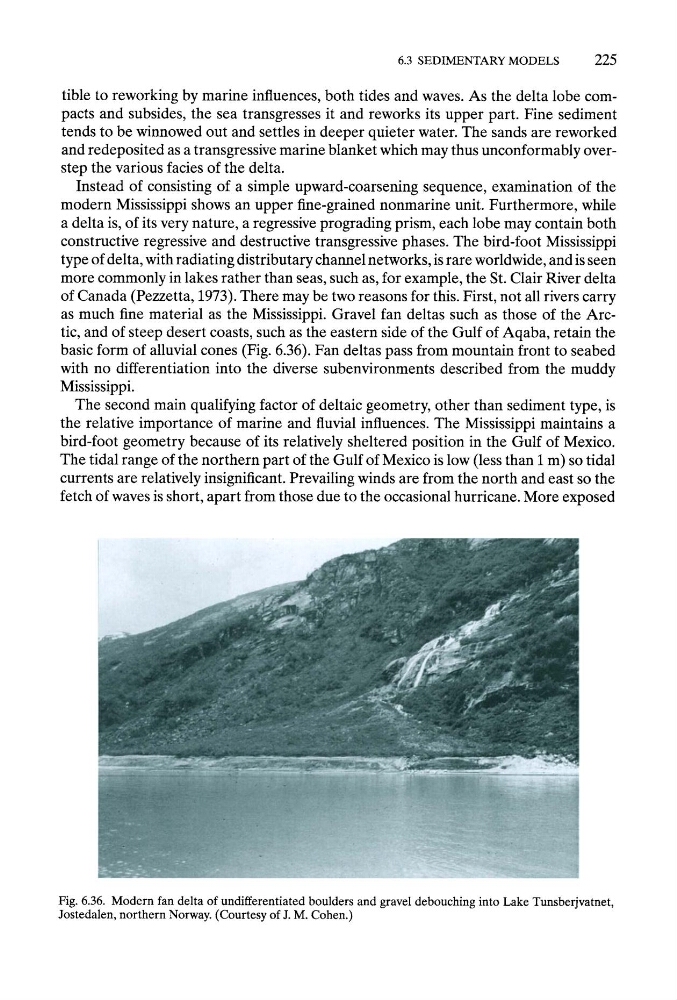
as much fine material as the Mississippi. Gravel fan deltas such as those of the Arctic, and of steep desert coasts, such as the eastern side of the Gulf of Aqaba, retain the
basic form of alluvial cones (Fig. 6.36). Fan deltas pass from mountain front to seabed
with no differentiation into the diverse subenvironments described from the muddy
Mississippi.
The second main qualifying factor of deltaic geometry, other than sediment type, is
the relative importance of marine and fluvial influences. The Mississippi maintains a
bird-foot geometry because of its relatively sheltered position in the Gulf of Mexico.
The tidal range of the northern part of the Gulf of Mexico is low (less than 1 m) so tidal
currents are relatively insignificant. Prevailing winds are from the north and east so the
fetch of waves is short, apart from those due to the occasional hurricane. More exposed
Fig. 6.36. Modern fan delta of undifferentiated boulders and gravel debouching into Lake Tunsberjvatnet,
Jostedalen, northern Norway. (Courtesy of J. M. Cohen.)
225
tible to reworking by marine influences, both tides and waves. As the delta lobe compacts and subsides, the sea transgresses it and reworks its upper part. Fine sediment
tends to be winnowed out and settles in deeper quieter water. The sands are reworked
and redeposited as a transgressive marine blanket which may thus unconformably overstep the various facies of the delta.
Instead of consisting of a simple upward-coarsening sequence, examination of the
modern Mississippi shows an upper fine-grained nonmarine unit. Furthermore, while
a delta is, of its very nature, a regressive prograding prism, each lobe may contain both
constructive regressive and destructive transgressive phases. The bird-foot Mississippi
type of delta, with radiating distributary channel networks, is rare worldwide, and is seen
more commonly in lakes rather than seas, such as, for example, the St. Clair River delta
of Canada (Pezzetta, 1973). There may be two reasons for this. First, not all rivers carry
as much fine material as the Mississippi. Gravel fan deltas such as those of the Arctic, and of steep desert coasts, such as the eastern side of the Gulf of Aqaba, retain the
basic form of alluvial cones (Fig. 6.36). Fan deltas pass from mountain front to seabed
with no differentiation into the diverse subenvironments described from the muddy
Mississippi.
The second main qualifying factor of deltaic geometry, other than sediment type, is
the relative importance of marine and fluvial influences. The Mississippi maintains a
bird-foot geometry because of its relatively sheltered position in the Gulf of Mexico.
The tidal range of the northern part of the Gulf of Mexico is low (less than 1 m) so tidal
currents are relatively insignificant. Prevailing winds are from the north and east so the
fetch of waves is short, apart from those due to the occasional hurricane. More exposed
Fig. 6.36. Modern fan delta of undifferentiated boulders and gravel debouching into Lake Tunsberjvatnet,
Jostedalen, northern Norway. (Courtesy of J. M. Cohen.)