

214
6 DEPOSITIONAL SYSTEMS
but are these sands actually laid rest in the geological column by sporadic catastrophic
floods, rather than by the process that shapes them? These may be some of the reasons
why a viable eolian sedimentary model has not been defined.
6.3.2.3.3 Economic aspects of eolian sands
Because of their good sorting and absence of clay matrix, eolian sands have excellent
primary porosity and permeability. They may thus serve as aquifers and petroleum reservoirs if they have not undergone extensive diagenesis. Like braided alluvium they normally lack shale interbeds that may serve as permeability barriers. It has been noted,
however, that permeability varies vertically through cross-bedded dune units (see Section 3.2.3.1.5). The finer-grained toesets are often poorly permeable, especially if they
have undergone early evaporitic cementation where they grade into interdune sabkhas.
Eolian petroleum reservoirs have been identified in the Triassic-Jurassic red beds
of the Rocky Mountain thrust belt in Colorado and Utah (Lundquist, 1983). Here the
Norphlet (Jurassic) sands are particularly well documented (see papers in Barwis et al.,
1990). Eolian sands in the Lower Permian Rotliegendes of northwest Europe contain
many giant gas fields, both in the southern North Sea and onshore. Detailed paleogeographic mapping has been essential to locate favorable reservoirs. Only the eolian sands
are permeable enough to be commercially productive. The fluvial and sabkha deposits
with which they are interbedded are too tight (Glennie, 1987; Sweet, 1999).
Modern eolian deposits are also hosts to placer minerals. Wind action is not as effective as aqueous action in segregating minerals of different density. This is because the
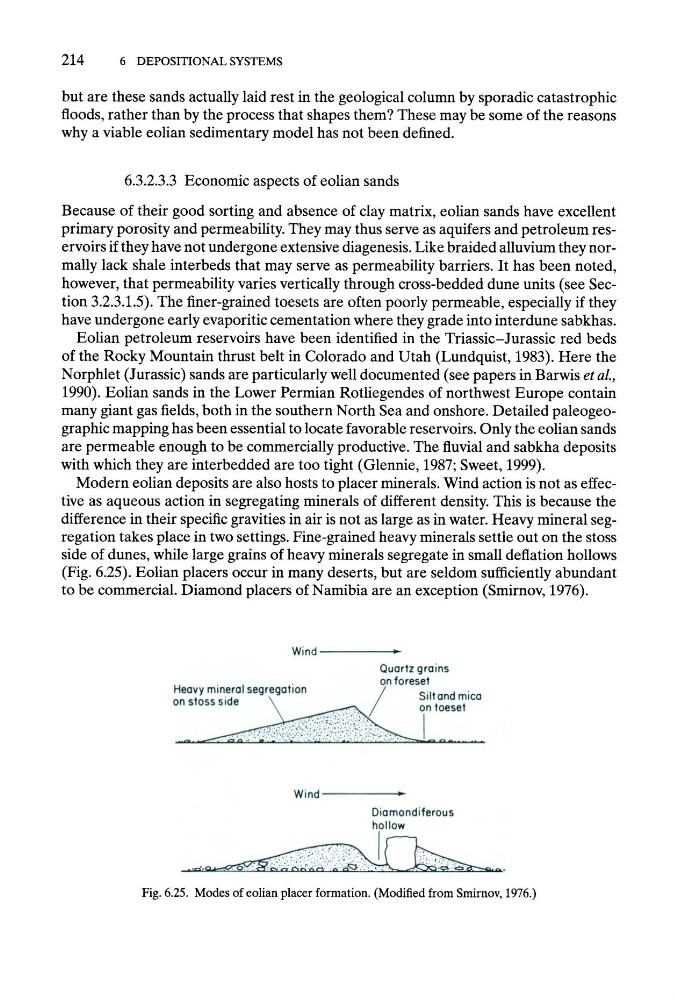
difference in their specific gravities in air is not as large as in water. Heavy mineral segregation takes place in two settings. Fine-grained heavy minerals settle out on the stoss
side of dunes, while large grains of heavy minerals segregate in small deflation hollows
(Fig. 6.25). Eolian placers occur in many deserts, but are seldom sufficiently abundant
to be commercial. Diamond placers of Namibia are an exception (Smirnov, 1976).
Fig. 6.25. Modes of eolian placer formation. (Modified from Smirnov, 1976.)
6 DEPOSITIONAL SYSTEMS
but are these sands actually laid rest in the geological column by sporadic catastrophic
floods, rather than by the process that shapes them? These may be some of the reasons
why a viable eolian sedimentary model has not been defined.
6.3.2.3.3 Economic aspects of eolian sands
Because of their good sorting and absence of clay matrix, eolian sands have excellent
primary porosity and permeability. They may thus serve as aquifers and petroleum reservoirs if they have not undergone extensive diagenesis. Like braided alluvium they normally lack shale interbeds that may serve as permeability barriers. It has been noted,
however, that permeability varies vertically through cross-bedded dune units (see Section 3.2.3.1.5). The finer-grained toesets are often poorly permeable, especially if they
have undergone early evaporitic cementation where they grade into interdune sabkhas.
Eolian petroleum reservoirs have been identified in the Triassic-Jurassic red beds
of the Rocky Mountain thrust belt in Colorado and Utah (Lundquist, 1983). Here the
Norphlet (Jurassic) sands are particularly well documented (see papers in Barwis et al.,
1990). Eolian sands in the Lower Permian Rotliegendes of northwest Europe contain
many giant gas fields, both in the southern North Sea and onshore. Detailed paleogeographic mapping has been essential to locate favorable reservoirs. Only the eolian sands
are permeable enough to be commercially productive. The fluvial and sabkha deposits
with which they are interbedded are too tight (Glennie, 1987; Sweet, 1999).
Modern eolian deposits are also hosts to placer minerals. Wind action is not as effective as aqueous action in segregating minerals of different density. This is because the
difference in their specific gravities in air is not as large as in water. Heavy mineral segregation takes place in two settings. Fine-grained heavy minerals settle out on the stoss
side of dunes, while large grains of heavy minerals segregate in small deflation hollows
(Fig. 6.25). Eolian placers occur in many deserts, but are seldom sufficiently abundant
to be commercial. Diamond placers of Namibia are an exception (Smirnov, 1976).
Fig. 6.25. Modes of eolian placer formation. (Modified from Smirnov, 1976.)