

6.3 SEDIMENTARY MODELS
213
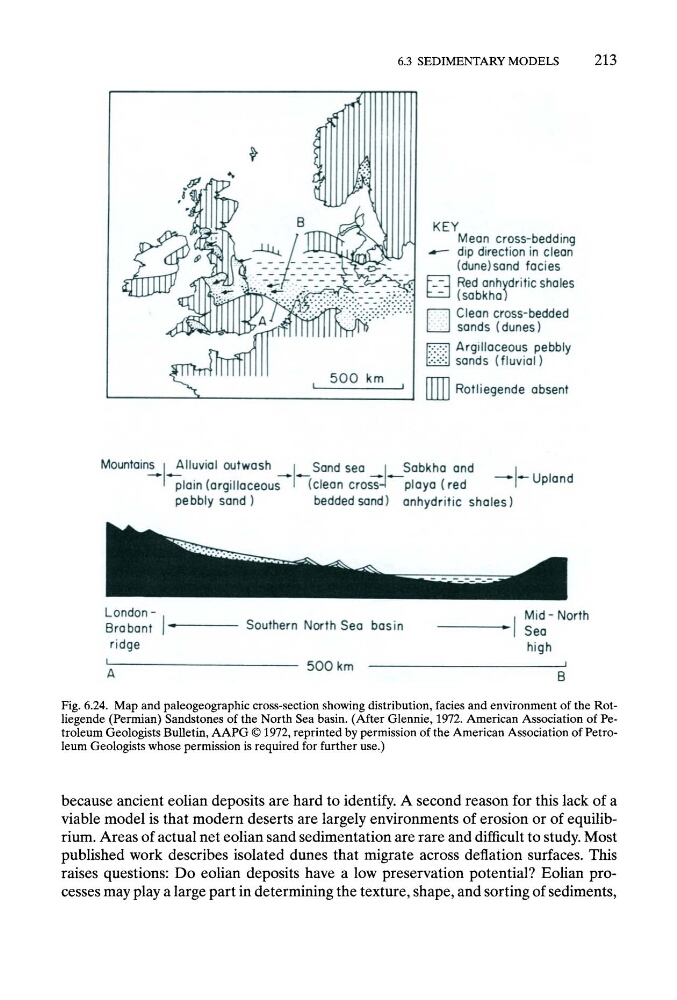
Fig. 6.24. Map and paleogeographic cross-section showing distribution, facies and environment of the Rotliegende (Permian) Sandstones of the North Sea basin. (After Glennie, 1972. American Association of Petroleum Geologists Bulletin, AAPG 9 1972, reprinted by permission of the American Association of Petroleum Geologists whose permission is required for further use.)
because ancient eolian deposits are hard to identify. A second reason for this lack of a
viable model is that modern deserts are largely environments of erosion or of equilibrium. Areas of actual net eolian sand sedimentation are rare and difficult to study. Most
published work describes isolated dunes that migrate across deflation surfaces. This
raises questions: Do eolian deposits have a low preservation potential? Eolian processes may play a large part in determining the texture, shape, and sorting of sediments,
213
Fig. 6.24. Map and paleogeographic cross-section showing distribution, facies and environment of the Rotliegende (Permian) Sandstones of the North Sea basin. (After Glennie, 1972. American Association of Petroleum Geologists Bulletin, AAPG 9 1972, reprinted by permission of the American Association of Petroleum Geologists whose permission is required for further use.)
because ancient eolian deposits are hard to identify. A second reason for this lack of a
viable model is that modern deserts are largely environments of erosion or of equilibrium. Areas of actual net eolian sand sedimentation are rare and difficult to study. Most
published work describes isolated dunes that migrate across deflation surfaces. This
raises questions: Do eolian deposits have a low preservation potential? Eolian processes may play a large part in determining the texture, shape, and sorting of sediments,