

6.3 SEDIMENTARY MODELS
201
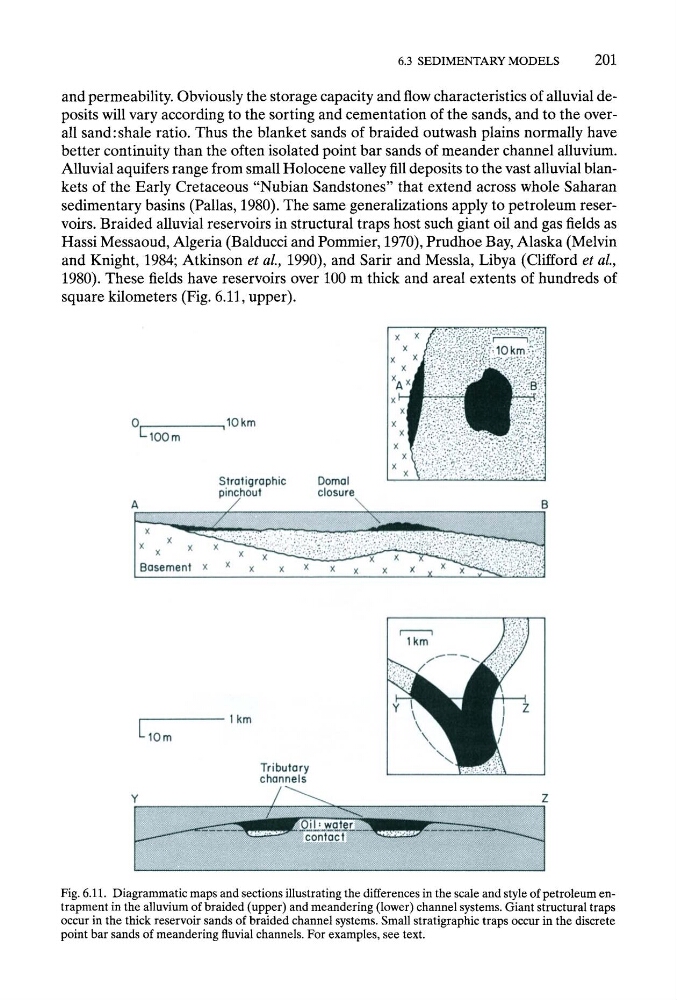
and permeability. Obviously the storage capacity and flow characteristics of alluvial deposits will vary according to the sorting and cementation of the sands, and to the overall sand: shale ratio. Thus the blanket sands of braided outwash plains normally have
better continuity than the often isolated point bar sands of meander channel alluvium.
Alluvial aquifers range from small Holocene valley fill deposits to the vast alluvial blankets of the Early Cretaceous "Nubian Sandstones" that extend across whole Saharan
sedimentary basins (Pallas, 1980). The same generalizations apply to petroleum reservoirs. Braided alluvial reservoirs in structural traps host such giant oil and gas fields as
Hassi Messaoud, Algeria (Balducci and Pommier, 1970), Prudhoe Bay, Alaska (Melvin
and Knight, 1984; Atkinson et al., 1990), and Sarir and Messla, Libya (Clifford et al.,
1980). These fields have reservoirs over 100 m thick and areal extents of hundreds of
square kilometers (Fig. 6.11, upper).
Fig. 6.11. Diagrammatic maps and sections illustrating the differences in the scale and style of petroleum entrapment in the alluvium of braided (upper) and meandering (lower) channel systems. Giant structural traps
occur in the thick reservoir sands of braided channel systems. Small stratigraphic traps occur in the discrete
point bar sands of meandering fluvial channels. For examples, see text.
201
and permeability. Obviously the storage capacity and flow characteristics of alluvial deposits will vary according to the sorting and cementation of the sands, and to the overall sand: shale ratio. Thus the blanket sands of braided outwash plains normally have
better continuity than the often isolated point bar sands of meander channel alluvium.
Alluvial aquifers range from small Holocene valley fill deposits to the vast alluvial blankets of the Early Cretaceous "Nubian Sandstones" that extend across whole Saharan
sedimentary basins (Pallas, 1980). The same generalizations apply to petroleum reservoirs. Braided alluvial reservoirs in structural traps host such giant oil and gas fields as
Hassi Messaoud, Algeria (Balducci and Pommier, 1970), Prudhoe Bay, Alaska (Melvin
and Knight, 1984; Atkinson et al., 1990), and Sarir and Messla, Libya (Clifford et al.,
1980). These fields have reservoirs over 100 m thick and areal extents of hundreds of
square kilometers (Fig. 6.11, upper).
Fig. 6.11. Diagrammatic maps and sections illustrating the differences in the scale and style of petroleum entrapment in the alluvium of braided (upper) and meandering (lower) channel systems. Giant structural traps
occur in the thick reservoir sands of braided channel systems. Small stratigraphic traps occur in the discrete
point bar sands of meandering fluvial channels. For examples, see text.