

200
6 DEPOSITIONAL SYSTEMS
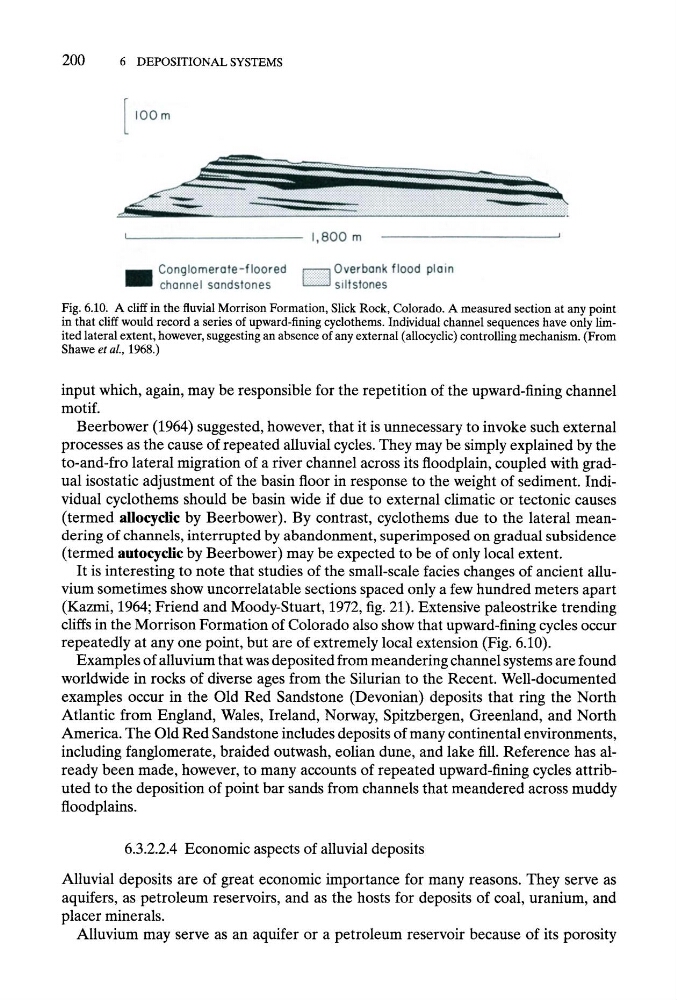
Fig. 6.10. A cliff in the fluvial Morrison Formation, Slick Rock, Colorado. A measured section at any point
in that cliff would record a series of upward-fining cyclothems. Individual channel sequences have only limited lateral extent, however, suggesting an absence of any external (allocyclic) controlling mechanism. (From
Shawe et aL, 1968.)
input which, again, may be responsible for the repetition of the upward-fining channel
motif.
Beerbower (1964) suggested, however, that it is unnecessary to invoke such external
processes as the cause of repeated alluvial cycles. They may be simply explained by the
to-and-fro lateral migration of a river channel across its floodplain, coupled with gradual isostatic adjustment of the basin floor in response to the weight of sediment. Individual cyclothems should be basin wide if due to external climatic or tectonic causes
(termed alloeyelie by Beerbower). By contrast, cyclothems due to the lateral meandering of channels, interrupted by abandonment, superimposed on gradual subsidence
(termed autoeydie by Beerbower) may be expected to be of only local extent.
It is interesting to note that studies of the small-scale facies changes of ancient alluvium sometimes show uncorrelatable sections spaced only a few hundred meters apart
(Kazmi, 1964; Friend and Moody-Stuart, 1972, fig. 21). Extensive paleostrike trending
cliffs in the Morrison Formation of Colorado also show that upward-fining cycles occur
repeatedly at any one point, but are of extremely local extension (Fig. 6.10).
Examples of alluvium that was deposited from meandering channel systems are found
worldwide in rocks of diverse ages from the Silurian to the Recent. Well-documented
examples occur in the Old Red Sandstone (Devonian) deposits that ring the North
Atlantic from England, Wales, Ireland, Norway, Spitzbergen, Greenland, and North
America. The Old Red Sandstone includes deposits of many continental environments,
including fanglomerate, braided outwash, eolian dune, and lake fill. Reference has already been made, however, to many accounts of repeated upward-fining cycles attributed to the deposition of point bar sands from channels that meandered across muddy
floodplains.
6.3.2.2.4 Economic aspects of alluvial deposits
Alluvial deposits are of great economic importance for many reasons. They serve as
aquifers, as petroleum reservoirs, and as the hosts for deposits of coal, uranium, and
placer minerals.
Alluvium may serve as an aquifer or a petroleum reservoir because of its porosity
6 DEPOSITIONAL SYSTEMS
Fig. 6.10. A cliff in the fluvial Morrison Formation, Slick Rock, Colorado. A measured section at any point
in that cliff would record a series of upward-fining cyclothems. Individual channel sequences have only limited lateral extent, however, suggesting an absence of any external (allocyclic) controlling mechanism. (From
Shawe et aL, 1968.)
input which, again, may be responsible for the repetition of the upward-fining channel
motif.
Beerbower (1964) suggested, however, that it is unnecessary to invoke such external
processes as the cause of repeated alluvial cycles. They may be simply explained by the
to-and-fro lateral migration of a river channel across its floodplain, coupled with gradual isostatic adjustment of the basin floor in response to the weight of sediment. Individual cyclothems should be basin wide if due to external climatic or tectonic causes
(termed alloeyelie by Beerbower). By contrast, cyclothems due to the lateral meandering of channels, interrupted by abandonment, superimposed on gradual subsidence
(termed autoeydie by Beerbower) may be expected to be of only local extent.
It is interesting to note that studies of the small-scale facies changes of ancient alluvium sometimes show uncorrelatable sections spaced only a few hundred meters apart
(Kazmi, 1964; Friend and Moody-Stuart, 1972, fig. 21). Extensive paleostrike trending
cliffs in the Morrison Formation of Colorado also show that upward-fining cycles occur
repeatedly at any one point, but are of extremely local extension (Fig. 6.10).
Examples of alluvium that was deposited from meandering channel systems are found
worldwide in rocks of diverse ages from the Silurian to the Recent. Well-documented
examples occur in the Old Red Sandstone (Devonian) deposits that ring the North
Atlantic from England, Wales, Ireland, Norway, Spitzbergen, Greenland, and North
America. The Old Red Sandstone includes deposits of many continental environments,
including fanglomerate, braided outwash, eolian dune, and lake fill. Reference has already been made, however, to many accounts of repeated upward-fining cycles attributed to the deposition of point bar sands from channels that meandered across muddy
floodplains.
6.3.2.2.4 Economic aspects of alluvial deposits
Alluvial deposits are of great economic importance for many reasons. They serve as
aquifers, as petroleum reservoirs, and as the hosts for deposits of coal, uranium, and
placer minerals.
Alluvium may serve as an aquifer or a petroleum reservoir because of its porosity