

162
5 SEDIMENTARY STRUCTURES
boundary between what is a large sedimentary slump and what is a tectonic fault block.
Nonetheless extensive lateral sediment displacement is often structurally controlled as
it grades into the realms of gravity tectonics.
5.3.5 Miscellaneous Structures
Among the vast number of sedimentary structures that have been observed, many do
not fit conveniently into the simple tripartite scheme outlined earlier. These miscellaneous structures include rain prints, salt pseudomorphs, and various vertical dike-like
structures of diverse morphology and origin. These include desiccation cracks, synaeresis cracks, sedimentary boudinage, and sand dikes.
5.3.5.1 Rain Prints
Rain prints occur within siltstones and claystones, and where such beds are overlain by
very fine sandstones. In plan view, rain prints are circular or ovate if due to windblown
rain. They are typically gregarious and closely spaced. Raised ridges are present around
each print. Individual craters range from 2 to 10 mm in diameter. Rain prints are good
indicators of subaerial exposure but are not exclusive to arid climates, though they may
have a higher preservation potential in such conditions.
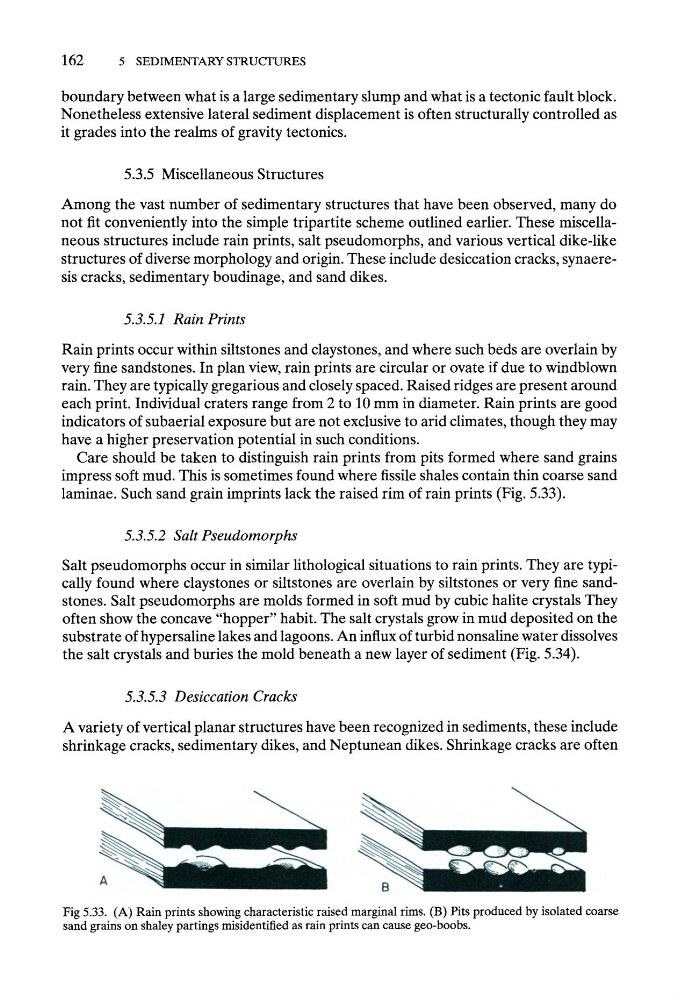
Care should be taken to distinguish rain prints from pits formed where sand grains
impress soft mud. This is sometimes found where fissile shales contain thin coarse sand
laminae. Such sand grain imprints lack the raised rim of rain prints (Fig. 5.33).
5.3.5.2 Salt Pseudomorphs
Salt pseudomorphs occur in similar lithological situations to rain prints. They are typically found where claystones or siltstones are overlain by siltstones or very fine sandstones. Salt pseudomorphs are molds formed in soft mud by cubic halite crystals They
often show the concave "hopper" habit. The salt crystals grow in mud deposited on the
substrate of hypersaline lakes and lagoons. An influx of turbid nonsaline water dissolves
the salt crystals and buries the mold beneath a new layer of sediment (Fig. 5.34).
5.3.5.3 Desiccation Cracks
A variety of vertical planar structures have been recognized in sediments, these include
shrinkage cracks, sedimentary dikes, and Neptunean dikes. Shrinkage cracks are often
Fig 5.33. (A) Rain prints showing characteristic raised marginal rims. (B) Pits produced by isolated coarse
sand grains on shaley partings misidentified as rain prints can cause geo-boobs.
5 SEDIMENTARY STRUCTURES
boundary between what is a large sedimentary slump and what is a tectonic fault block.
Nonetheless extensive lateral sediment displacement is often structurally controlled as
it grades into the realms of gravity tectonics.
5.3.5 Miscellaneous Structures
Among the vast number of sedimentary structures that have been observed, many do
not fit conveniently into the simple tripartite scheme outlined earlier. These miscellaneous structures include rain prints, salt pseudomorphs, and various vertical dike-like
structures of diverse morphology and origin. These include desiccation cracks, synaeresis cracks, sedimentary boudinage, and sand dikes.
5.3.5.1 Rain Prints
Rain prints occur within siltstones and claystones, and where such beds are overlain by
very fine sandstones. In plan view, rain prints are circular or ovate if due to windblown
rain. They are typically gregarious and closely spaced. Raised ridges are present around
each print. Individual craters range from 2 to 10 mm in diameter. Rain prints are good
indicators of subaerial exposure but are not exclusive to arid climates, though they may
have a higher preservation potential in such conditions.
Care should be taken to distinguish rain prints from pits formed where sand grains
impress soft mud. This is sometimes found where fissile shales contain thin coarse sand
laminae. Such sand grain imprints lack the raised rim of rain prints (Fig. 5.33).
5.3.5.2 Salt Pseudomorphs
Salt pseudomorphs occur in similar lithological situations to rain prints. They are typically found where claystones or siltstones are overlain by siltstones or very fine sandstones. Salt pseudomorphs are molds formed in soft mud by cubic halite crystals They
often show the concave "hopper" habit. The salt crystals grow in mud deposited on the
substrate of hypersaline lakes and lagoons. An influx of turbid nonsaline water dissolves
the salt crystals and buries the mold beneath a new layer of sediment (Fig. 5.34).
5.3.5.3 Desiccation Cracks
A variety of vertical planar structures have been recognized in sediments, these include
shrinkage cracks, sedimentary dikes, and Neptunean dikes. Shrinkage cracks are often
Fig 5.33. (A) Rain prints showing characteristic raised marginal rims. (B) Pits produced by isolated coarse
sand grains on shaley partings misidentified as rain prints can cause geo-boobs.