

5.3 PRIMARY INORGANIC SEDIMENTARY STRUCTURES
161
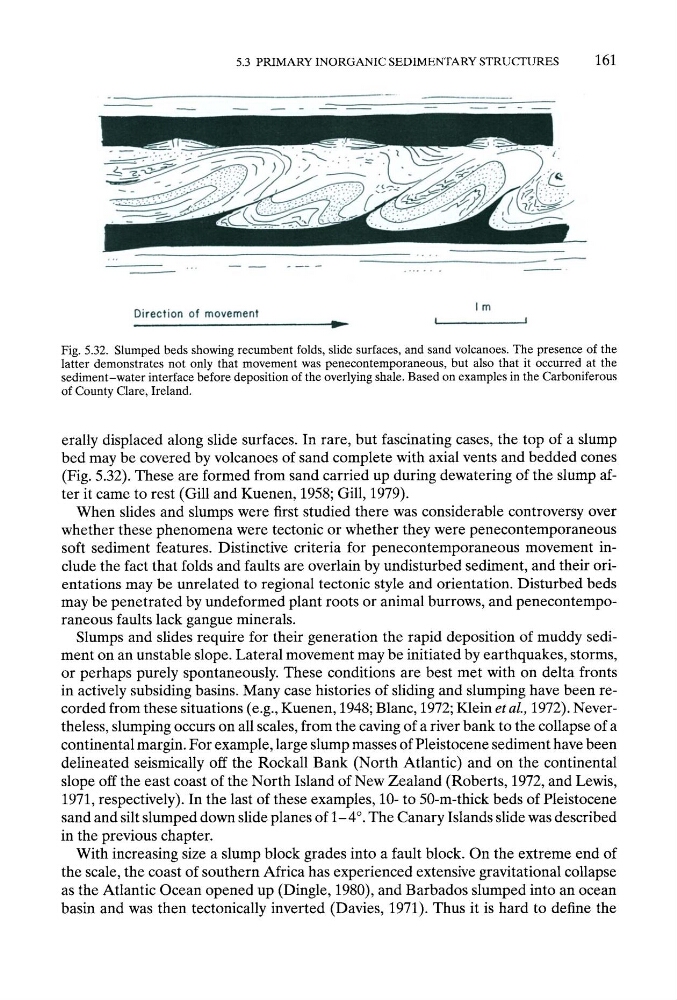
Fig. 5.32. Slumped beds showing recumbent folds, slide surfaces, and sand volcanoes. The presence of the
latter demonstrates not only that movement was penecontemporaneous, but also that it occurred at the
sediment-water interface before deposition of the overlying shale. Based on examples in the Carboniferous
of County Clare, Ireland.
erally displaced along slide surfaces. In rare, but fascinating cases, the top of a slump
bed may be covered by volcanoes of sand complete with axial vents and bedded cones
(Fig. 5.32). These are formed from sand carried up during dewatering of the slump after it came to rest (Gill and Kuenen, 1958; Gill, 1979).
When slides and slumps were first studied there was considerable controversy over
whether these phenomena were tectonic or whether they were penecontemporaneous
soft sediment features. Distinctive criteria for penecontemporaneous movement include the fact that folds and faults are overlain by undisturbed sediment, and their orientations may be unrelated to regional tectonic style and orientation. Disturbed beds
may be penetrated by undeformed plant roots or animal burrows, and penecontemporaneous faults lack gangue minerals.
Slumps and slides require for their generation the rapid deposition of muddy sediment on an unstable slope. Lateral movement may be initiated by earthquakes, storms,
or perhaps purely spontaneously. These conditions are best met with on delta fronts
in actively subsiding basins. Many case histories of sliding and slumping have been recorded from these situations (e.g., Kuenen, 1948; Blanc, 1972; Klein et aL, 1972). Nevertheless, slumping occurs on all scales, from the caving of a river bank to the collapse of a
continental margin. For example, large slump masses of Pleistocene sediment have been
delineated seismically off the Rockall Bank (North Atlantic) and on the continental
slope off the east coast of the North Island of New Zealand (Roberts, 1972, and Lewis,
1971, respectively). In the last of these examples, 10- to 50-m-thick beds of Pleistocene
sand and silt slumped down slide planes of 1-4 ~ . The Canary Islands slide was described
in the previous chapter.
With increasing size a slump block grades into a fault block. On the extreme end of
the scale, the coast of southern Africa has experienced extensive gravitational collapse
as the Atlantic Ocean opened up (Dingle, 1980), and Barbados slumped into an ocean
basin and was then tectonically inverted (Davies, 1971). Thus it is hard to define the
161
Fig. 5.32. Slumped beds showing recumbent folds, slide surfaces, and sand volcanoes. The presence of the
latter demonstrates not only that movement was penecontemporaneous, but also that it occurred at the
sediment-water interface before deposition of the overlying shale. Based on examples in the Carboniferous
of County Clare, Ireland.
erally displaced along slide surfaces. In rare, but fascinating cases, the top of a slump
bed may be covered by volcanoes of sand complete with axial vents and bedded cones
(Fig. 5.32). These are formed from sand carried up during dewatering of the slump after it came to rest (Gill and Kuenen, 1958; Gill, 1979).
When slides and slumps were first studied there was considerable controversy over
whether these phenomena were tectonic or whether they were penecontemporaneous
soft sediment features. Distinctive criteria for penecontemporaneous movement include the fact that folds and faults are overlain by undisturbed sediment, and their orientations may be unrelated to regional tectonic style and orientation. Disturbed beds
may be penetrated by undeformed plant roots or animal burrows, and penecontemporaneous faults lack gangue minerals.
Slumps and slides require for their generation the rapid deposition of muddy sediment on an unstable slope. Lateral movement may be initiated by earthquakes, storms,
or perhaps purely spontaneously. These conditions are best met with on delta fronts
in actively subsiding basins. Many case histories of sliding and slumping have been recorded from these situations (e.g., Kuenen, 1948; Blanc, 1972; Klein et aL, 1972). Nevertheless, slumping occurs on all scales, from the caving of a river bank to the collapse of a
continental margin. For example, large slump masses of Pleistocene sediment have been
delineated seismically off the Rockall Bank (North Atlantic) and on the continental
slope off the east coast of the North Island of New Zealand (Roberts, 1972, and Lewis,
1971, respectively). In the last of these examples, 10- to 50-m-thick beds of Pleistocene
sand and silt slumped down slide planes of 1-4 ~ . The Canary Islands slide was described
in the previous chapter.
With increasing size a slump block grades into a fault block. On the extreme end of
the scale, the coast of southern Africa has experienced extensive gravitational collapse
as the Atlantic Ocean opened up (Dingle, 1980), and Barbados slumped into an ocean
basin and was then tectonically inverted (Davies, 1971). Thus it is hard to define the