

154
5 SEDIMENTARY STRUCTURES
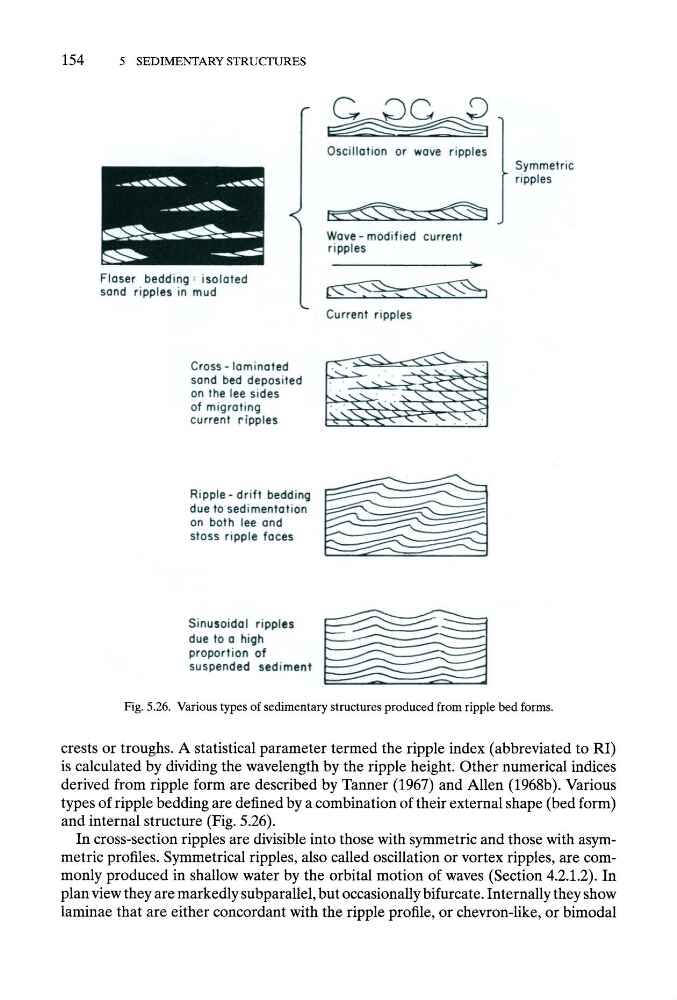
Fig. 5.26. Various types of sedimentary structures produced from ripple bed forms.
crests or troughs. A statistical parameter termed the ripple index (abbreviated to RI)
is calculated by dividing the wavelength by the ripple height. Other numerical indices
derived from ripple form are described by Tanner (1967) and Allen (1968b). Various
types of ripple bedding are defined by a combination of their external shape (bed form)
and internal structure (Fig. 5.26).
In cross-section ripples are divisible into those with symmetric and those with asymmetric profiles. Symmetrical ripples, also called oscillation or vortex ripples, are commonly produced in shallow water by the orbital motion of waves (Section 4.2.1.2). In
plan view they are markedly subparallel, but occasionally bifurcate. Internally they show
laminae that are either concordant with the ripple profile, or chevron-like, or bimodal
5 SEDIMENTARY STRUCTURES
Fig. 5.26. Various types of sedimentary structures produced from ripple bed forms.
crests or troughs. A statistical parameter termed the ripple index (abbreviated to RI)
is calculated by dividing the wavelength by the ripple height. Other numerical indices
derived from ripple form are described by Tanner (1967) and Allen (1968b). Various
types of ripple bedding are defined by a combination of their external shape (bed form)
and internal structure (Fig. 5.26).
In cross-section ripples are divisible into those with symmetric and those with asymmetric profiles. Symmetrical ripples, also called oscillation or vortex ripples, are commonly produced in shallow water by the orbital motion of waves (Section 4.2.1.2). In
plan view they are markedly subparallel, but occasionally bifurcate. Internally they show
laminae that are either concordant with the ripple profile, or chevron-like, or bimodal