

5.3 PRIMARY INORGANIC SEDIMENTARY STRUCTURES
153
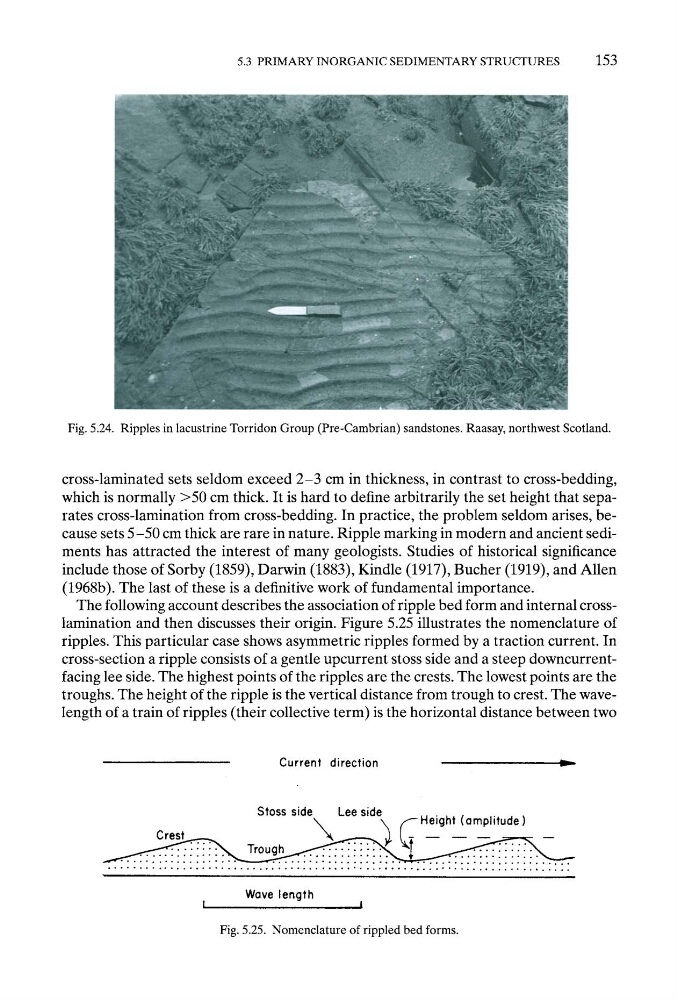
Fig. 5.24. Ripples in lacustrine Torridon Group (Pre-Cambrian) sandstones. Raasay, northwest Scotland.
cross-laminated sets seldom exceed 2-3 cm in thickness, in contrast to cross-bedding,
which is normally >50 cm thick. It is hard to define arbitrarily the set height that separates cross-lamination from cross-bedding. In practice, the problem seldom arises, because sets 5-50 cm thick are rare in nature. Ripple marking in modern and ancient sediments has attracted the interest of many geologists. Studies of historical significance
include those of Sorby (1859), Darwin (1883), Kindle (1917), Bucher (1919), and Allen
(1968b). The last of these is a definitive work of fundamental importance.
The following account describes the association of ripple bed form and internal crosslamination and then discusses their origin. Figure 5.25 illustrates the nomenclature of
ripples. This particular case shows asymmetric ripples formed by a traction current. In
cross-section a ripple consists of a gentle upcurrent stoss side and a steep downcurrentfacing lee side. The highest points of the ripples are the crests. The lowest points are the
troughs. The height of the ripple is the vertical distance from trough to crest. The wavelength of a train of ripples (their collective term) is the horizontal distance between two
Current direction
,
Stoss side
Lee side
\ (,--- Height (amplitude)
Crest
. . . . . . . . . . . . . . . . . . . . . . . . . . . . . . . . . . . . . . .
, . . . .
9 . . . . . . . . . . . . . . . . . . . . . . . . . . . . .
Wave length
I
.
1
Fig. 5.25. Nomenclature of rippled bed forms.
153
Fig. 5.24. Ripples in lacustrine Torridon Group (Pre-Cambrian) sandstones. Raasay, northwest Scotland.
cross-laminated sets seldom exceed 2-3 cm in thickness, in contrast to cross-bedding,
which is normally >50 cm thick. It is hard to define arbitrarily the set height that separates cross-lamination from cross-bedding. In practice, the problem seldom arises, because sets 5-50 cm thick are rare in nature. Ripple marking in modern and ancient sediments has attracted the interest of many geologists. Studies of historical significance
include those of Sorby (1859), Darwin (1883), Kindle (1917), Bucher (1919), and Allen
(1968b). The last of these is a definitive work of fundamental importance.
The following account describes the association of ripple bed form and internal crosslamination and then discusses their origin. Figure 5.25 illustrates the nomenclature of
ripples. This particular case shows asymmetric ripples formed by a traction current. In
cross-section a ripple consists of a gentle upcurrent stoss side and a steep downcurrentfacing lee side. The highest points of the ripples are the crests. The lowest points are the
troughs. The height of the ripple is the vertical distance from trough to crest. The wavelength of a train of ripples (their collective term) is the horizontal distance between two
Current direction
,
Stoss side
Lee side
\ (,--- Height (amplitude)
Crest
. . . . . . . . . . . . . . . . . . . . . . . . . . . . . . . . . . . . . . .
, . . . .
9 . . . . . . . . . . . . . . . . . . . . . . . . . . . . .
Wave length
I
.
1
Fig. 5.25. Nomenclature of rippled bed forms.