

5.3 PRIMARY INORGANIC SEDIMENTARY STRUCTURES
151
Current
"'
~
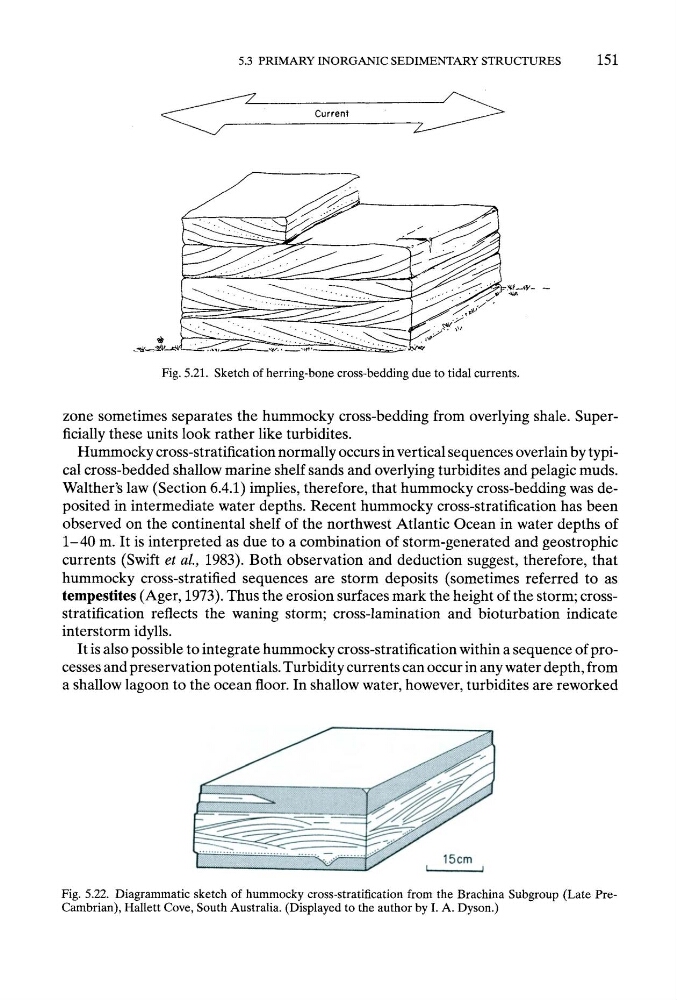
Fig. 5.21. Sketch of herring-bone cross-bedding due to tidal currents.
zone sometimes separates the hummocky cross-bedding from overlying shale. Superficially these units look rather like turbidites.
Hummocky cross-stratification normally occurs in vertical sequences overlain by typical cross-bedded shallow marine shelf sands and overlying turbidites and pelagic muds.
Walther's law (Section 6.4.1) implies, therefore, that hummocky cross-bedding was deposited in intermediate water depths. Recent hummocky cross-stratification has been
observed on the continental shelf of the northwest Atlantic Ocean in water depths of
1-40 m. It is interpreted as due to a combination of storm-generated and geostrophic
currents (Swift et al., 1983). Both observation and deduction suggest, therefore, that
hummocky cross-stratified sequences are storm deposits (sometimes referred to as
tempestites (Ager, 1973). Thus the erosion surfaces mark the height of the storm; crossstratification reflects the waning storm; cross-lamination and bioturbation indicate
interstorm idylls.
It is also possible to integrate hummocky cross-stratification within a sequence of processes and preservation potentials. Turbidity currents can occur in any water depth, from
a shallow lagoon to the ocean floor. In shallow water, however, turbidites are reworked
Fig. 5.22. Diagrammatic sketch of hummocky cross-stratification from the Brachina Subgroup (Late PreCambrian), Hallett Cove, South Australia. (Displayed to the author by I. A. Dyson.)
151
Current
"'
~
Fig. 5.21. Sketch of herring-bone cross-bedding due to tidal currents.
zone sometimes separates the hummocky cross-bedding from overlying shale. Superficially these units look rather like turbidites.
Hummocky cross-stratification normally occurs in vertical sequences overlain by typical cross-bedded shallow marine shelf sands and overlying turbidites and pelagic muds.
Walther's law (Section 6.4.1) implies, therefore, that hummocky cross-bedding was deposited in intermediate water depths. Recent hummocky cross-stratification has been
observed on the continental shelf of the northwest Atlantic Ocean in water depths of
1-40 m. It is interpreted as due to a combination of storm-generated and geostrophic
currents (Swift et al., 1983). Both observation and deduction suggest, therefore, that
hummocky cross-stratified sequences are storm deposits (sometimes referred to as
tempestites (Ager, 1973). Thus the erosion surfaces mark the height of the storm; crossstratification reflects the waning storm; cross-lamination and bioturbation indicate
interstorm idylls.
It is also possible to integrate hummocky cross-stratification within a sequence of processes and preservation potentials. Turbidity currents can occur in any water depth, from
a shallow lagoon to the ocean floor. In shallow water, however, turbidites are reworked
Fig. 5.22. Diagrammatic sketch of hummocky cross-stratification from the Brachina Subgroup (Late PreCambrian), Hallett Cove, South Australia. (Displayed to the author by I. A. Dyson.)