

150
5 SEDIMENTARY STRUCTURES
t
50rn
10m
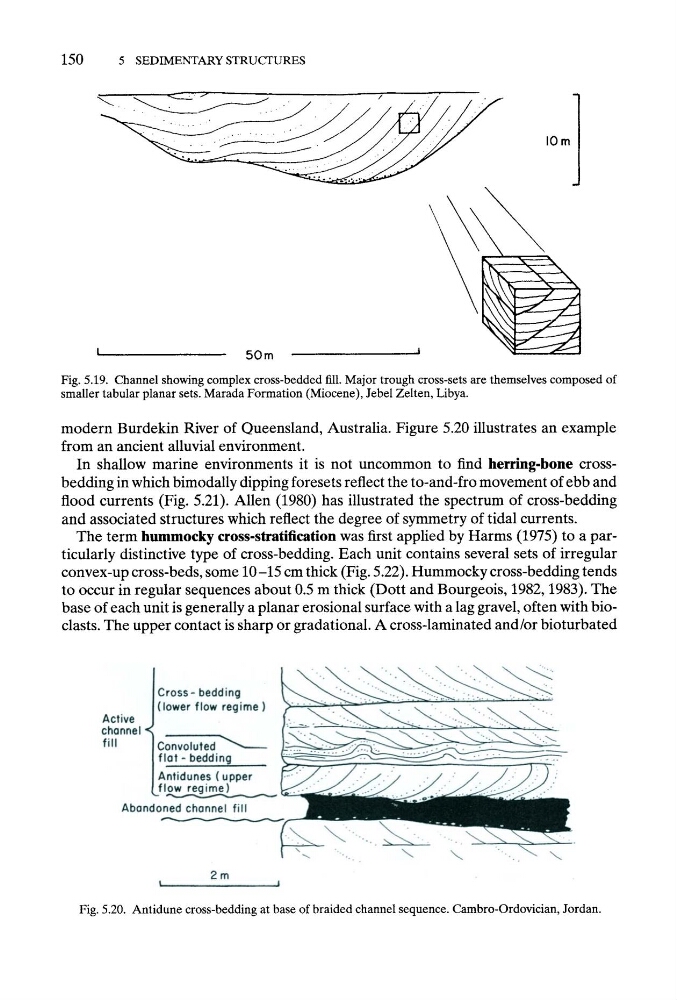
Fig. 5.19. Channel showing complex cross-bedded fill. Major trough cross-sets are themselves composed of
smaller tabular planar sets. Marada Formation (Miocene), Jebel Zelten, Libya.
modern Burdekin River of Queensland, Australia. Figure 5.20 illustrates an example
from an ancient alluvial environment.
In shallow marine environments it is not uncommon to find herring-bone crossbedding in which bimodally dipping foresets reflect the to-and-fro movement of ebb and
flood currents (Fig. 5.21). Allen (1980) has illustrated the spectrum of cross-bedding
and associated structures which reflect the degree of symmetry of tidal currents.
The term hummocky cross-stratification was first applied by Harms (1975) to a particularly distinctive type of cross-bedding. Each unit contains several sets of irregular
convex-up cross-beds, some 10-15 cm thick (Fig. 5.22). Hummocky cross-bedding tends
to occur in regular sequences about 0.5 m thick (Dott and Bourgeois, 1982, 1983). The
base of each unit is generally a planar erosional surface with a lag gravel, often with bioclasts. The upper contact is sharp or gradational. A cross-laminated and/or bioturbated
Fig. 5.20. Antidune cross-bedding at base of braided channel sequence. Cambro-Ordovician, Jordan.
5 SEDIMENTARY STRUCTURES
t
50rn
10m
Fig. 5.19. Channel showing complex cross-bedded fill. Major trough cross-sets are themselves composed of
smaller tabular planar sets. Marada Formation (Miocene), Jebel Zelten, Libya.
modern Burdekin River of Queensland, Australia. Figure 5.20 illustrates an example
from an ancient alluvial environment.
In shallow marine environments it is not uncommon to find herring-bone crossbedding in which bimodally dipping foresets reflect the to-and-fro movement of ebb and
flood currents (Fig. 5.21). Allen (1980) has illustrated the spectrum of cross-bedding
and associated structures which reflect the degree of symmetry of tidal currents.
The term hummocky cross-stratification was first applied by Harms (1975) to a particularly distinctive type of cross-bedding. Each unit contains several sets of irregular
convex-up cross-beds, some 10-15 cm thick (Fig. 5.22). Hummocky cross-bedding tends
to occur in regular sequences about 0.5 m thick (Dott and Bourgeois, 1982, 1983). The
base of each unit is generally a planar erosional surface with a lag gravel, often with bioclasts. The upper contact is sharp or gradational. A cross-laminated and/or bioturbated
Fig. 5.20. Antidune cross-bedding at base of braided channel sequence. Cambro-Ordovician, Jordan.