

134
5 SEDIMENTARY STRUCTURES
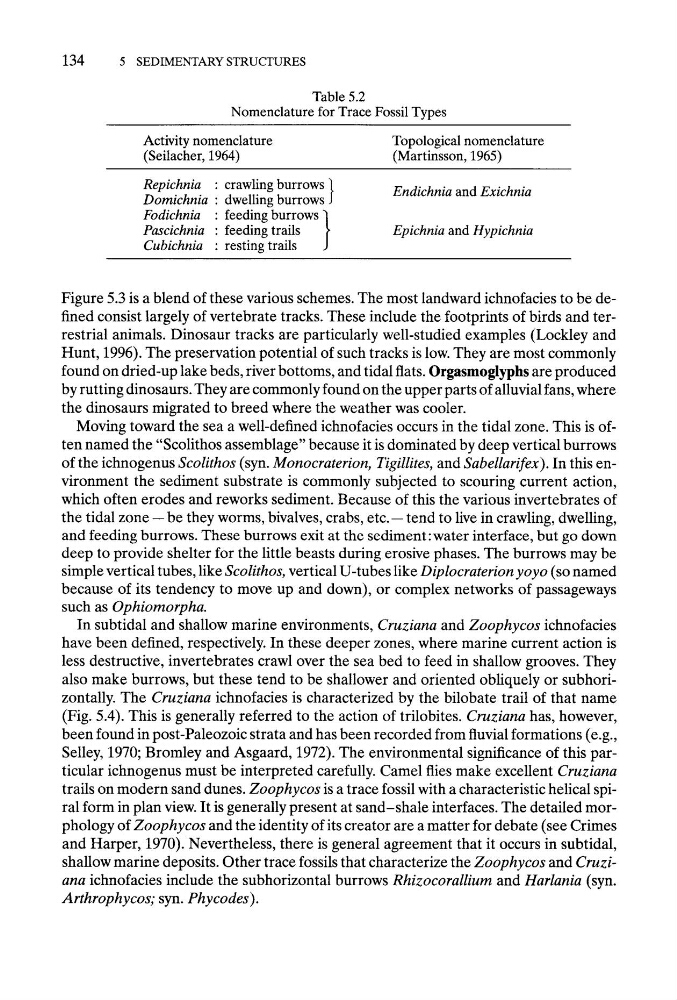
Table 5.2
Nomenclature for Trace Fossil Types
Activity nomenclature
(Seilacher, 1964)
Topological nomenclature
(Martinsson, 1965)
Repichnia 9 crawling burrows
Domichnia dwelling burrows J
Fodichnia 9 feeding burrows "1
Pascichnia feeding trails
Cubichnia resting trails
Endichnia and Exichnia
Epichnia and Hypichnia
Figure 5.3 is a blend of these various schemes. The most landward ichnofacies to be defined consist largely of vertebrate tracks. These include the footprints of birds and terrestrial animals. Dinosaur tracks are particularly well-studied examples (Lockley and
Hunt, 1996). The preservation potential of such tracks is low. They are most commonly
found on dried-up lake beds, river bottoms, and tidal flats. Orgasmoglyphs are produced
by rutting dinosaurs. They are commonly found on the upper parts of alluvial fans, where
the dinosaurs migrated to breed where the weather was cooler.
Moving toward the sea a well-defined ichnofacies occurs in the tidal zone. This is often named the "Scolithos assemblage" because it is dominated by deep vertical burrows
of the ichnogenus Scolithos (syn. Monocraterion, Tigillites, and Sabellarifex). In this environment the sediment substrate is commonly subjected to scouring current action,
which often erodes and reworks sediment. Because of this the various invertebrates of
the tidal zone -- be they worms, bivalves, crabs, etc.-- tend to live in crawling, dwelling,
and feeding burrows. These burrows exit at the sediment:water interface, but go down
deep to provide shelter for the little beasts during erosive phases. The burrows may be
simple vertical tubes, like Scolithos, vertical U-tubes like Diplocraterion yoyo (so named
because of its tendency to move up and down), or complex networks of passageways
such as Ophiomorpha.
In subtidal and shallow marine environments, Cruziana and Zoophycos ichnofacies
have been defined, respectively. In these deeper zones, where marine current action is
less destructive, invertebrates crawl over the sea bed to feed in shallow grooves. They
also make burrows, but these tend to be shallower and oriented obliquely or subhorizontally. The Cruziana ichnofacies is characterized by the bilobate trail of that name
(Fig. 5.4). This is generally referred to the action of trilobites. Cruziana has, however,
been found in post-Paleozoic strata and has been recorded from fluvial formations (e.g.,
Selley, 1970; Bromley and Asgaard, 1972). The environmental significance of this particular ichnogenus must be interpreted carefully. Camel flies make excellent Cruziana
trails on modern sand dunes. Zoophycos is a trace fossil with a characteristic helical spiral form in plan view. It is generally present at sand-shale interfaces. The detailed morphology of Zoophycos and the identity of its creator are a matter for debate (see Crimes
and Harper, 1970). Nevertheless, there is general agreement that it occurs in subtidal,
shallow marine deposits. Other trace fossils that characterize the Zoophycos and Cruziana ichnofacies include the subhorizontal burrows Rhizocorallium and Harlania (syn.
Arthrophycos; syn. Phycodes).
5 SEDIMENTARY STRUCTURES
Table 5.2
Nomenclature for Trace Fossil Types
Activity nomenclature
(Seilacher, 1964)
Topological nomenclature
(Martinsson, 1965)
Repichnia 9 crawling burrows
Domichnia dwelling burrows J
Fodichnia 9 feeding burrows "1
Pascichnia feeding trails
Cubichnia resting trails
Endichnia and Exichnia
Epichnia and Hypichnia
Figure 5.3 is a blend of these various schemes. The most landward ichnofacies to be defined consist largely of vertebrate tracks. These include the footprints of birds and terrestrial animals. Dinosaur tracks are particularly well-studied examples (Lockley and
Hunt, 1996). The preservation potential of such tracks is low. They are most commonly
found on dried-up lake beds, river bottoms, and tidal flats. Orgasmoglyphs are produced
by rutting dinosaurs. They are commonly found on the upper parts of alluvial fans, where
the dinosaurs migrated to breed where the weather was cooler.
Moving toward the sea a well-defined ichnofacies occurs in the tidal zone. This is often named the "Scolithos assemblage" because it is dominated by deep vertical burrows
of the ichnogenus Scolithos (syn. Monocraterion, Tigillites, and Sabellarifex). In this environment the sediment substrate is commonly subjected to scouring current action,
which often erodes and reworks sediment. Because of this the various invertebrates of
the tidal zone -- be they worms, bivalves, crabs, etc.-- tend to live in crawling, dwelling,
and feeding burrows. These burrows exit at the sediment:water interface, but go down
deep to provide shelter for the little beasts during erosive phases. The burrows may be
simple vertical tubes, like Scolithos, vertical U-tubes like Diplocraterion yoyo (so named
because of its tendency to move up and down), or complex networks of passageways
such as Ophiomorpha.
In subtidal and shallow marine environments, Cruziana and Zoophycos ichnofacies
have been defined, respectively. In these deeper zones, where marine current action is
less destructive, invertebrates crawl over the sea bed to feed in shallow grooves. They
also make burrows, but these tend to be shallower and oriented obliquely or subhorizontally. The Cruziana ichnofacies is characterized by the bilobate trail of that name
(Fig. 5.4). This is generally referred to the action of trilobites. Cruziana has, however,
been found in post-Paleozoic strata and has been recorded from fluvial formations (e.g.,
Selley, 1970; Bromley and Asgaard, 1972). The environmental significance of this particular ichnogenus must be interpreted carefully. Camel flies make excellent Cruziana
trails on modern sand dunes. Zoophycos is a trace fossil with a characteristic helical spiral form in plan view. It is generally present at sand-shale interfaces. The detailed morphology of Zoophycos and the identity of its creator are a matter for debate (see Crimes
and Harper, 1970). Nevertheless, there is general agreement that it occurs in subtidal,
shallow marine deposits. Other trace fossils that characterize the Zoophycos and Cruziana ichnofacies include the subhorizontal burrows Rhizocorallium and Harlania (syn.
Arthrophycos; syn. Phycodes).