

5.2 BIOGENIC SEDIMENTARY STRUCTURES
133
5.2 BIOGENIC SEDIMENTARY STRUCTURES
A great variety of structures in sedimentary rocks can be attributed to the work of organisms. These structures are referred to as biogenic, in contrast to the inorganic sedimentary structures. Biogenic structures include plant rootlets, vertebrate footprints (tracks),
trails (due to invertebrates), soft sediment burrows, and hard rock borings. These phenomena are collectively known as trace fossils and their study is referred to as iehnology. Important works on ichnology include those by Crimes and Harper (1970, 1977),
Frey (1975), Hantzschel (1975), Gall (1983), Brenchley (1990), and Bromley (1990).
An individual morphological type of trace fossil is termed an iehnogenus. One of the
basic principles of trace fossil analysis is that similar ichnogenera can be produced by a
wide variety of organisms. The shape of a trace fossil reflects environment rather than
creator. This means that trace fossils can be very important indicators of the origin of
the sediment in which they are found because of their close environmental control. Furthermore, trace fossils always occur in place and cannot be reworked like most other
fossils. Sedimentologists therefore need to know something about trace fossils. Some
basic principles of occurrence and nomenclature will be described before analyzing the
relationship between trace fossils and environments. The various types of ichnogenera
cannot be grouped phyllogenetically because, as already pointed out, different organisms produce similar traces. Ichnofossils have been grouped according to the activity
which made them (Seilacher, 1964) and according to their topology (Martinsson, 1965).
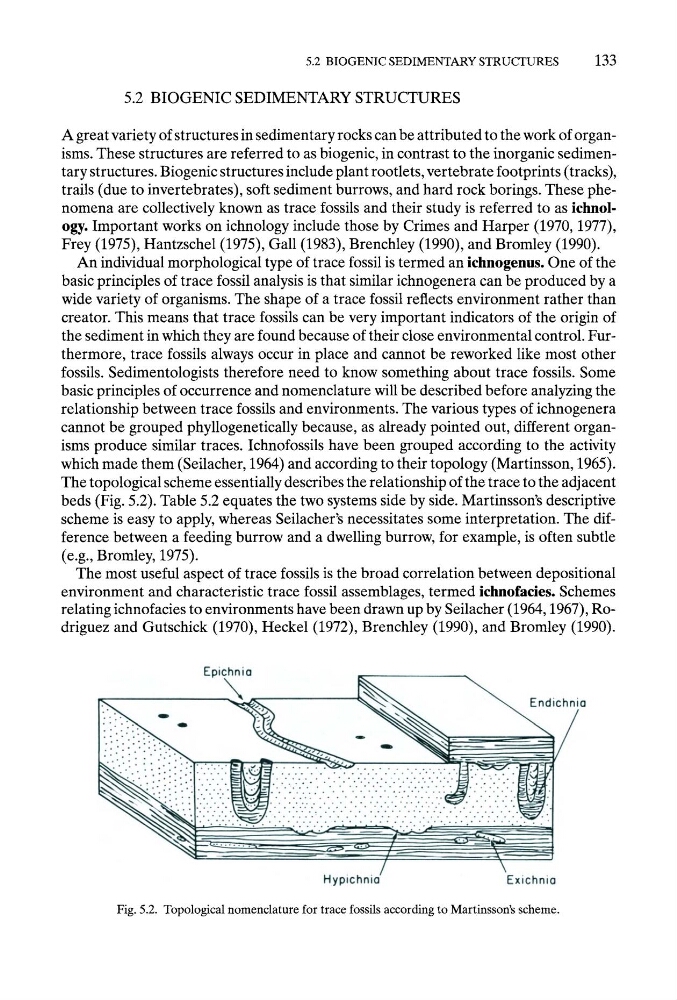
The topological scheme essentially describes the relationship of the trace to the adjacent
beds (Fig. 5.2). Table 5.2 equates the two systems side by side. Martinsson's descriptive
scheme is easy to apply, whereas Seilacher's necessitates some interpretation. The difference between a feeding burrow and a dwelling burrow, for example, is often subtle
(e.g., Bromley, 1975).
The most useful aspect of trace fossils is the broad correlation between depositional
environment and characteristic trace fossil assemblages, termed iehnofaeies. Schemes
relating ichnofacies to environments have been drawn up by Seilacher (1964,1967), Rodriguez and Gutschick (1970), Heckel (1972), Brenchley (1990), and Bromley (1990).
Fig. 5.2. Topological nomenclature for trace fossils according to Martinsson's scheme.
133
5.2 BIOGENIC SEDIMENTARY STRUCTURES
A great variety of structures in sedimentary rocks can be attributed to the work of organisms. These structures are referred to as biogenic, in contrast to the inorganic sedimentary structures. Biogenic structures include plant rootlets, vertebrate footprints (tracks),
trails (due to invertebrates), soft sediment burrows, and hard rock borings. These phenomena are collectively known as trace fossils and their study is referred to as iehnology. Important works on ichnology include those by Crimes and Harper (1970, 1977),
Frey (1975), Hantzschel (1975), Gall (1983), Brenchley (1990), and Bromley (1990).
An individual morphological type of trace fossil is termed an iehnogenus. One of the
basic principles of trace fossil analysis is that similar ichnogenera can be produced by a
wide variety of organisms. The shape of a trace fossil reflects environment rather than
creator. This means that trace fossils can be very important indicators of the origin of
the sediment in which they are found because of their close environmental control. Furthermore, trace fossils always occur in place and cannot be reworked like most other
fossils. Sedimentologists therefore need to know something about trace fossils. Some
basic principles of occurrence and nomenclature will be described before analyzing the
relationship between trace fossils and environments. The various types of ichnogenera
cannot be grouped phyllogenetically because, as already pointed out, different organisms produce similar traces. Ichnofossils have been grouped according to the activity
which made them (Seilacher, 1964) and according to their topology (Martinsson, 1965).
The topological scheme essentially describes the relationship of the trace to the adjacent
beds (Fig. 5.2). Table 5.2 equates the two systems side by side. Martinsson's descriptive
scheme is easy to apply, whereas Seilacher's necessitates some interpretation. The difference between a feeding burrow and a dwelling burrow, for example, is often subtle
(e.g., Bromley, 1975).
The most useful aspect of trace fossils is the broad correlation between depositional
environment and characteristic trace fossil assemblages, termed iehnofaeies. Schemes
relating ichnofacies to environments have been drawn up by Seilacher (1964,1967), Rodriguez and Gutschick (1970), Heckel (1972), Brenchley (1990), and Bromley (1990).
Fig. 5.2. Topological nomenclature for trace fossils according to Martinsson's scheme.