

120
4 TRANSPORTATION AND SEDIMENTATION
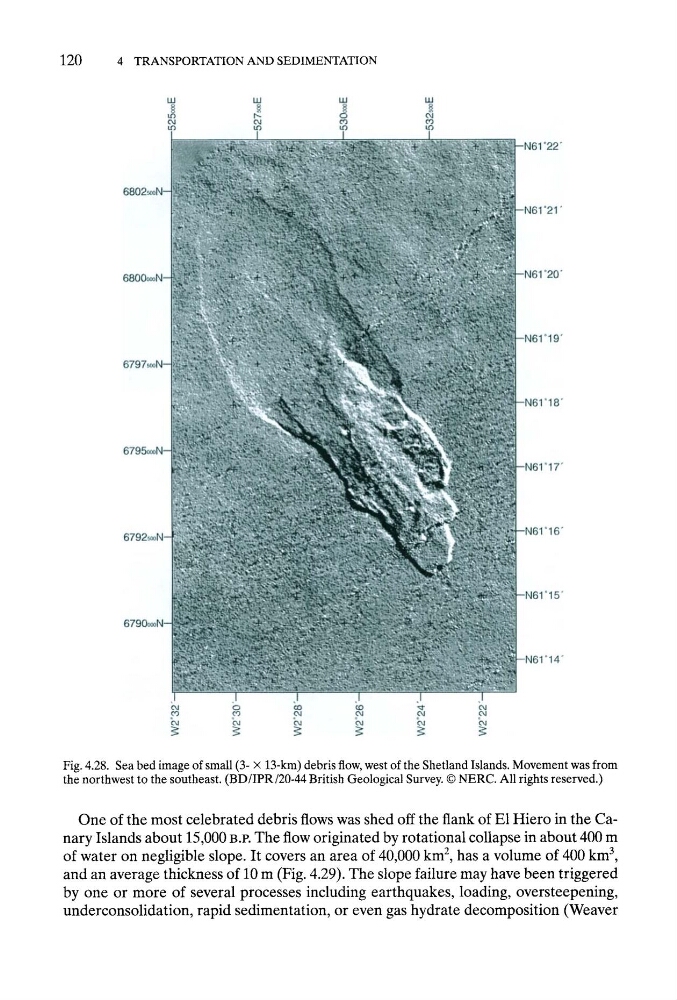
Fig. 4.28. Sea bed image of small (3- x 13-km) debris flow, west of the Shetland Islands. Movement was from
the northwest to the southeast. (BD/IPR/20-44 British Geological Survey. 9 NERC. All rights reserved.)
One of the most celebrated debris flows was shed off the flank of E1 Hiero in the Canary Islands about 15,000 B.P. The flow originated by rotational collapse in about 400 m
of water on negligible slope. It covers an area of 40,000 km 2, has a volume of 400 km 3,
and an average thickness of 10 m (Fig. 4.29). The slope failure may have been triggered
by one or more of several processes including earthquakes, loading, oversteepening,
underconsolidation, rapid sedimentation, or even gas hydrate decomposition (Weaver
4 TRANSPORTATION AND SEDIMENTATION
Fig. 4.28. Sea bed image of small (3- x 13-km) debris flow, west of the Shetland Islands. Movement was from
the northwest to the southeast. (BD/IPR/20-44 British Geological Survey. 9 NERC. All rights reserved.)
One of the most celebrated debris flows was shed off the flank of E1 Hiero in the Canary Islands about 15,000 B.P. The flow originated by rotational collapse in about 400 m
of water on negligible slope. It covers an area of 40,000 km 2, has a volume of 400 km 3,
and an average thickness of 10 m (Fig. 4.29). The slope failure may have been triggered
by one or more of several processes including earthquakes, loading, oversteepening,
underconsolidation, rapid sedimentation, or even gas hydrate decomposition (Weaver