

118
4 TRANSPORTATION AND SEDIMENTATION
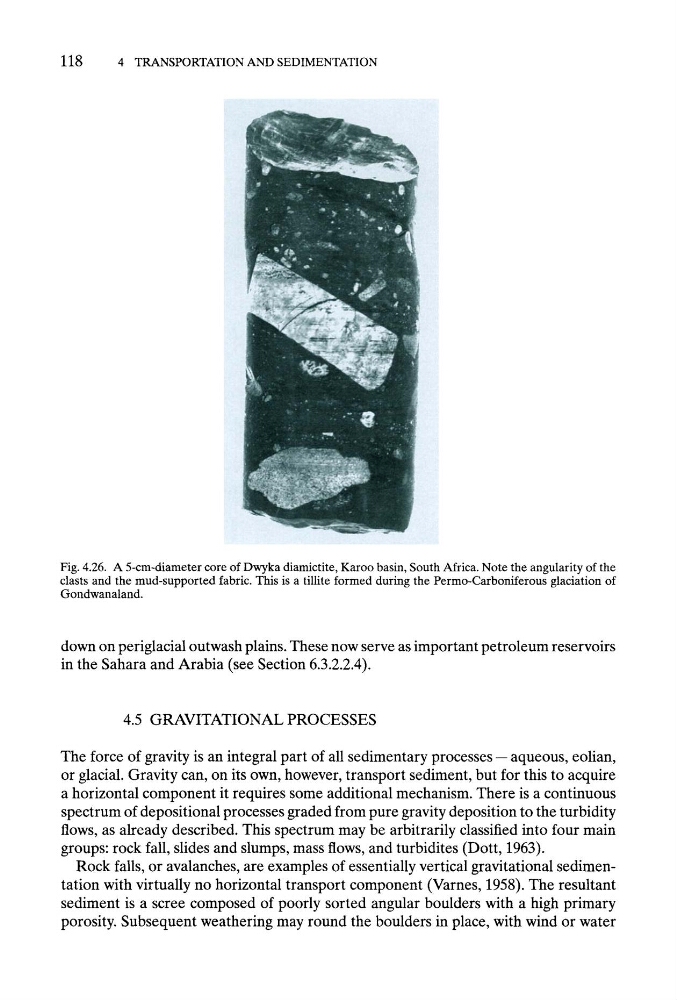
Fig. 4.26. A 5-cm-diameter core of Dwyka diamictite, Karoo basin, South Africa. Note the angularity of the
clasts and the mud-supported fabric. This is a tillite formed during the Permo-Carboniferous glaciation of
Gondwanaland.
down on periglacial outwash plains. These now serve as important petroleum reservoirs
in the Sahara and Arabia (see Section 6.3.2.2.4).
4.5 GRAVITATIONAL PROCESSES
The force of gravity is an integral part of all sedimentary processes- aqueous, eolian,
or glacial. Gravity can, on its own, however, transport sediment, but for this to acquire
a horizontal component it requires some additional mechanism. There is a continuous
spectrum of depositional processes graded from pure gravity deposition to the turbidity
flows, as already described. This spectrum may be arbitrarily classified into four main
groups: rock fall, slides and slumps, mass flows, and turbidites (Dott, 1963).
Rock falls, or avalanches, are examples of essentially vertical gravitational sedimentation with virtually no horizontal transport component (Varnes, 1958). The resultant
sediment is a scree composed of poorly sorted angular boulders with a high primary
porosity. Subsequent weathering may round the boulders in place, with wind or water
4 TRANSPORTATION AND SEDIMENTATION
Fig. 4.26. A 5-cm-diameter core of Dwyka diamictite, Karoo basin, South Africa. Note the angularity of the
clasts and the mud-supported fabric. This is a tillite formed during the Permo-Carboniferous glaciation of
Gondwanaland.
down on periglacial outwash plains. These now serve as important petroleum reservoirs
in the Sahara and Arabia (see Section 6.3.2.2.4).
4.5 GRAVITATIONAL PROCESSES
The force of gravity is an integral part of all sedimentary processes- aqueous, eolian,
or glacial. Gravity can, on its own, however, transport sediment, but for this to acquire
a horizontal component it requires some additional mechanism. There is a continuous
spectrum of depositional processes graded from pure gravity deposition to the turbidity
flows, as already described. This spectrum may be arbitrarily classified into four main
groups: rock fall, slides and slumps, mass flows, and turbidites (Dott, 1963).
Rock falls, or avalanches, are examples of essentially vertical gravitational sedimentation with virtually no horizontal transport component (Varnes, 1958). The resultant
sediment is a scree composed of poorly sorted angular boulders with a high primary
porosity. Subsequent weathering may round the boulders in place, with wind or water