

116
4 TRANSPORTATION AND SEDIMENTATION
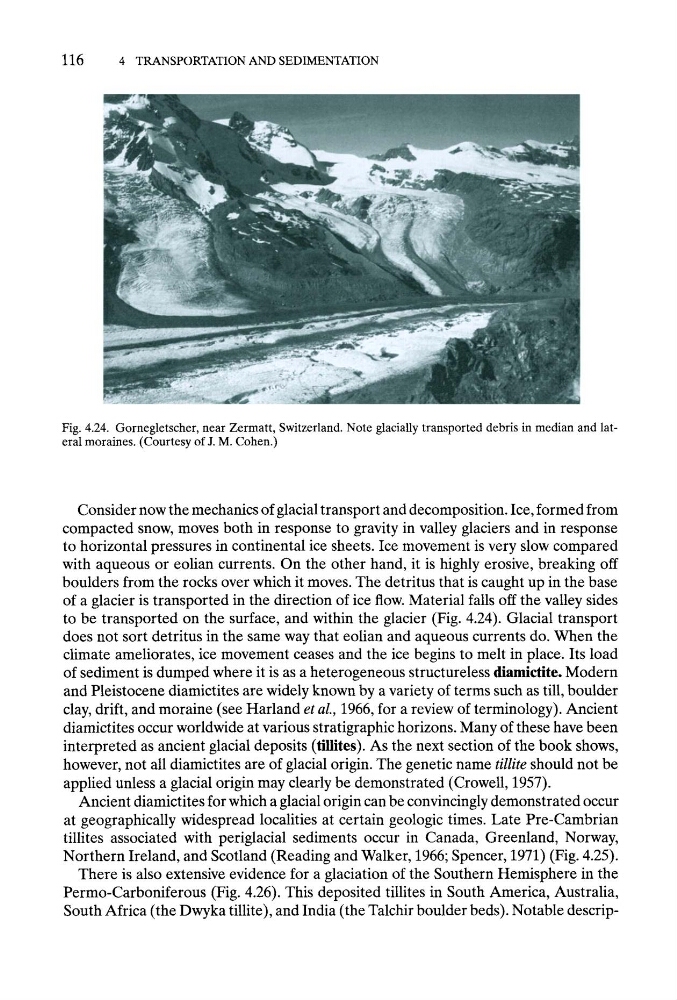
Fig. 4.24. Gornegletscher, near Zermatt, Switzerland. Note glacially transported debris in median and lateral moraines. (Courtesy of J. M. Cohen.)
Consider now the mechanics of glacial transport and decomposition. Ice, formed from
compacted snow, moves both in response to gravity in valley glaciers and in response
to horizontal pressures in continental ice sheets. Ice movement is very slow compared
with aqueous or eolian currents. On the other hand, it is highly erosive, breaking off
boulders from the rocks over which it moves. The detritus that is caught up in the base
of a glacier is transported in the direction of ice flow. Material falls off the valley sides
to be transported on the surface, and within the glacier (Fig. 4.24). Glacial transport
does not sort detritus in the same way that eolian and aqueous currents do. When the
climate ameliorates, ice movement ceases and the ice begins to melt in place. Its load
of sediment is dumped where it is as a heterogeneous structureless diamietite. Modern
and Pleistocene diamictites are widely known by a variety of terms such as till, boulder
clay, drift, and moraine (see Harland et al., 1966, for a review of terminology). Ancient
diamictites occur worldwide at various stratigraphic horizons. Many of these have been
interpreted as ancient glacial deposits (tillites). As the next section of the book shows,
however, not all diamictites are of glacial origin. The genetic name tillite should not be
applied unless a glacial origin may clearly be demonstrated (Crowell, 1957).
Ancient diamictites for which a glacial origin can be convincingly demonstrated occur
at geographically widespread localities at certain geologic times. Late Pre-Cambrian
tillites associated with periglacial sediments occur in Canada, Greenland, Norway,
Northern Ireland, and Scotland (Reading and Walker, 1966; Spencer, 1971) (Fig. 4.25).
There is also extensive evidence for a glaciation of the Southern Hemisphere in the
Permo-Carboniferous (Fig. 4.26). This deposited tillites in South America, Australia,
South Africa (the Dwyka tillite), and India (the Talchir boulder beds). Notable descrip-
4 TRANSPORTATION AND SEDIMENTATION
Fig. 4.24. Gornegletscher, near Zermatt, Switzerland. Note glacially transported debris in median and lateral moraines. (Courtesy of J. M. Cohen.)
Consider now the mechanics of glacial transport and decomposition. Ice, formed from
compacted snow, moves both in response to gravity in valley glaciers and in response
to horizontal pressures in continental ice sheets. Ice movement is very slow compared
with aqueous or eolian currents. On the other hand, it is highly erosive, breaking off
boulders from the rocks over which it moves. The detritus that is caught up in the base
of a glacier is transported in the direction of ice flow. Material falls off the valley sides
to be transported on the surface, and within the glacier (Fig. 4.24). Glacial transport
does not sort detritus in the same way that eolian and aqueous currents do. When the
climate ameliorates, ice movement ceases and the ice begins to melt in place. Its load
of sediment is dumped where it is as a heterogeneous structureless diamietite. Modern
and Pleistocene diamictites are widely known by a variety of terms such as till, boulder
clay, drift, and moraine (see Harland et al., 1966, for a review of terminology). Ancient
diamictites occur worldwide at various stratigraphic horizons. Many of these have been
interpreted as ancient glacial deposits (tillites). As the next section of the book shows,
however, not all diamictites are of glacial origin. The genetic name tillite should not be
applied unless a glacial origin may clearly be demonstrated (Crowell, 1957).
Ancient diamictites for which a glacial origin can be convincingly demonstrated occur
at geographically widespread localities at certain geologic times. Late Pre-Cambrian
tillites associated with periglacial sediments occur in Canada, Greenland, Norway,
Northern Ireland, and Scotland (Reading and Walker, 1966; Spencer, 1971) (Fig. 4.25).
There is also extensive evidence for a glaciation of the Southern Hemisphere in the
Permo-Carboniferous (Fig. 4.26). This deposited tillites in South America, Australia,
South Africa (the Dwyka tillite), and India (the Talchir boulder beds). Notable descrip-