

4.4 GLACIAL PROCESSES
115
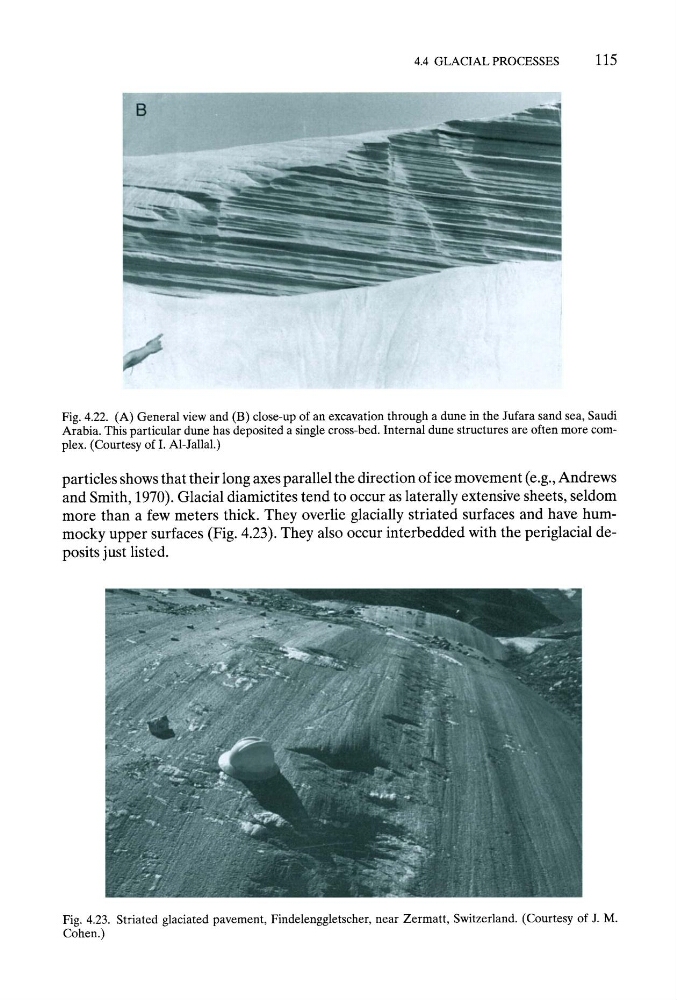
Fig. 4.22. (A) General view and (B) close-up of an excavation through a dune in the Jufara sand sea, Saudi
Arabia. This particular dune has deposited a single cross-bed. Internal dune structures are often more complex. (Courtesy of I. A1-Jallal.)
particles shows that their long axes parallel the direction of ice movement (e.g., Andrews
and Smith, 1970). Glacial diamictites tend to occur as laterally extensive sheets, seldom
more than a few meters thick. They overlie glacially striated surfaces and have hummocky upper surfaces (Fig. 4.23). They also occur interbedded with the periglacial deposits just listed.
Fig. 4.23. Striated glaciated pavement, Findelenggletscher, near Zermatt, Switzerland. (Courtesy of J. M.
Cohen.)
115
Fig. 4.22. (A) General view and (B) close-up of an excavation through a dune in the Jufara sand sea, Saudi
Arabia. This particular dune has deposited a single cross-bed. Internal dune structures are often more complex. (Courtesy of I. A1-Jallal.)
particles shows that their long axes parallel the direction of ice movement (e.g., Andrews
and Smith, 1970). Glacial diamictites tend to occur as laterally extensive sheets, seldom
more than a few meters thick. They overlie glacially striated surfaces and have hummocky upper surfaces (Fig. 4.23). They also occur interbedded with the periglacial deposits just listed.
Fig. 4.23. Striated glaciated pavement, Findelenggletscher, near Zermatt, Switzerland. (Courtesy of J. M.
Cohen.)