

378
Chapter 11: The Pacific Ocean
0
50
100
150
0
5
10
15
20
25
30
Climatology (years)
Depth (m)
Production at DCM (%)
Zm (sigma)
Zeu
Pt (at DCM)
0.26
0.28
0.30
0.32
0.34
0.08
0.10
0.11
0.13
0.14
0.16
SeaWiFS (WARM): September 1997 - January 2002
Surface Chl (mg m -3
)
Pt d
-1
Chl m
-3
Pt (gC m
-2
d
-1
)
1998
1999
2000
2001
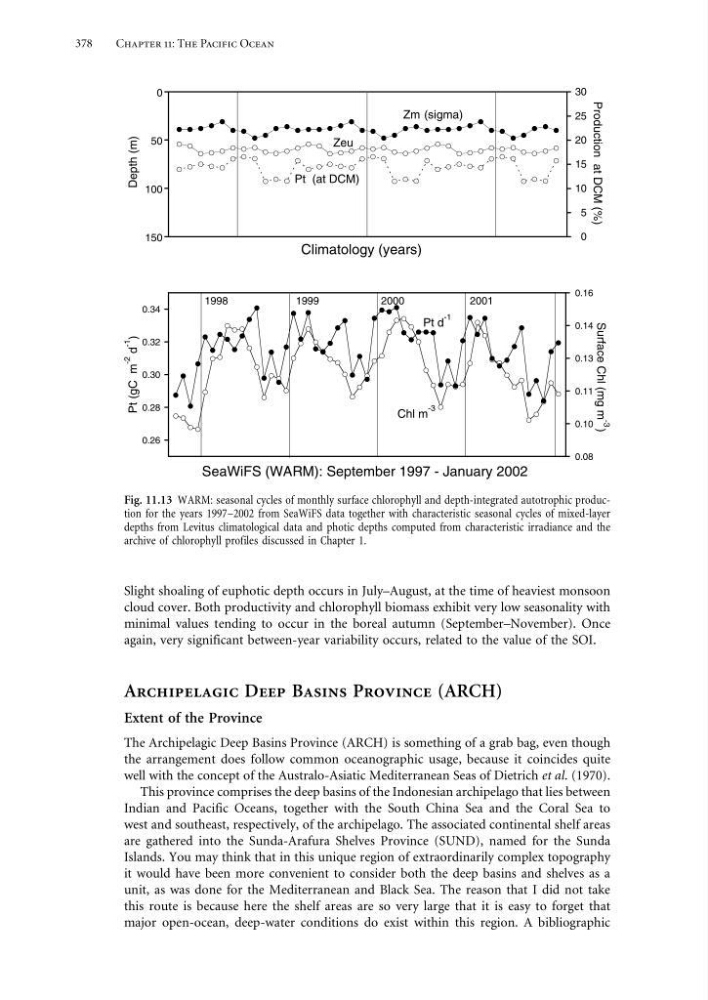
Fig. 11.13 WARM: seasonal cycles of monthly surface chlorophyll and depth-integrated autotrophic production for the years 1997–2002 from SeaWiFS data together with characteristic seasonal cycles of mixed-layer
depths from Levitus climatological data and photic depths computed from characteristic irradiance and the
archive of chlorophyll profiles discussed in Chapter 1.
Slight shoaling of euphotic depth occurs in July–August, at the time of heaviest monsoon
cloud cover. Both productivity and chlorophyll biomass exhibit very low seasonality with
minimal values tending to occur in the boreal autumn (September–November). Once
again, very significant between-year variability occurs, related to the value of the SOI.
Archipelagic Deep Basins Province (ARCH)
Extent of the Province
The Archipelagic Deep Basins Province (ARCH) is something of a grab bag, even though
the arrangement does follow common oceanographic usage, because it coincides quite
well with the concept of the Australo-Asiatic Mediterranean Seas of Dietrich et al. (1970).
This province comprises the deep basins of the Indonesian archipelago that lies between
Indian and Pacific Oceans, together with the South China Sea and the Coral Sea to
west and southeast, respectively, of the archipelago. The associated continental shelf areas
are gathered into the Sunda-Arafura Shelves Province (SUND), named for the Sunda
Islands. You may think that in this unique region of extraordinarily complex topography
it would have been more convenient to consider both the deep basins and shelves as a
unit, as was done for the Mediterranean and Black Sea. The reason that I did not take
this route is because here the shelf areas are so very large that it is easy to forget that
major open-ocean, deep-water conditions do exist within this region. A bibliographic
Chapter 11: The Pacific Ocean
0
50
100
150
0
5
10
15
20
25
30
Climatology (years)
Depth (m)
Production at DCM (%)
Zm (sigma)
Zeu
Pt (at DCM)
0.26
0.28
0.30
0.32
0.34
0.08
0.10
0.11
0.13
0.14
0.16
SeaWiFS (WARM): September 1997 - January 2002
Surface Chl (mg m -3
)
Pt d
-1
Chl m
-3
Pt (gC m
-2
d
-1
)
1998
1999
2000
2001
Fig. 11.13 WARM: seasonal cycles of monthly surface chlorophyll and depth-integrated autotrophic production for the years 1997–2002 from SeaWiFS data together with characteristic seasonal cycles of mixed-layer
depths from Levitus climatological data and photic depths computed from characteristic irradiance and the
archive of chlorophyll profiles discussed in Chapter 1.
Slight shoaling of euphotic depth occurs in July–August, at the time of heaviest monsoon
cloud cover. Both productivity and chlorophyll biomass exhibit very low seasonality with
minimal values tending to occur in the boreal autumn (September–November). Once
again, very significant between-year variability occurs, related to the value of the SOI.
Archipelagic Deep Basins Province (ARCH)
Extent of the Province
The Archipelagic Deep Basins Province (ARCH) is something of a grab bag, even though
the arrangement does follow common oceanographic usage, because it coincides quite
well with the concept of the Australo-Asiatic Mediterranean Seas of Dietrich et al. (1970).
This province comprises the deep basins of the Indonesian archipelago that lies between
Indian and Pacific Oceans, together with the South China Sea and the Coral Sea to
west and southeast, respectively, of the archipelago. The associated continental shelf areas
are gathered into the Sunda-Arafura Shelves Province (SUND), named for the Sunda
Islands. You may think that in this unique region of extraordinarily complex topography
it would have been more convenient to consider both the deep basins and shelves as a
unit, as was done for the Mediterranean and Black Sea. The reason that I did not take
this route is because here the shelf areas are so very large that it is easy to forget that
major open-ocean, deep-water conditions do exist within this region. A bibliographic