

Atlantic Coastal Biome
269
coast of Patagonia and Tierra del Fuego that lack glaciated terrain: here, the Pleistocene
ice flowed largely down the Pacific slope.
A shelf-break front occurs at least along the whole north-south section of the Patagonian shelf edge from 37
S to 47
S (Glorioso, 1987), separating the cool subantarctic water
offshore from the warmer shelf water. Tidal dissipation rates are high and an inshore
tidally mixed zone lies shoreward of the 40-m isobath, where a slight escarpment on
the shelf topography may occur, and is especially well developed off headlands, as at
the Valdes peninsula at 42
S. Seaward of the mixed area, and separated from it across
typical tidal fronts, summer stratification occurs. Macrotidal conditions occur south of
the Gulf of San Jorge (50
S) down to the southern end of the province; here, observations
of tidal fronts have been related successfully to the stratification parameter (Glorioso
and Simpson, 1994). Elsewhere, except in some embayments, mesotidal conditions
prevail.
Defining Characteristics of Regional Oceanography
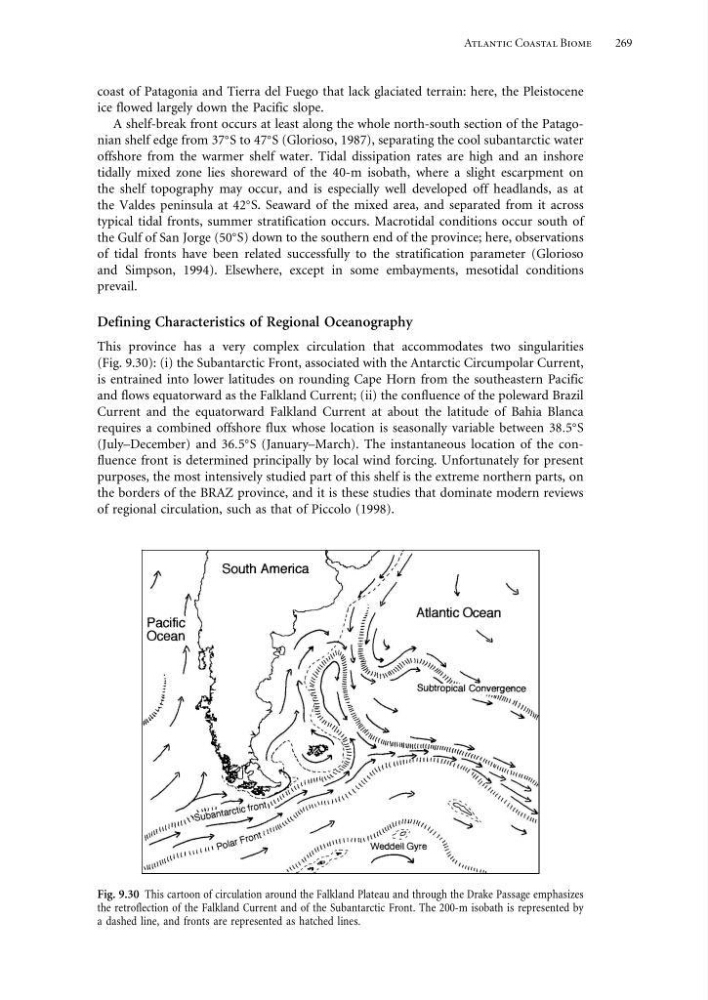
This province has a very complex circulation that accommodates two singularities
(Fig. 9.30): (i) the Subantarctic Front, associated with the Antarctic Circumpolar Current,
is entrained into lower latitudes on rounding Cape Horn from the southeastern Pacific
and flows equatorward as the Falkland Current; (ii) the confluence of the poleward Brazil
Current and the equatorward Falkland Current at about the latitude of Bahia Blanca
requires a combined offshore flux whose location is seasonally variable between 385
S
(July–December) and 365
S (January–March). The instantaneous location of the confluence front is determined principally by local wind forcing. Unfortunately for present
purposes, the most intensively studied part of this shelf is the extreme northern parts, on
the borders of the BRAZ province, and it is these studies that dominate modern reviews
of regional circulation, such as that of Piccolo (1998).
Fig. 9.30 This cartoon of circulation around the Falkland Plateau and through the Drake Passage emphasizes
the retroflection of the Falkland Current and of the Subantarctic Front. The 200-m isobath is represented by
a dashed line, and fronts are represented as hatched lines.
269
coast of Patagonia and Tierra del Fuego that lack glaciated terrain: here, the Pleistocene
ice flowed largely down the Pacific slope.
A shelf-break front occurs at least along the whole north-south section of the Patagonian shelf edge from 37
S to 47
S (Glorioso, 1987), separating the cool subantarctic water
offshore from the warmer shelf water. Tidal dissipation rates are high and an inshore
tidally mixed zone lies shoreward of the 40-m isobath, where a slight escarpment on
the shelf topography may occur, and is especially well developed off headlands, as at
the Valdes peninsula at 42
S. Seaward of the mixed area, and separated from it across
typical tidal fronts, summer stratification occurs. Macrotidal conditions occur south of
the Gulf of San Jorge (50
S) down to the southern end of the province; here, observations
of tidal fronts have been related successfully to the stratification parameter (Glorioso
and Simpson, 1994). Elsewhere, except in some embayments, mesotidal conditions
prevail.
Defining Characteristics of Regional Oceanography
This province has a very complex circulation that accommodates two singularities
(Fig. 9.30): (i) the Subantarctic Front, associated with the Antarctic Circumpolar Current,
is entrained into lower latitudes on rounding Cape Horn from the southeastern Pacific
and flows equatorward as the Falkland Current; (ii) the confluence of the poleward Brazil
Current and the equatorward Falkland Current at about the latitude of Bahia Blanca
requires a combined offshore flux whose location is seasonally variable between 385
S
(July–December) and 365
S (January–March). The instantaneous location of the confluence front is determined principally by local wind forcing. Unfortunately for present
purposes, the most intensively studied part of this shelf is the extreme northern parts, on
the borders of the BRAZ province, and it is these studies that dominate modern reviews
of regional circulation, such as that of Piccolo (1998).
Fig. 9.30 This cartoon of circulation around the Falkland Plateau and through the Drake Passage emphasizes
the retroflection of the Falkland Current and of the Subantarctic Front. The 200-m isobath is represented by
a dashed line, and fronts are represented as hatched lines.