

37
which was the same for P. glandulosa (Fig. 5.3 ). When the grass plants were clipped,
in the treatment with added nutrients, the grass total dry mass was reduced from
21.5 g/pot to 3.0 g/pot or 86 %. The grass total dry mass was 7.2 times greater without clipping. In addition, the clipping reduced the grass belowground dry mass from
9.5 g/pot to 0.5 g/pot or by 94.8 %. There was no signifi cant difference in the grass
dry mass when one P. glandulosa was planted in the same pot with the grass (data
not shown). When P. glandulosa was planted with the grass and the grass was not
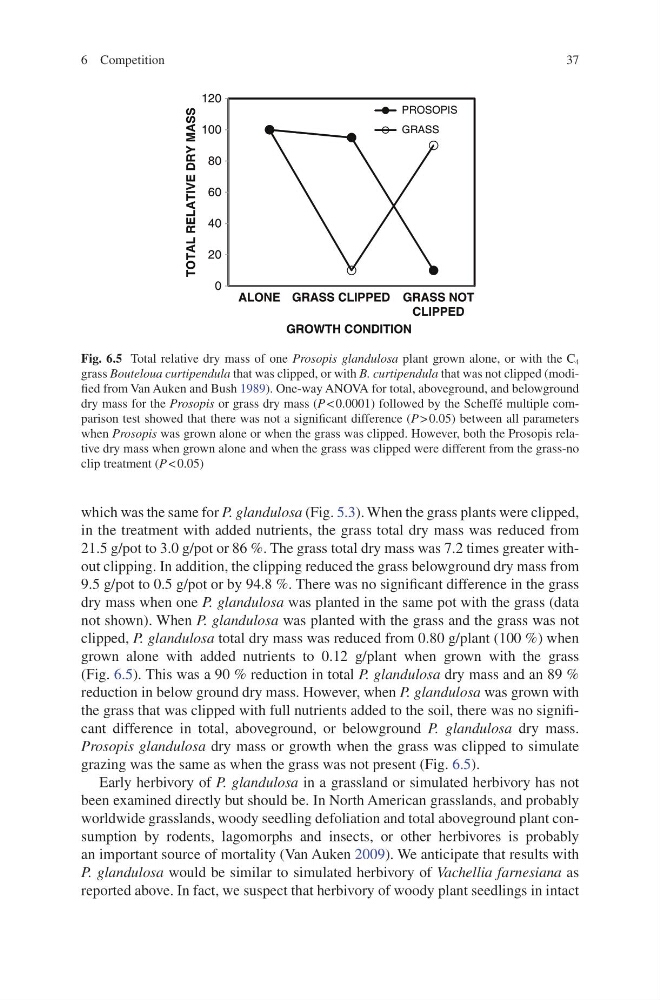
clipped, P. glandulosa total dry mass was reduced from 0.80 g/plant (100 %) when
grown alone with added nutrients to 0.12 g/plant when grown with the grass
(Fig. 6.5 ). This was a 90 % reduction in total P. glandulosa dry mass and an 89 %
reduction in below ground dry mass. However, when P. glandulosa was grown with
the grass that was clipped with full nutrients added to the soil, there was no signifi -
cant difference in total, aboveground, or belowground P. glandulosa dry mass.
Prosopis glandulosa dry mass or growth when the grass was clipped to simulate
grazing was the same as when the grass was not present (Fig. 6.5 ).
Early herbivory of P. glandulosa in a grassland or simulated herbivory has not
been examined directly but should be. In North American grasslands, and probably
worldwide grasslands, woody seedling defoliation and total aboveground plant consumption by rodents, lagomorphs and insects, or other herbivores is probably
an important source of mortality (Van Auken 2009 ). We anticipate that results with
P. glandulosa would be similar to simulated herbivory of Vachellia farnesiana as
reported above. In fact, we suspect that herbivory of woody plant seedlings in intact
0
20
40
60
80
100
120
ALONE GRASS CLIPPED GRASS NOT
CLIPPED
TOTAL RELATIVE DRY MASS
GROWTH CONDITION
PROSOPIS
GRASS
Fig. 6.5 Total relative dry mass of one Prosopis glandulosa plant grown alone, or with the C 4
grass Bouteloua curtipendula that was clipped, or with B. curtipendula that was not clipped (modifi ed from Van Auken and Bush 1989 ). One-way ANOVA for total, aboveground, and belowground
dry mass for the Prosopis or grass dry mass ( P < 0.0001) followed by the Scheffé multiple comparison test showed that there was not a signifi cant difference ( P > 0.05) between all parameters
when Prosopis was grown alone or when the grass was clipped. However, both the Prosopis relative dry mass when grown alone and when the grass was clipped were different from the grass-no
clip treatment ( P < 0.05)
6 Competition
which was the same for P. glandulosa (Fig. 5.3 ). When the grass plants were clipped,
in the treatment with added nutrients, the grass total dry mass was reduced from
21.5 g/pot to 3.0 g/pot or 86 %. The grass total dry mass was 7.2 times greater without clipping. In addition, the clipping reduced the grass belowground dry mass from
9.5 g/pot to 0.5 g/pot or by 94.8 %. There was no signifi cant difference in the grass
dry mass when one P. glandulosa was planted in the same pot with the grass (data
not shown). When P. glandulosa was planted with the grass and the grass was not
clipped, P. glandulosa total dry mass was reduced from 0.80 g/plant (100 %) when
grown alone with added nutrients to 0.12 g/plant when grown with the grass
(Fig. 6.5 ). This was a 90 % reduction in total P. glandulosa dry mass and an 89 %
reduction in below ground dry mass. However, when P. glandulosa was grown with
the grass that was clipped with full nutrients added to the soil, there was no signifi -
cant difference in total, aboveground, or belowground P. glandulosa dry mass.
Prosopis glandulosa dry mass or growth when the grass was clipped to simulate
grazing was the same as when the grass was not present (Fig. 6.5 ).
Early herbivory of P. glandulosa in a grassland or simulated herbivory has not
been examined directly but should be. In North American grasslands, and probably
worldwide grasslands, woody seedling defoliation and total aboveground plant consumption by rodents, lagomorphs and insects, or other herbivores is probably
an important source of mortality (Van Auken 2009 ). We anticipate that results with
P. glandulosa would be similar to simulated herbivory of Vachellia farnesiana as
reported above. In fact, we suspect that herbivory of woody plant seedlings in intact
0
20
40
60
80
100
120
ALONE GRASS CLIPPED GRASS NOT
CLIPPED
TOTAL RELATIVE DRY MASS
GROWTH CONDITION
PROSOPIS
GRASS
Fig. 6.5 Total relative dry mass of one Prosopis glandulosa plant grown alone, or with the C 4
grass Bouteloua curtipendula that was clipped, or with B. curtipendula that was not clipped (modifi ed from Van Auken and Bush 1989 ). One-way ANOVA for total, aboveground, and belowground
dry mass for the Prosopis or grass dry mass ( P < 0.0001) followed by the Scheffé multiple comparison test showed that there was not a signifi cant difference ( P > 0.05) between all parameters
when Prosopis was grown alone or when the grass was clipped. However, both the Prosopis relative dry mass when grown alone and when the grass was clipped were different from the grass-no
clip treatment ( P < 0.05)
6 Competition