

Références bibliographiques
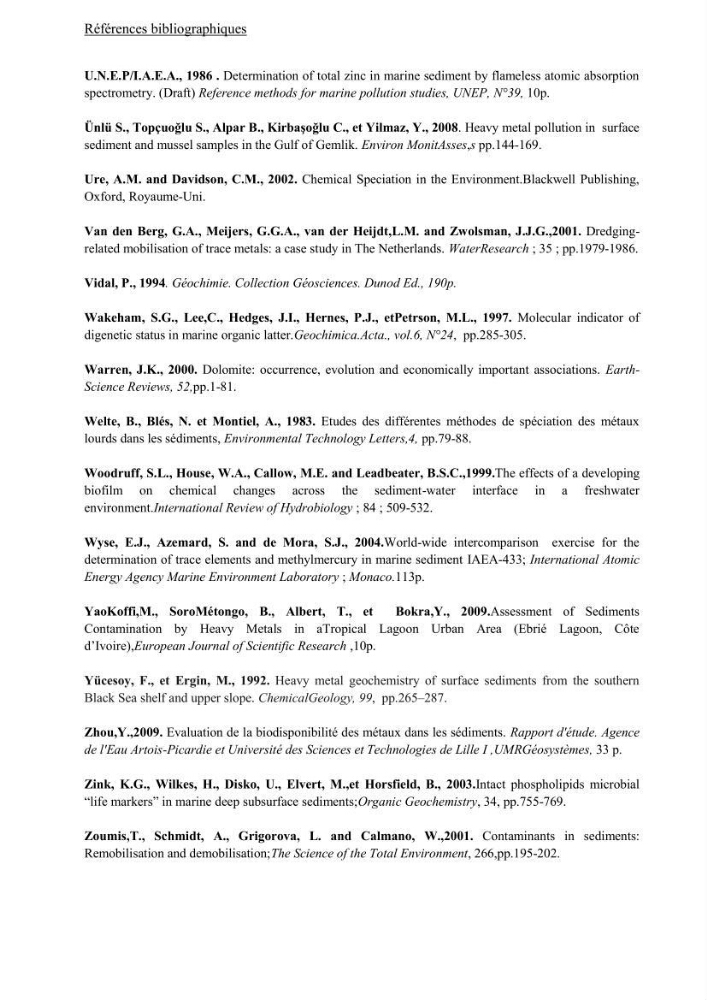
U.N.E.P/I.A.E.A., 1986 . Determination of total zinc in marine sediment by flameless atomic absorption
spectrometry. (Draft) Reference methods for marine pollution studies, UNEP, N°39, 10p.
Ünlü S., Topçuoğlu S., Alpar B., Kirbaşoğlu C., et Yilmaz, Y., 2008. Heavy metal pollution in surface
sediment and mussel samples in the Gulf of Gemlik. Environ MonitAsses,s pp.144-169.
Ure, A.M. and Davidson, C.M., 2002. Chemical Speciation in the Environment.Blackwell Publishing,
Oxford, Royaume-Uni.
Van den Berg, G.A., Meijers, G.G.A., van der Heijdt,L.M. and Zwolsman, J.J.G.,2001. Dredgingrelated mobilisation of trace metals: a case study in The Netherlands. WaterResearch ; 35 ; pp.1979-1986.
Vidal, P., 1994. Géochimie. Collection Géosciences. Dunod Ed., 190p.
Wakeham, S.G., Lee,C., Hedges, J.I., Hernes, P.J., etPetrson, M.L., 1997. Molecular indicator of
digenetic status in marine organic latter.Geochimica.Acta., vol.6, N°24, pp.285-305.
Warren, J.K., 2000. Dolomite: occurrence, evolution and economically important associations. EarthScience Reviews, 52,pp.1-81.
Welte, B., Blés, N. et Montiel, A., 1983. Etudes des différentes méthodes de spéciation des métaux
lourds dans les sédiments, Environmental Technology Letters,4, pp.79-88.
Woodruff, S.L., House, W.A., Callow, M.E. and Leadbeater, B.S.C.,1999.The effects of a developing
biofilm on chemical changes across the sediment-water interface in a freshwater
environment.International Review of Hydrobiology ; 84 ; 509-532.
Wyse, E.J., Azemard, S. and de Mora, S.J., 2004.World-wide intercomparison exercise for the
determination of trace elements and methylmercury in marine sediment IAEA-433; International Atomic
Energy Agency Marine Environment Laboratory ; Monaco.113p.
YaoKoffi,M., SoroMétongo, B., Albert, T., et
Bokra,Y., 2009.Assessment of Sediments
Contamination by Heavy Metals in aTropical Lagoon Urban Area (Ebrié Lagoon, Côte
d’Ivoire),European Journal of Scientific Research ,10p.
Yücesoy, F., et Ergin, M., 1992. Heavy metal geochemistry of surface sediments from the southern
Black Sea shelf and upper slope. ChemicalGeology, 99, pp.265–287.
Zhou,Y.,2009. Evaluation de la biodisponibilité des métaux dans les sédiments. Rapport d'étude. Agence
de l'Eau Artois-Picardie et Université des Sciences et Technologies de Lille I ,UMRGéosystèmes, 33 p.
Zink, K.G., Wilkes, H., Disko, U., Elvert, M.,et Horsfield, B., 2003.Intact phospholipids microbial
“life markers” in marine deep subsurface sediments;Organic Geochemistry, 34, pp.755-769.
Zoumis,T., Schmidt, A., Grigorova, L. and Calmano, W.,2001. Contaminants in sediments:
Remobilisation and demobilisation;The Science of the Total Environment, 266,pp.195-202.
U.N.E.P/I.A.E.A., 1986 . Determination of total zinc in marine sediment by flameless atomic absorption
spectrometry. (Draft) Reference methods for marine pollution studies, UNEP, N°39, 10p.
Ünlü S., Topçuoğlu S., Alpar B., Kirbaşoğlu C., et Yilmaz, Y., 2008. Heavy metal pollution in surface
sediment and mussel samples in the Gulf of Gemlik. Environ MonitAsses,s pp.144-169.
Ure, A.M. and Davidson, C.M., 2002. Chemical Speciation in the Environment.Blackwell Publishing,
Oxford, Royaume-Uni.
Van den Berg, G.A., Meijers, G.G.A., van der Heijdt,L.M. and Zwolsman, J.J.G.,2001. Dredgingrelated mobilisation of trace metals: a case study in The Netherlands. WaterResearch ; 35 ; pp.1979-1986.
Vidal, P., 1994. Géochimie. Collection Géosciences. Dunod Ed., 190p.
Wakeham, S.G., Lee,C., Hedges, J.I., Hernes, P.J., etPetrson, M.L., 1997. Molecular indicator of
digenetic status in marine organic latter.Geochimica.Acta., vol.6, N°24, pp.285-305.
Warren, J.K., 2000. Dolomite: occurrence, evolution and economically important associations. EarthScience Reviews, 52,pp.1-81.
Welte, B., Blés, N. et Montiel, A., 1983. Etudes des différentes méthodes de spéciation des métaux
lourds dans les sédiments, Environmental Technology Letters,4, pp.79-88.
Woodruff, S.L., House, W.A., Callow, M.E. and Leadbeater, B.S.C.,1999.The effects of a developing
biofilm on chemical changes across the sediment-water interface in a freshwater
environment.International Review of Hydrobiology ; 84 ; 509-532.
Wyse, E.J., Azemard, S. and de Mora, S.J., 2004.World-wide intercomparison exercise for the
determination of trace elements and methylmercury in marine sediment IAEA-433; International Atomic
Energy Agency Marine Environment Laboratory ; Monaco.113p.
YaoKoffi,M., SoroMétongo, B., Albert, T., et
Bokra,Y., 2009.Assessment of Sediments
Contamination by Heavy Metals in aTropical Lagoon Urban Area (Ebrié Lagoon, Côte
d’Ivoire),European Journal of Scientific Research ,10p.
Yücesoy, F., et Ergin, M., 1992. Heavy metal geochemistry of surface sediments from the southern
Black Sea shelf and upper slope. ChemicalGeology, 99, pp.265–287.
Zhou,Y.,2009. Evaluation de la biodisponibilité des métaux dans les sédiments. Rapport d'étude. Agence
de l'Eau Artois-Picardie et Université des Sciences et Technologies de Lille I ,UMRGéosystèmes, 33 p.
Zink, K.G., Wilkes, H., Disko, U., Elvert, M.,et Horsfield, B., 2003.Intact phospholipids microbial
“life markers” in marine deep subsurface sediments;Organic Geochemistry, 34, pp.755-769.
Zoumis,T., Schmidt, A., Grigorova, L. and Calmano, W.,2001. Contaminants in sediments:
Remobilisation and demobilisation;The Science of the Total Environment, 266,pp.195-202.