

(AOPs) are the best-recommended technologies for the removal of different pollutants from wastewater. The most practical AOP is the heterogeneous photocatalysis oxidation method, which has been widely
used for water cleaning because of its multiple advantages especially
the capability of carrying out under ambient conditions [9]. In fact,
there has been a growing interest in the field of hybrid catalysis materials during the last few years [10,11]. Some minerals such as sepiolite [12,13], montmorillonite [14,15], diatomite [16,17,19], kaolinite [18], and attapulgite [19] attracted the attention. These previous
studies reported the advantages of using these natural minerals as
carriers of the photocatalysts. Among various natural minerals, the
calcite attracted more scholars’ attention because of its potential applications in catalysis, drug delivery or as fillers of extended properties
[20]. Moreover, as a photocatalyst, traditional TiO 2 powder has some
disadvantages because of their low adsorption capacity, strong tendency to aggregate, poor reusability, and difficult separation from
aqueous solution [21].
Within this context, this study explores the possibility of elaborating
a new catalysis material using natural Algerian shale widely abundant
in northeastern Algeria and North Africa. This mineral mainly composed of calcite (CaCO 3 ) particles that were tested after coating with
TiO 2 using a Sol-Gel method. The elaborated materials were characterized and their photocatalytic activities were evaluated considering
their ability of tetracycline antibiotic (TC) degradation. The tetracycline molecule is taken as model of antibiotics since it is widely used
in aquaculture in particular to control furunculos in some farming fish
species [22]. Most important photocatalytic parameters of the synthesized nanocomposites were optimized.
2. Materials and methods
2.1. Raw materials and chemicals
Natural calcite was obtained from the region of Ghoufi (Province of
Batna, northeastern of Algeria). All chemicals and solvents were of
analytical grade and used as received: Tetracycline (C 22 H 24 O 8 N 2 )
(Purity = 98%, Sigma-Aldrich), Ethanol (EtOH) (absolute grade,
purity = 99.9%), Methanol (MeOH) (absolute grade, purity = 99.9%),
titanium (IV) isopropoxide Ti(OC 3 H 7 ) 4 (purity = 99%, Alfa Aezar), HCl
(Panreac), and NaOH (Biochem).
2.2. Synthesis of pure TiO 2 and CAL/TiO 2 composites
The preparation of pure TiO 2 and Calcite/TiO 2 composites was
made by the Sol-Gel method. Pure TiO 2 was prepared by dissolving Ti
(OC 3 H 7 ) 4 in MeOH/EtOH solution with molar ratio 1:1:10. The obtained solution was maintained at 75 °C for 3 h and an appropriate
amount of water was added drop by drop into the hot solution (75 °C).
After gelling, the sample was dried at 110 °C overnight and then heattreated in air for 2 h at 480 °C with a heating rate of 3 °C.min
−1 [23].
The CAL/TiO 2 composites were prepared according to the TiO 2 procedure, except that CAL and titanium isopropoxide precursor were mixed
before water adding. Typically, CAL/TiO 2 composites were prepared by
varying the amount of the TiO 2 incorporated into the raw material
(Calcite). The obtained composites were labeled as CAL5, CAL15 and
CAL30 according to their relative contents of TiO 2 (CAL/TiO 2 weight
ratios): 95/5 for CAL5, 85/15 for CAL15 and 70/30 for CAL30. Natural
calcite (labeled CAL) was taken as reference to investigate the physicochemical properties.
2.3. Technical characterizations
The crystallographic phases of the CAL/TiO 2 materials were determined using an X-ray diffractometer (BRUKER-D8 ADVANCE,
Germany) with Cu–K α radiation (λ = 0.15406 nm) under the operation
conditions of 40 kV and 40 mA; the samples were scanned at a rate of 4
˚/min. Powder samples were analyzed on Attenuated Total Reflection
Fourier Transform Infrared spectroscopy (ATR-FTIR) equipment
(ALPHA) (BRUKER, Germany) operated by Opus 6.5 software.
The specific surface area of samples was measured by N 2 adsorption
at 77 K on a constant volume adsorption apparatus (Micromeritics
ASAP 2020 Surface Area and Porosity Analyzer) and calculated using
the well kwon Brunaer–Emmett–Teller (BET) method. The pore size
distribution was determined from the adsorption isotherm using
Barret–Joyner–Halenda (BJH) method. Surface morphology and composition were analyzed by SEM-EDX Quanta 250 from the FEI company
(USA). The EDX mapping elements was also obtained using Jeol 6360
equipment. Electrochemical study was realized using Solartron SI 1287
potentiostat. The potential was given with respect to saturated calomel
electrode (SCE) as reference and platinum foil was applied as counter
electrode. The thermo-gravimetric analysis (TGA) was carried out on a
calorimeter SDT Q600 from TA Company (USA).
2.4. Photocatalytic experiment
Tetracycline stock solution (200 mg.L
−1
) was prepared weekly
using bidistilled water and stored in dark at 4 °C. All experiments were
performed in a laboratory-scale batch system at constant temperature
(25 °C). 0.1 g of elaborated composites catalysis and 200 mL of
50 mg.L
−1 TC solution were mixed in the container and put in dark
room under stirring for 60 min to reach adsorption equilibrium. UV
light was provided by 24 W UV-lamp equipped with an internal optical
filter that produces a monochromatic irradiation of 254 nm. During
photocatalytic experiments, the temperature was maintained at 25 °C
using external water cooling system around the reactor. At each 30 min,
samples (2 mL) were taken, centrifuged and analyzed with UV–vis
spectrophotometer (Jasco V-630) at 358 nm. Total organic carbon
(TOC) was measured using InnovOx TOC-V CPH analyzer (Japan).
3. Results and discussion
3.1. Structural properties of CAL/TiO 2 systems
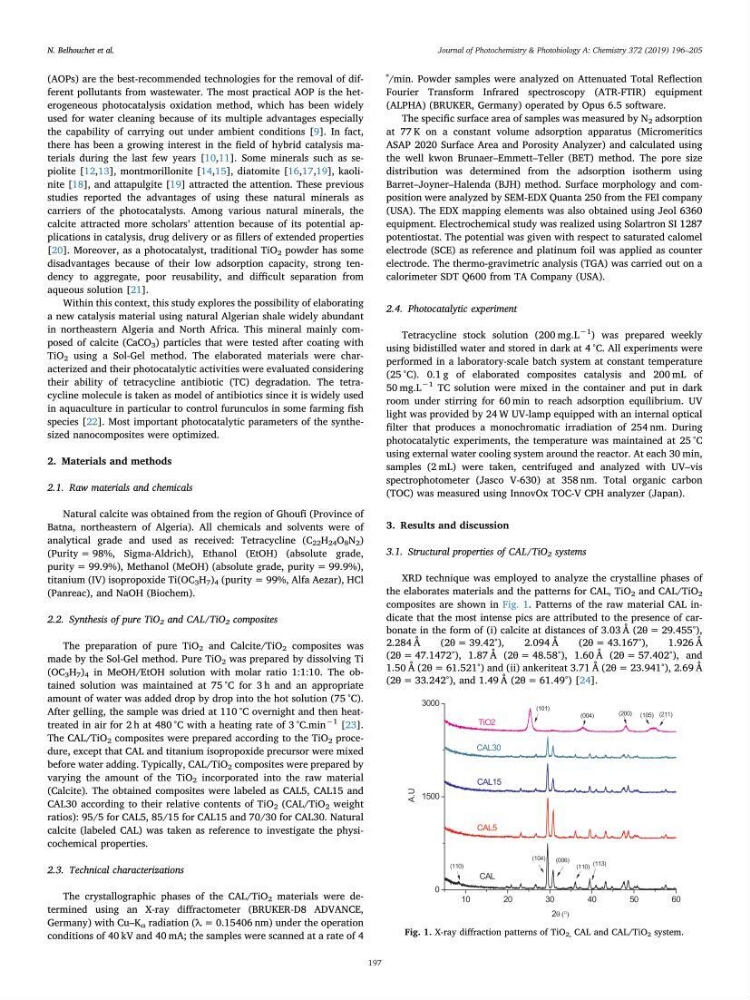
XRD technique was employed to analyze the crystalline phases of
the elaborates materials and the patterns for CAL, TiO 2 and CAL/TiO 2
composites are shown in Fig. 1. Patterns of the raw material CAL indicate that the most intense pics are attributed to the presence of carbonate in the form of (i) calcite at distances of 3.03 Å (2θ = 29.455°),
2.284 Å
(2θ = 39.42°),
2.094 Å
(2θ = 43.167°),
1.926 Å
(2θ = 47.1472°), 1.87 Å (2θ = 48.58°), 1.60 Å (2θ = 57.402°), and
1.50 Å (2θ = 61.521°) and (ii) ankeriteat 3.71 Å (2θ = 23.941°), 2.69 Å
(2θ = 33.242°), and 1.49 Å (2θ = 61.49°) [24].
Fig. 1. X-ray diffraction patterns of TiO 2, CAL and CAL/TiO 2 system.
N. Belhouchet et al.
Journal of Photochemistry & Photobiology A: Chemistry 372 (2019) 196–205
197
used for water cleaning because of its multiple advantages especially
the capability of carrying out under ambient conditions [9]. In fact,
there has been a growing interest in the field of hybrid catalysis materials during the last few years [10,11]. Some minerals such as sepiolite [12,13], montmorillonite [14,15], diatomite [16,17,19], kaolinite [18], and attapulgite [19] attracted the attention. These previous
studies reported the advantages of using these natural minerals as
carriers of the photocatalysts. Among various natural minerals, the
calcite attracted more scholars’ attention because of its potential applications in catalysis, drug delivery or as fillers of extended properties
[20]. Moreover, as a photocatalyst, traditional TiO 2 powder has some
disadvantages because of their low adsorption capacity, strong tendency to aggregate, poor reusability, and difficult separation from
aqueous solution [21].
Within this context, this study explores the possibility of elaborating
a new catalysis material using natural Algerian shale widely abundant
in northeastern Algeria and North Africa. This mineral mainly composed of calcite (CaCO 3 ) particles that were tested after coating with
TiO 2 using a Sol-Gel method. The elaborated materials were characterized and their photocatalytic activities were evaluated considering
their ability of tetracycline antibiotic (TC) degradation. The tetracycline molecule is taken as model of antibiotics since it is widely used
in aquaculture in particular to control furunculos in some farming fish
species [22]. Most important photocatalytic parameters of the synthesized nanocomposites were optimized.
2. Materials and methods
2.1. Raw materials and chemicals
Natural calcite was obtained from the region of Ghoufi (Province of
Batna, northeastern of Algeria). All chemicals and solvents were of
analytical grade and used as received: Tetracycline (C 22 H 24 O 8 N 2 )
(Purity = 98%, Sigma-Aldrich), Ethanol (EtOH) (absolute grade,
purity = 99.9%), Methanol (MeOH) (absolute grade, purity = 99.9%),
titanium (IV) isopropoxide Ti(OC 3 H 7 ) 4 (purity = 99%, Alfa Aezar), HCl
(Panreac), and NaOH (Biochem).
2.2. Synthesis of pure TiO 2 and CAL/TiO 2 composites
The preparation of pure TiO 2 and Calcite/TiO 2 composites was
made by the Sol-Gel method. Pure TiO 2 was prepared by dissolving Ti
(OC 3 H 7 ) 4 in MeOH/EtOH solution with molar ratio 1:1:10. The obtained solution was maintained at 75 °C for 3 h and an appropriate
amount of water was added drop by drop into the hot solution (75 °C).
After gelling, the sample was dried at 110 °C overnight and then heattreated in air for 2 h at 480 °C with a heating rate of 3 °C.min
−1 [23].
The CAL/TiO 2 composites were prepared according to the TiO 2 procedure, except that CAL and titanium isopropoxide precursor were mixed
before water adding. Typically, CAL/TiO 2 composites were prepared by
varying the amount of the TiO 2 incorporated into the raw material
(Calcite). The obtained composites were labeled as CAL5, CAL15 and
CAL30 according to their relative contents of TiO 2 (CAL/TiO 2 weight
ratios): 95/5 for CAL5, 85/15 for CAL15 and 70/30 for CAL30. Natural
calcite (labeled CAL) was taken as reference to investigate the physicochemical properties.
2.3. Technical characterizations
The crystallographic phases of the CAL/TiO 2 materials were determined using an X-ray diffractometer (BRUKER-D8 ADVANCE,
Germany) with Cu–K α radiation (λ = 0.15406 nm) under the operation
conditions of 40 kV and 40 mA; the samples were scanned at a rate of 4
˚/min. Powder samples were analyzed on Attenuated Total Reflection
Fourier Transform Infrared spectroscopy (ATR-FTIR) equipment
(ALPHA) (BRUKER, Germany) operated by Opus 6.5 software.
The specific surface area of samples was measured by N 2 adsorption
at 77 K on a constant volume adsorption apparatus (Micromeritics
ASAP 2020 Surface Area and Porosity Analyzer) and calculated using
the well kwon Brunaer–Emmett–Teller (BET) method. The pore size
distribution was determined from the adsorption isotherm using
Barret–Joyner–Halenda (BJH) method. Surface morphology and composition were analyzed by SEM-EDX Quanta 250 from the FEI company
(USA). The EDX mapping elements was also obtained using Jeol 6360
equipment. Electrochemical study was realized using Solartron SI 1287
potentiostat. The potential was given with respect to saturated calomel
electrode (SCE) as reference and platinum foil was applied as counter
electrode. The thermo-gravimetric analysis (TGA) was carried out on a
calorimeter SDT Q600 from TA Company (USA).
2.4. Photocatalytic experiment
Tetracycline stock solution (200 mg.L
−1
) was prepared weekly
using bidistilled water and stored in dark at 4 °C. All experiments were
performed in a laboratory-scale batch system at constant temperature
(25 °C). 0.1 g of elaborated composites catalysis and 200 mL of
50 mg.L
−1 TC solution were mixed in the container and put in dark
room under stirring for 60 min to reach adsorption equilibrium. UV
light was provided by 24 W UV-lamp equipped with an internal optical
filter that produces a monochromatic irradiation of 254 nm. During
photocatalytic experiments, the temperature was maintained at 25 °C
using external water cooling system around the reactor. At each 30 min,
samples (2 mL) were taken, centrifuged and analyzed with UV–vis
spectrophotometer (Jasco V-630) at 358 nm. Total organic carbon
(TOC) was measured using InnovOx TOC-V CPH analyzer (Japan).
3. Results and discussion
3.1. Structural properties of CAL/TiO 2 systems
XRD technique was employed to analyze the crystalline phases of
the elaborates materials and the patterns for CAL, TiO 2 and CAL/TiO 2
composites are shown in Fig. 1. Patterns of the raw material CAL indicate that the most intense pics are attributed to the presence of carbonate in the form of (i) calcite at distances of 3.03 Å (2θ = 29.455°),
2.284 Å
(2θ = 39.42°),
2.094 Å
(2θ = 43.167°),
1.926 Å
(2θ = 47.1472°), 1.87 Å (2θ = 48.58°), 1.60 Å (2θ = 57.402°), and
1.50 Å (2θ = 61.521°) and (ii) ankeriteat 3.71 Å (2θ = 23.941°), 2.69 Å
(2θ = 33.242°), and 1.49 Å (2θ = 61.49°) [24].
Fig. 1. X-ray diffraction patterns of TiO 2, CAL and CAL/TiO 2 system.
N. Belhouchet et al.
Journal of Photochemistry & Photobiology A: Chemistry 372 (2019) 196–205
197