

78
2.3. Conduct / Activity:
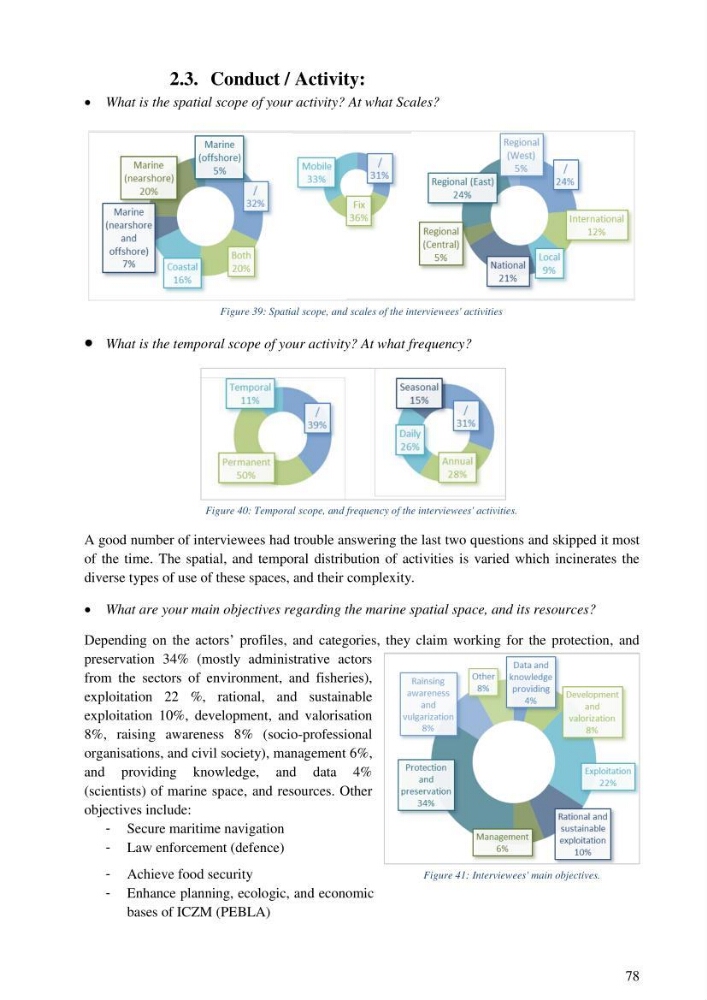
What is the spatial scope of your activity? At what Scales?
What is the temporal scope of your activity? At what frequency?
A good number of interviewees had trouble answering the last two questions and skipped it most
of the time. The spatial, and temporal distribution of activities is varied which incinerates the
diverse types of use of these spaces, and their complexity.
What are your main objectives regarding the marine spatial space, and its resources?
Depending on the actors‟ profiles, and categories, they claim working for the protection, and
preservation 34% (mostly administrative actors
from the sectors of environment, and fisheries),
exploitation 22 %, rational, and sustainable
exploitation 10%, development, and valorisation
8%, raising awareness 8% (socio-professional
organisations, and civil society), management 6%,
and providing knowledge, and data 4%
(scientists) of marine space, and resources. Other
objectives include:
- Secure maritime navigation
- Law enforcement (defence)
- Achieve food security
- Enhance planning, ecologic, and economic
bases of ICZM (PEBLA)
Figure 39: Spatial scope, and scales of the interviewees' activities
Figure 40: Temporal scope, and frequency of the interviewees' activities.
Figure 41: Interviewees' main objectives.
2.3. Conduct / Activity:
What is the spatial scope of your activity? At what Scales?
What is the temporal scope of your activity? At what frequency?
A good number of interviewees had trouble answering the last two questions and skipped it most
of the time. The spatial, and temporal distribution of activities is varied which incinerates the
diverse types of use of these spaces, and their complexity.
What are your main objectives regarding the marine spatial space, and its resources?
Depending on the actors‟ profiles, and categories, they claim working for the protection, and
preservation 34% (mostly administrative actors
from the sectors of environment, and fisheries),
exploitation 22 %, rational, and sustainable
exploitation 10%, development, and valorisation
8%, raising awareness 8% (socio-professional
organisations, and civil society), management 6%,
and providing knowledge, and data 4%
(scientists) of marine space, and resources. Other
objectives include:
- Secure maritime navigation
- Law enforcement (defence)
- Achieve food security
- Enhance planning, ecologic, and economic
bases of ICZM (PEBLA)
Figure 39: Spatial scope, and scales of the interviewees' activities
Figure 40: Temporal scope, and frequency of the interviewees' activities.
Figure 41: Interviewees' main objectives.