

50
The actors who have the highest influence on the rest of the system are the same in theory, and on the
field (real MSP), counting Medias (M), Ministries in charge of territorial planning (MICLAT) fisheries,
and aquaculture (MFPP), environment (ME), and the coastguard service (NCGS). The ministry of
finances (MF) also appears to be highly influent in real MSP. Two actors are the least influent in real,
and theoretical MSP: recreational fishermen (RF), and nautical activities (NA) while two others have
very low influences in real MSP: the national coastal commission of Annaba (NCCA), and small trades
(ST).
Seventeen actors are very dependent on others in both theoretical and real MSP studies but in different
orders. With the most dependent ones being commonly fishermen (F), and NCAA followed by fishery
operators (ST, TFO, and SFO) port facilities (FPC, MUPA, FPE, FPS, FSA), administrative actors
(MFPP, ME, EDA, EDS, DFAA), municipalities of the Edough region (MER), and environment
protection associations (EPA). The least dependent actors are NCGS, M, fisheries, and aquaculture
training centres (FATC), department of training, and vocational education (DTVE), and NA in both
systems but NA‟s dependence increases in real MSP. Most differences are positive meaning that the
majority of actors (34) are more dependent, and influent in theory than in real MSP except the ministry
of tourism, and handicrafts (MTH) who‟s influence is bigger in reality, and NA, NCFA, M who are
more dependent in real MSP than in theory, in that order. Also, two actors: universities (OU), and
NCGS have the same dependences in theory, and real MSP. The most relevant differences are NCAA,
F, and MER‟s influences along with NCAA, fishery operators, and port facilities‟ dependences which
are higher in theory than in reality.
2.1.2. MDII competitiveness
2.1.2.1. MDII competitiveness vector
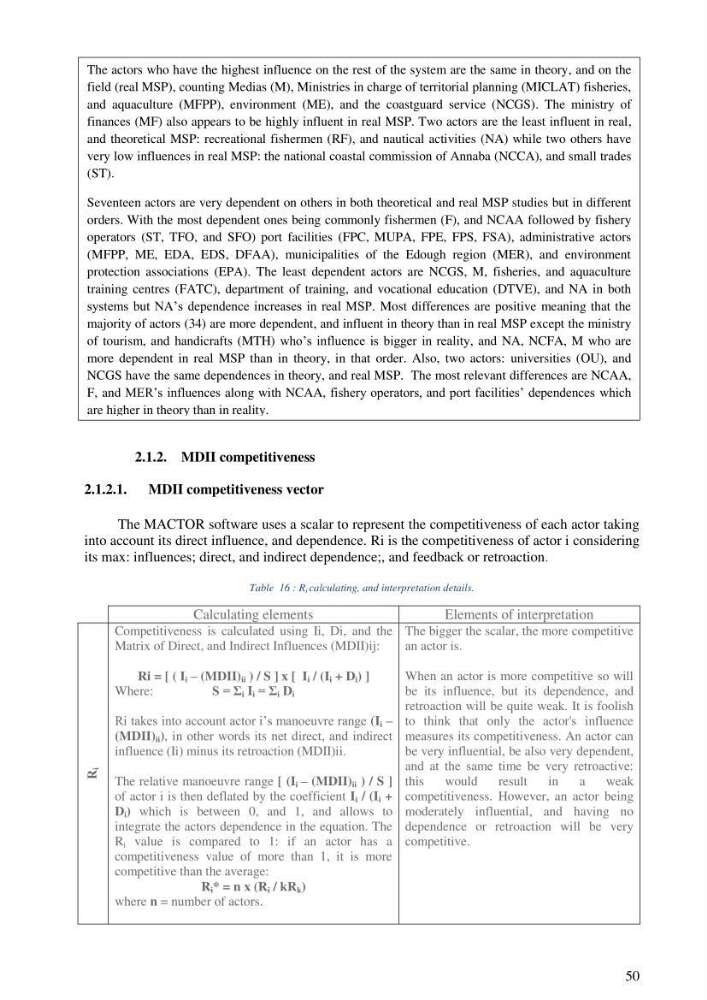
The MACTOR software uses a scalar to represent the competitiveness of each actor taking
into account its direct influence, and dependence. Ri is the competitiveness of actor i considering
its max: influences; direct, and indirect dependence;, and feedback or retroaction.
Table 16 : R i calculating, and interpretation details.
Calculating elements
Elements of interpretation
R i
Competitiveness is calculated using Ii, Di, and the
Matrix of Direct, and Indirect Influences (MDII)ij:
Ri = [ ( I i – (MDII) ii ) / S ] x [ I i / (I i + D i ) ]
Where:
S = Σ i I i = Σ i D i
Ri takes into account actor i‟s manoeuvre range (I i –
(MDII) ii ), in other words its net direct, and indirect
influence (Ii) minus its retroaction (MDII)ii.
The relative manoeuvre range [ (I i – (MDII) ii ) / S ]
of actor i is then deflated by the coefficient I i / (I i +
D i ) which is between 0, and 1, and allows to
integrate the actors dependence in the equation. The
R i value is compared to 1: if an actor has a
competitiveness value of more than 1, it is more
competitive than the average:
R i * = n x (R i / kR k )
where n = number of actors.
The bigger the scalar, the more competitive
an actor is.
When an actor is more competitive so will
be its influence, but its dependence, and
retroaction will be quite weak. It is foolish
to think that only the actor's influence
measures its competitiveness. An actor can
be very influential, be also very dependent,
and at the same time be very retroactive:
this
would
result
in
a
weak
competitiveness. However, an actor being
moderately influential, and having no
dependence or retroaction will be very
competitive.
The actors who have the highest influence on the rest of the system are the same in theory, and on the
field (real MSP), counting Medias (M), Ministries in charge of territorial planning (MICLAT) fisheries,
and aquaculture (MFPP), environment (ME), and the coastguard service (NCGS). The ministry of
finances (MF) also appears to be highly influent in real MSP. Two actors are the least influent in real,
and theoretical MSP: recreational fishermen (RF), and nautical activities (NA) while two others have
very low influences in real MSP: the national coastal commission of Annaba (NCCA), and small trades
(ST).
Seventeen actors are very dependent on others in both theoretical and real MSP studies but in different
orders. With the most dependent ones being commonly fishermen (F), and NCAA followed by fishery
operators (ST, TFO, and SFO) port facilities (FPC, MUPA, FPE, FPS, FSA), administrative actors
(MFPP, ME, EDA, EDS, DFAA), municipalities of the Edough region (MER), and environment
protection associations (EPA). The least dependent actors are NCGS, M, fisheries, and aquaculture
training centres (FATC), department of training, and vocational education (DTVE), and NA in both
systems but NA‟s dependence increases in real MSP. Most differences are positive meaning that the
majority of actors (34) are more dependent, and influent in theory than in real MSP except the ministry
of tourism, and handicrafts (MTH) who‟s influence is bigger in reality, and NA, NCFA, M who are
more dependent in real MSP than in theory, in that order. Also, two actors: universities (OU), and
NCGS have the same dependences in theory, and real MSP. The most relevant differences are NCAA,
F, and MER‟s influences along with NCAA, fishery operators, and port facilities‟ dependences which
are higher in theory than in reality.
2.1.2. MDII competitiveness
2.1.2.1. MDII competitiveness vector
The MACTOR software uses a scalar to represent the competitiveness of each actor taking
into account its direct influence, and dependence. Ri is the competitiveness of actor i considering
its max: influences; direct, and indirect dependence;, and feedback or retroaction.
Table 16 : R i calculating, and interpretation details.
Calculating elements
Elements of interpretation
R i
Competitiveness is calculated using Ii, Di, and the
Matrix of Direct, and Indirect Influences (MDII)ij:
Ri = [ ( I i – (MDII) ii ) / S ] x [ I i / (I i + D i ) ]
Where:
S = Σ i I i = Σ i D i
Ri takes into account actor i‟s manoeuvre range (I i –
(MDII) ii ), in other words its net direct, and indirect
influence (Ii) minus its retroaction (MDII)ii.
The relative manoeuvre range [ (I i – (MDII) ii ) / S ]
of actor i is then deflated by the coefficient I i / (I i +
D i ) which is between 0, and 1, and allows to
integrate the actors dependence in the equation. The
R i value is compared to 1: if an actor has a
competitiveness value of more than 1, it is more
competitive than the average:
R i * = n x (R i / kR k )
where n = number of actors.
The bigger the scalar, the more competitive
an actor is.
When an actor is more competitive so will
be its influence, but its dependence, and
retroaction will be quite weak. It is foolish
to think that only the actor's influence
measures its competitiveness. An actor can
be very influential, be also very dependent,
and at the same time be very retroactive:
this
would
result
in
a
weak
competitiveness. However, an actor being
moderately influential, and having no
dependence or retroaction will be very
competitive.