

45
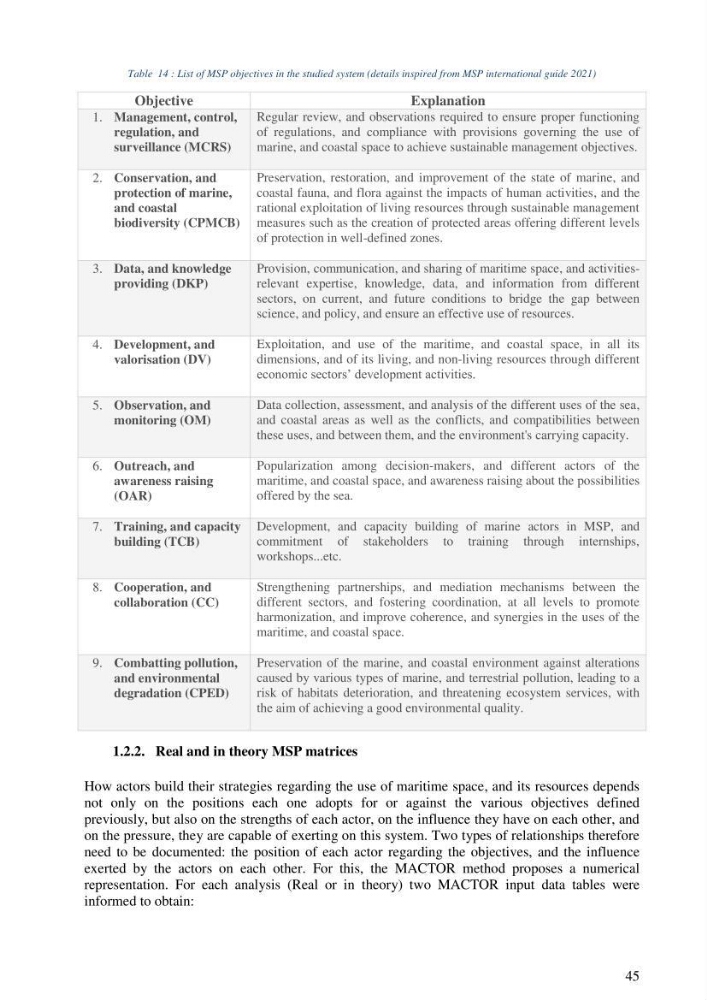
Table 14 : List of MSP objectives in the studied system (details inspired from MSP international guide 2021)
Objective
Explanation
1. Management, control,
regulation, and
surveillance (MCRS)
Regular review, and observations required to ensure proper functioning
of regulations, and compliance with provisions governing the use of
marine, and coastal space to achieve sustainable management objectives.
2. Conservation, and
protection of marine,
and coastal
biodiversity (CPMCB)
Preservation, restoration, and improvement of the state of marine, and
coastal fauna, and flora against the impacts of human activities, and the
rational exploitation of living resources through sustainable management
measures such as the creation of protected areas offering different levels
of protection in well-defined zones.
3. Data, and knowledge
providing (DKP)
Provision, communication, and sharing of maritime space, and activitiesrelevant expertise, knowledge, data, and information from different
sectors, on current, and future conditions to bridge the gap between
science, and policy, and ensure an effective use of resources.
4. Development, and
valorisation (DV)
Exploitation, and use of the maritime, and coastal space, in all its
dimensions, and of its living, and non-living resources through different
economic sectors‟ development activities.
5. Observation, and
monitoring (OM)
Data collection, assessment, and analysis of the different uses of the sea,
and coastal areas as well as the conflicts, and compatibilities between
these uses, and between them, and the environment's carrying capacity.
6. Outreach, and
awareness raising
(OAR)
Popularization among decision-makers, and different actors of the
maritime, and coastal space, and awareness raising about the possibilities
offered by the sea.
7. Training, and capacity
building (TCB)
Development, and capacity building of marine actors in MSP, and
commitment of stakeholders to training through internships,
workshops...etc.
8. Cooperation, and
collaboration (CC)
Strengthening partnerships, and mediation mechanisms between the
different sectors, and fostering coordination, at all levels to promote
harmonization, and improve coherence, and synergies in the uses of the
maritime, and coastal space.
9. Combatting pollution,
and environmental
degradation (CPED)
Preservation of the marine, and coastal environment against alterations
caused by various types of marine, and terrestrial pollution, leading to a
risk of habitats deterioration, and threatening ecosystem services, with
the aim of achieving a good environmental quality.
1.2.2. Real and in theory MSP matrices
How actors build their strategies regarding the use of maritime space, and its resources depends
not only on the positions each one adopts for or against the various objectives defined
previously, but also on the strengths of each actor, on the influence they have on each other, and
on the pressure, they are capable of exerting on this system. Two types of relationships therefore
need to be documented: the position of each actor regarding the objectives, and the influence
exerted by the actors on each other. For this, the MACTOR method proposes a numerical
representation. For each analysis (Real or in theory) two MACTOR input data tables were
informed to obtain:
Table 14 : List of MSP objectives in the studied system (details inspired from MSP international guide 2021)
Objective
Explanation
1. Management, control,
regulation, and
surveillance (MCRS)
Regular review, and observations required to ensure proper functioning
of regulations, and compliance with provisions governing the use of
marine, and coastal space to achieve sustainable management objectives.
2. Conservation, and
protection of marine,
and coastal
biodiversity (CPMCB)
Preservation, restoration, and improvement of the state of marine, and
coastal fauna, and flora against the impacts of human activities, and the
rational exploitation of living resources through sustainable management
measures such as the creation of protected areas offering different levels
of protection in well-defined zones.
3. Data, and knowledge
providing (DKP)
Provision, communication, and sharing of maritime space, and activitiesrelevant expertise, knowledge, data, and information from different
sectors, on current, and future conditions to bridge the gap between
science, and policy, and ensure an effective use of resources.
4. Development, and
valorisation (DV)
Exploitation, and use of the maritime, and coastal space, in all its
dimensions, and of its living, and non-living resources through different
economic sectors‟ development activities.
5. Observation, and
monitoring (OM)
Data collection, assessment, and analysis of the different uses of the sea,
and coastal areas as well as the conflicts, and compatibilities between
these uses, and between them, and the environment's carrying capacity.
6. Outreach, and
awareness raising
(OAR)
Popularization among decision-makers, and different actors of the
maritime, and coastal space, and awareness raising about the possibilities
offered by the sea.
7. Training, and capacity
building (TCB)
Development, and capacity building of marine actors in MSP, and
commitment of stakeholders to training through internships,
workshops...etc.
8. Cooperation, and
collaboration (CC)
Strengthening partnerships, and mediation mechanisms between the
different sectors, and fostering coordination, at all levels to promote
harmonization, and improve coherence, and synergies in the uses of the
maritime, and coastal space.
9. Combatting pollution,
and environmental
degradation (CPED)
Preservation of the marine, and coastal environment against alterations
caused by various types of marine, and terrestrial pollution, leading to a
risk of habitats deterioration, and threatening ecosystem services, with
the aim of achieving a good environmental quality.
1.2.2. Real and in theory MSP matrices
How actors build their strategies regarding the use of maritime space, and its resources depends
not only on the positions each one adopts for or against the various objectives defined
previously, but also on the strengths of each actor, on the influence they have on each other, and
on the pressure, they are capable of exerting on this system. Two types of relationships therefore
need to be documented: the position of each actor regarding the objectives, and the influence
exerted by the actors on each other. For this, the MACTOR method proposes a numerical
representation. For each analysis (Real or in theory) two MACTOR input data tables were
informed to obtain: