

26
This chapter provides an overview of the methodological approach explaining the study‟s logical
framework, problematic, and scales. The study area is also presented here. Details of the
methodologies used to collect data, analyse, and interpret information will be separately
illustrated in each of the 4 following chapters with their respective appendices.
1. Logical framework:
To properly conduct this study, we organised our reflexion on the subject starting from concrete
problems that are observed in the Algerian marine and coastal environment. According to recent
studies, this environment witnesses a widespread degradation of marine habitats, depletion of
resources, and loss of biodiversity due to pressures caused by the unbalanced, and increasing
human use of maritime space, and its resources, marine pollution, impacts of climate change, in
addition to the fact that maritime literacy in the country is not highly regarded. These said
“problems” are directly linked to two major issues: marine biodiversity conservation and
achieving a good ecological status in this distinctive environment along with other socioeconomic issues.
In a sustainable development context, the challenge to deal with these issues would be met by
moving towards the achievement of sustainable development goals such as SDG 14: life below
water, and 12: responsible consumption, and production.
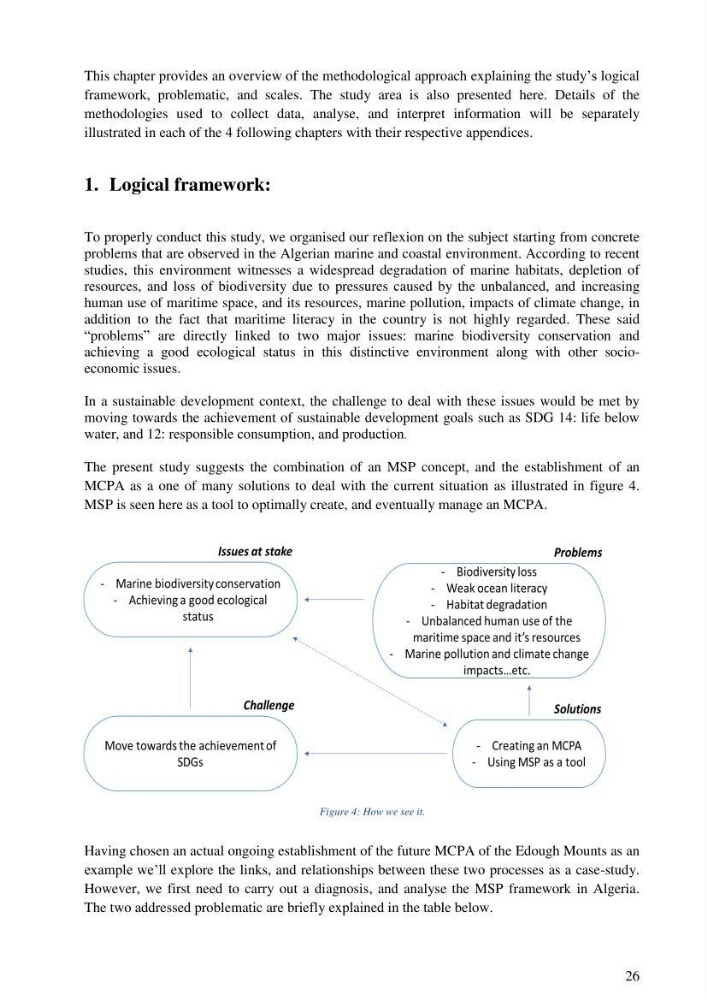
The present study suggests the combination of an MSP concept, and the establishment of an
MCPA as a one of many solutions to deal with the current situation as illustrated in figure 4.
MSP is seen here as a tool to optimally create, and eventually manage an MCPA.
Having chosen an actual ongoing establishment of the future MCPA of the Edough Mounts as an
example we‟ll explore the links, and relationships between these two processes as a case-study.
However, we first need to carry out a diagnosis, and analyse the MSP framework in Algeria.
The two addressed problematic are briefly explained in the table below.
Figure 4: How we see it.
This chapter provides an overview of the methodological approach explaining the study‟s logical
framework, problematic, and scales. The study area is also presented here. Details of the
methodologies used to collect data, analyse, and interpret information will be separately
illustrated in each of the 4 following chapters with their respective appendices.
1. Logical framework:
To properly conduct this study, we organised our reflexion on the subject starting from concrete
problems that are observed in the Algerian marine and coastal environment. According to recent
studies, this environment witnesses a widespread degradation of marine habitats, depletion of
resources, and loss of biodiversity due to pressures caused by the unbalanced, and increasing
human use of maritime space, and its resources, marine pollution, impacts of climate change, in
addition to the fact that maritime literacy in the country is not highly regarded. These said
“problems” are directly linked to two major issues: marine biodiversity conservation and
achieving a good ecological status in this distinctive environment along with other socioeconomic issues.
In a sustainable development context, the challenge to deal with these issues would be met by
moving towards the achievement of sustainable development goals such as SDG 14: life below
water, and 12: responsible consumption, and production.
The present study suggests the combination of an MSP concept, and the establishment of an
MCPA as a one of many solutions to deal with the current situation as illustrated in figure 4.
MSP is seen here as a tool to optimally create, and eventually manage an MCPA.
Having chosen an actual ongoing establishment of the future MCPA of the Edough Mounts as an
example we‟ll explore the links, and relationships between these two processes as a case-study.
However, we first need to carry out a diagnosis, and analyse the MSP framework in Algeria.
The two addressed problematic are briefly explained in the table below.
Figure 4: How we see it.