

77
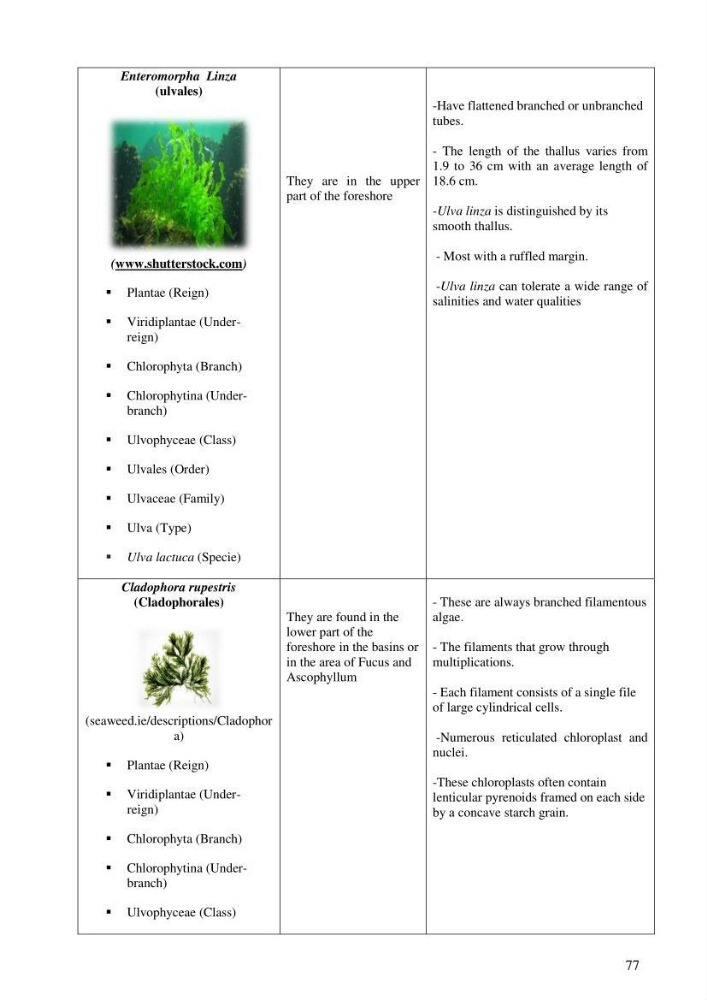
Enteromorpha Linza
(ulvales)
(www.shutterstock.com)
Plantae (Reign)
Viridiplantae (Underreign)
Chlorophyta (Branch)
Chlorophytina (Underbranch)
Ulvophyceae (Class)
Ulvales (Order)
Ulvaceae (Family)
Ulva (Type)
Ulva lactuca (Specie)
They are in the upper
part of the foreshore
-Have flattened branched or unbranched
tubes.
- The length of the thallus varies from
1.9 to 36 cm with an average length of
18.6 cm.
-Ulva linza is distinguished by its
smooth thallus.
- Most with a ruffled margin.
-Ulva linza can tolerate a wide range of
salinities and water qualities
Cladophora rupestris
(Cladophorales)
(seaweed.ie/descriptions/Cladophor
a)
Plantae (Reign)
Viridiplantae (Underreign)
Chlorophyta (Branch)
Chlorophytina (Underbranch)
Ulvophyceae (Class)
They are found in the
lower part of the
foreshore in the basins or
in the area of Fucus and
Ascophyllum
- These are always branched filamentous
algae.
- The filaments that grow through
multiplications.
- Each filament consists of a single file
of large cylindrical cells.
-Numerous reticulated chloroplast and
nuclei.
-These chloroplasts often contain
lenticular pyrenoids framed on each side
by a concave starch grain.
Enteromorpha Linza
(ulvales)
(www.shutterstock.com)
Plantae (Reign)
Viridiplantae (Underreign)
Chlorophyta (Branch)
Chlorophytina (Underbranch)
Ulvophyceae (Class)
Ulvales (Order)
Ulvaceae (Family)
Ulva (Type)
Ulva lactuca (Specie)
They are in the upper
part of the foreshore
-Have flattened branched or unbranched
tubes.
- The length of the thallus varies from
1.9 to 36 cm with an average length of
18.6 cm.
-Ulva linza is distinguished by its
smooth thallus.
- Most with a ruffled margin.
-Ulva linza can tolerate a wide range of
salinities and water qualities
Cladophora rupestris
(Cladophorales)
(seaweed.ie/descriptions/Cladophor
a)
Plantae (Reign)
Viridiplantae (Underreign)
Chlorophyta (Branch)
Chlorophytina (Underbranch)
Ulvophyceae (Class)
They are found in the
lower part of the
foreshore in the basins or
in the area of Fucus and
Ascophyllum
- These are always branched filamentous
algae.
- The filaments that grow through
multiplications.
- Each filament consists of a single file
of large cylindrical cells.
-Numerous reticulated chloroplast and
nuclei.
-These chloroplasts often contain
lenticular pyrenoids framed on each side
by a concave starch grain.