

II. ENVIRONMENTAL IMPACTS AND RISKS EVALUATION OF OFFSHORE DRILLING
_____________________________________________________________________________
66
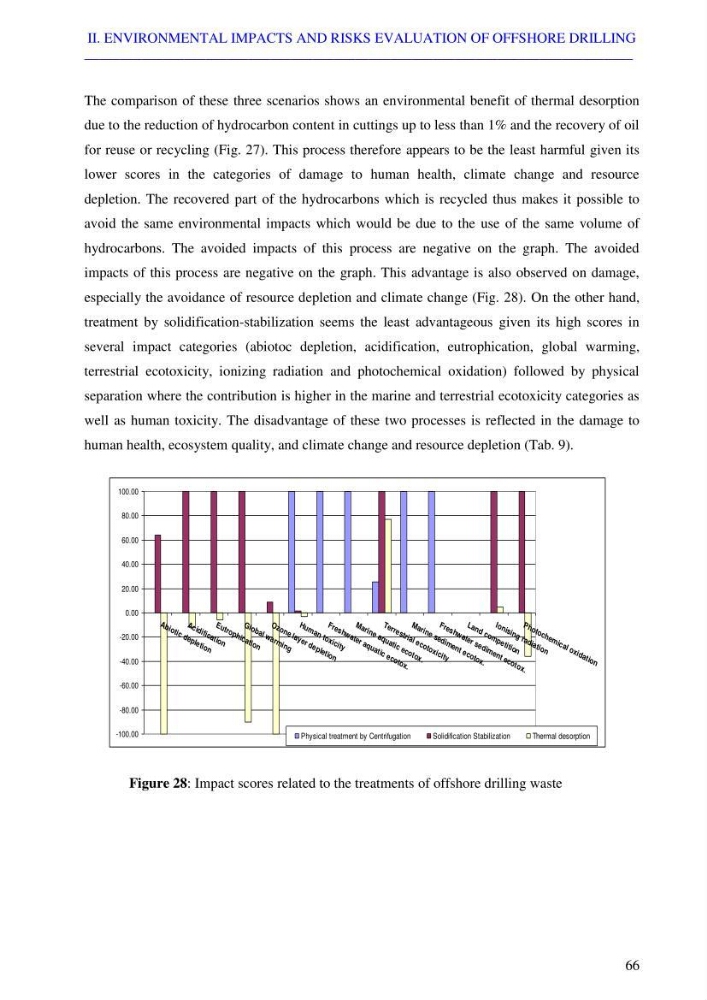
The comparison of these three scenarios shows an environmental benefit of thermal desorption
due to the reduction of hydrocarbon content in cuttings up to less than 1% and the recovery of oil
for reuse or recycling (Fig. 27). This process therefore appears to be the least harmful given its
lower scores in the categories of damage to human health, climate change and resource
depletion. The recovered part of the hydrocarbons which is recycled thus makes it possible to
avoid the same environmental impacts which would be due to the use of the same volume of
hydrocarbons. The avoided impacts of this process are negative on the graph. The avoided
impacts of this process are negative on the graph. This advantage is also observed on damage,
especially the avoidance of resource depletion and climate change (Fig. 28). On the other hand,
treatment by solidification-stabilization seems the least advantageous given its high scores in
several impact categories (abiotoc depletion, acidification, eutrophication, global warming,
terrestrial ecotoxicity, ionizing radiation and photochemical oxidation) followed by physical
separation where the contribution is higher in the marine and terrestrial ecotoxicity categories as
well as human toxicity. The disadvantage of these two processes is reflected in the damage to
human health, ecosystem quality, and climate change and resource depletion (Tab. 9).
Figure 28: Impact scores related to the treatments of offshore drilling waste
-100.00
-80.00
-60.00
-40.00
-20.00
0.00
20.00
40.00
60.00
80.00
100.00
A b io ti c d e p le ti o n
A c id if ic a t io n
E u tr o p h ic a ti o n
G lo b a l w a r m in g
O z o n e la y e r d e p le t io n
H u m a n to x ic it y
F r e s h w a te r a q u a t ic e c o to x .
M a r in e a q u a ti c e c o t o x .
T e r r e s tr ia l e c o to x ic it y
M a r in e s e d im e n t e c o to x .
F r e s h w a te r s e d im e n t e c o t o x .
L a n d c o m p e ti ti o n
Io n is in g r a d ia ti o n
P h o to c h e m ic a l o x id a t io n
Physical treatment by Centrifugation
Solidification Stabilization
Thermal desorption
_____________________________________________________________________________
66
The comparison of these three scenarios shows an environmental benefit of thermal desorption
due to the reduction of hydrocarbon content in cuttings up to less than 1% and the recovery of oil
for reuse or recycling (Fig. 27). This process therefore appears to be the least harmful given its
lower scores in the categories of damage to human health, climate change and resource
depletion. The recovered part of the hydrocarbons which is recycled thus makes it possible to
avoid the same environmental impacts which would be due to the use of the same volume of
hydrocarbons. The avoided impacts of this process are negative on the graph. The avoided
impacts of this process are negative on the graph. This advantage is also observed on damage,
especially the avoidance of resource depletion and climate change (Fig. 28). On the other hand,
treatment by solidification-stabilization seems the least advantageous given its high scores in
several impact categories (abiotoc depletion, acidification, eutrophication, global warming,
terrestrial ecotoxicity, ionizing radiation and photochemical oxidation) followed by physical
separation where the contribution is higher in the marine and terrestrial ecotoxicity categories as
well as human toxicity. The disadvantage of these two processes is reflected in the damage to
human health, ecosystem quality, and climate change and resource depletion (Tab. 9).
Figure 28: Impact scores related to the treatments of offshore drilling waste
-100.00
-80.00
-60.00
-40.00
-20.00
0.00
20.00
40.00
60.00
80.00
100.00
A b io ti c d e p le ti o n
A c id if ic a t io n
E u tr o p h ic a ti o n
G lo b a l w a r m in g
O z o n e la y e r d e p le t io n
H u m a n to x ic it y
F r e s h w a te r a q u a t ic e c o to x .
M a r in e a q u a ti c e c o t o x .
T e r r e s tr ia l e c o to x ic it y
M a r in e s e d im e n t e c o to x .
F r e s h w a te r s e d im e n t e c o t o x .
L a n d c o m p e ti ti o n
Io n is in g r a d ia ti o n
P h o to c h e m ic a l o x id a t io n
Physical treatment by Centrifugation
Solidification Stabilization
Thermal desorption