

II. ENVIRONMENTAL IMPACTS AND RISKS EVALUATION OF OFFSHORE DRILLING
_____________________________________________________________________________
50
II.2.2.2 Life Cycle Inventory Analysis
For inventory analysis and environmental impact analysis, Simapro software was used, where
the data was collected from generic databases and the specialized bibliography from the work of
several authors (Ghazi and al. 2011 ; Edwards and al. 2014, Abubaker and al. 2015).
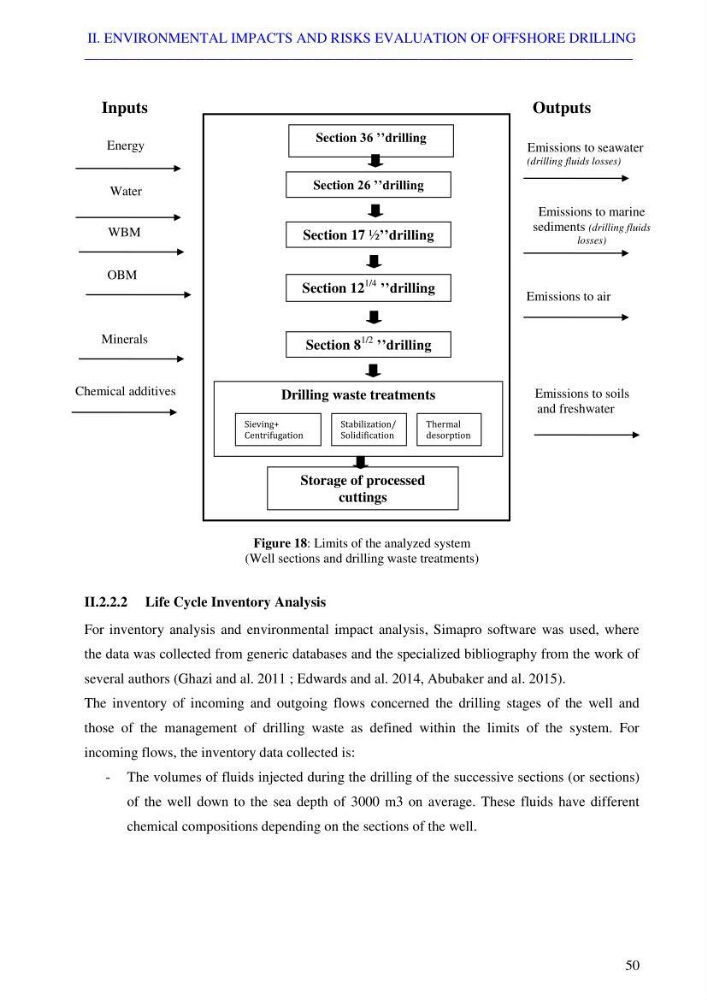
The inventory of incoming and outgoing flows concerned the drilling stages of the well and
those of the management of drilling waste as defined within the limits of the system. For
incoming flows, the inventory data collected is:
- The volumes of fluids injected during the drilling of the successive sections (or sections)
of the well down to the sea depth of 3000 m3 on average. These fluids have different
chemical compositions depending on the sections of the well.
Figure 18: Limits of the analyzed system
(Well sections and drilling waste treatments)
Energy
Water
WBM
OBM
Chemical additives
Minerals
Inputs
Section 36 ’’drilling
Section 26 ’’drilling
Section 17 ½’’drilling
Section 12
1/4
’’drilling
Section 8
1/2
’’drilling
Drilling waste treatments
Storage of processed
cuttings
Stabilization/
Solidification
Sieving+
Centrifugation
Thermal
desorption
Emissions to seawater
(drilling fluids losses)
Emissions to marine
sediments (drilling fluids
losses)
Emissions to soils
and freshwater
Emissions to air
Outputs
_____________________________________________________________________________
50
II.2.2.2 Life Cycle Inventory Analysis
For inventory analysis and environmental impact analysis, Simapro software was used, where
the data was collected from generic databases and the specialized bibliography from the work of
several authors (Ghazi and al. 2011 ; Edwards and al. 2014, Abubaker and al. 2015).
The inventory of incoming and outgoing flows concerned the drilling stages of the well and
those of the management of drilling waste as defined within the limits of the system. For
incoming flows, the inventory data collected is:
- The volumes of fluids injected during the drilling of the successive sections (or sections)
of the well down to the sea depth of 3000 m3 on average. These fluids have different
chemical compositions depending on the sections of the well.
Figure 18: Limits of the analyzed system
(Well sections and drilling waste treatments)
Energy
Water
WBM
OBM
Chemical additives
Minerals
Inputs
Section 36 ’’drilling
Section 26 ’’drilling
Section 17 ½’’drilling
Section 12
1/4
’’drilling
Section 8
1/2
’’drilling
Drilling waste treatments
Storage of processed
cuttings
Stabilization/
Solidification
Sieving+
Centrifugation
Thermal
desorption
Emissions to seawater
(drilling fluids losses)
Emissions to marine
sediments (drilling fluids
losses)
Emissions to soils
and freshwater
Emissions to air
Outputs