

II. ENVIRONMENTAL IMPACTS AND RISKS EVALUATION OF OFFSHORE DRILLING
_____________________________________________________________________________
37
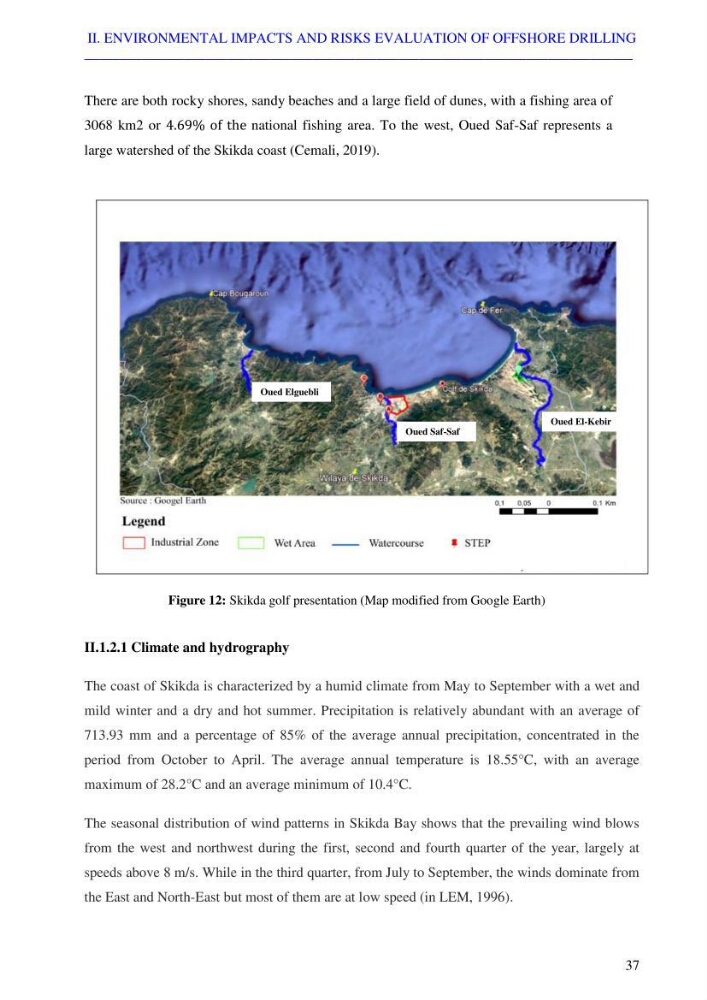
There are both rocky shores, sandy beaches and a large field of dunes, with a fishing area of
3068 km2 or 4.69% of the national fishing area. To the west, Oued Saf-Saf represents a
large watershed of the Skikda coast (Cemali, 2019).
II.1.2.1 Climate and hydrography
The coast of Skikda is characterized by a humid climate from May to September with a wet and
mild winter and a dry and hot summer. Precipitation is relatively abundant with an average of
713.93 mm and a percentage of 85% of the average annual precipitation, concentrated in the
period from October to April. The average annual temperature is 18.55°C, with an average
maximum of 28.2°C and an average minimum of 10.4°C.
The seasonal distribution of wind patterns in Skikda Bay shows that the prevailing wind blows
from the west and northwest during the first, second and fourth quarter of the year, largely at
speeds above 8 m/s. While in the third quarter, from July to September, the winds dominate from
the East and North-East but most of them are at low speed (in LEM, 1996).
Figure 12: Skikda golf presentation (Map modified from Google Earth)
Oued El-Kebir
Oued Saf-Saf
Oued Elguebli
_____________________________________________________________________________
37
There are both rocky shores, sandy beaches and a large field of dunes, with a fishing area of
3068 km2 or 4.69% of the national fishing area. To the west, Oued Saf-Saf represents a
large watershed of the Skikda coast (Cemali, 2019).
II.1.2.1 Climate and hydrography
The coast of Skikda is characterized by a humid climate from May to September with a wet and
mild winter and a dry and hot summer. Precipitation is relatively abundant with an average of
713.93 mm and a percentage of 85% of the average annual precipitation, concentrated in the
period from October to April. The average annual temperature is 18.55°C, with an average
maximum of 28.2°C and an average minimum of 10.4°C.
The seasonal distribution of wind patterns in Skikda Bay shows that the prevailing wind blows
from the west and northwest during the first, second and fourth quarter of the year, largely at
speeds above 8 m/s. While in the third quarter, from July to September, the winds dominate from
the East and North-East but most of them are at low speed (in LEM, 1996).
Figure 12: Skikda golf presentation (Map modified from Google Earth)
Oued El-Kebir
Oued Saf-Saf
Oued Elguebli