

I. LITERATURE REVIEW OF OFFSHORE OIL AND GAS DRILLING
18
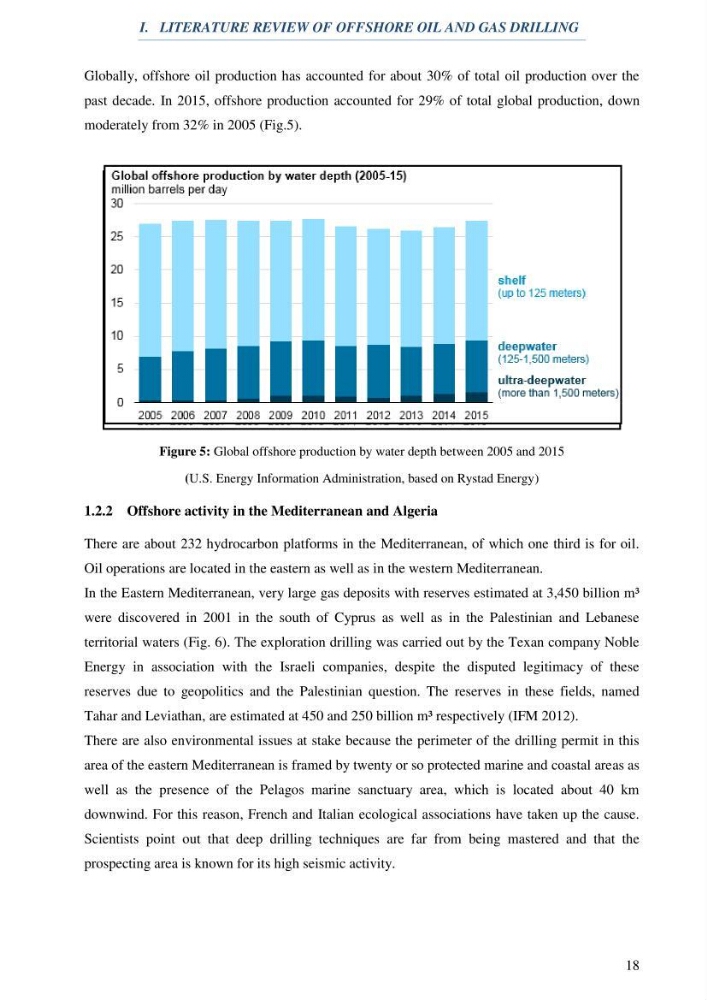
Globally, offshore oil production has accounted for about 30% of total oil production over the
past decade. In 2015, offshore production accounted for 29% of total global production, down
moderately from 32% in 2005 (Fig.5).
1.2.2 Offshore activity in the Mediterranean and Algeria
There are about 232 hydrocarbon platforms in the Mediterranean, of which one third is for oil.
Oil operations are located in the eastern as well as in the western Mediterranean.
In the Eastern Mediterranean, very large gas deposits with reserves estimated at 3,450 billion m³
were discovered in 2001 in the south of Cyprus as well as in the Palestinian and Lebanese
territorial waters (Fig. 6). The exploration drilling was carried out by the Texan company Noble
Energy in association with the Israeli companies, despite the disputed legitimacy of these
reserves due to geopolitics and the Palestinian question. The reserves in these fields, named
Tahar and Leviathan, are estimated at 450 and 250 billion m³ respectively (IFM 2012).
There are also environmental issues at stake because the perimeter of the drilling permit in this
area of the eastern Mediterranean is framed by twenty or so protected marine and coastal areas as
well as the presence of the Pelagos marine sanctuary area, which is located about 40 km
downwind. For this reason, French and Italian ecological associations have taken up the cause.
Scientists point out that deep drilling techniques are far from being mastered and that the
prospecting area is known for its high seismic activity.
Figure 5: Global offshore production by water depth between 2005 and 2015
(U.S. Energy Information Administration, based on Rystad Energy)
18
Globally, offshore oil production has accounted for about 30% of total oil production over the
past decade. In 2015, offshore production accounted for 29% of total global production, down
moderately from 32% in 2005 (Fig.5).
1.2.2 Offshore activity in the Mediterranean and Algeria
There are about 232 hydrocarbon platforms in the Mediterranean, of which one third is for oil.
Oil operations are located in the eastern as well as in the western Mediterranean.
In the Eastern Mediterranean, very large gas deposits with reserves estimated at 3,450 billion m³
were discovered in 2001 in the south of Cyprus as well as in the Palestinian and Lebanese
territorial waters (Fig. 6). The exploration drilling was carried out by the Texan company Noble
Energy in association with the Israeli companies, despite the disputed legitimacy of these
reserves due to geopolitics and the Palestinian question. The reserves in these fields, named
Tahar and Leviathan, are estimated at 450 and 250 billion m³ respectively (IFM 2012).
There are also environmental issues at stake because the perimeter of the drilling permit in this
area of the eastern Mediterranean is framed by twenty or so protected marine and coastal areas as
well as the presence of the Pelagos marine sanctuary area, which is located about 40 km
downwind. For this reason, French and Italian ecological associations have taken up the cause.
Scientists point out that deep drilling techniques are far from being mastered and that the
prospecting area is known for its high seismic activity.
Figure 5: Global offshore production by water depth between 2005 and 2015
(U.S. Energy Information Administration, based on Rystad Energy)