

I. LITERATURE REVIEW OF OFFSHORE OIL AND GAS DRILLING
15
I.1 Formation of marine hydrocarbon deposits
Oil is a fossil fuel that was formed between 20 and 350 million years ago. It comes from the
decomposition of marine organisms. The transformation of organic matter from living organisms
into oil takes tens of millions of years, passing through an intermediate substance called kerogen.
Kerogen is formed by the action of anaerobic bacteria.
Organic waste is composed of C, N, O which are generally destroyed and digested by bacteria,
but some are deposited at the bottom of closed seas, lagoons, lakes which are poor in O2, they
are thus protected from the action of bacteria. The organic matter mixes with sediments (sand,
clay) and accumulates in successive layers over millions of years, the oldest layers are thus
buried under the most recent ones by their own masses and following their coverage by new
deposits, the sedimentary layers sink naturally into the earth's crust and solidify into a mother
rock, this formation traps the kerogen. As the bedrock is also buried, the kerogen is subjected to
increasingly high geothermal pressures and temperatures, and the kerogen undergoes thermal
cracking, also known as "pyrolysis". This chemical transformation removes residual nitrogen and
oxygen to leave water, CO2 and hydrocarbons, molecules composed exclusively of carbon and
hydrogen.
The mixture of liquid hydrocarbons is called crude oil, when the bedrock is not sufficiently
buried, the kerogen it contains does not undergo pyrolysis, called oil shale, it is a fossil fuel
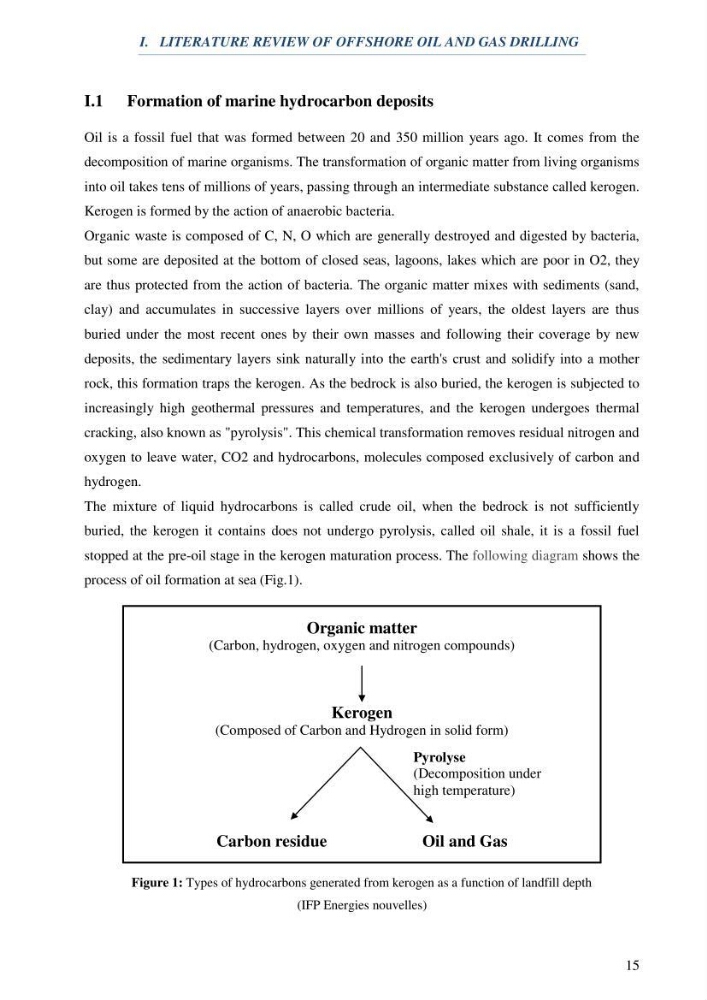
stopped at the pre-oil stage in the kerogen maturation process. The following diagram shows the
process of oil formation at sea (Fig.1).
Organic matter
(Carbon, hydrogen, oxygen and nitrogen compounds)
Kerogen
(Composed of Carbon and Hydrogen in solid form)
Carbon residue
Oil and Gas
Figure 1: Types of hydrocarbons generated from kerogen as a function of landfill depth
(IFP Energies nouvelles)
Pyrolyse
(Decomposition under
high temperature)
15
I.1 Formation of marine hydrocarbon deposits
Oil is a fossil fuel that was formed between 20 and 350 million years ago. It comes from the
decomposition of marine organisms. The transformation of organic matter from living organisms
into oil takes tens of millions of years, passing through an intermediate substance called kerogen.
Kerogen is formed by the action of anaerobic bacteria.
Organic waste is composed of C, N, O which are generally destroyed and digested by bacteria,
but some are deposited at the bottom of closed seas, lagoons, lakes which are poor in O2, they
are thus protected from the action of bacteria. The organic matter mixes with sediments (sand,
clay) and accumulates in successive layers over millions of years, the oldest layers are thus
buried under the most recent ones by their own masses and following their coverage by new
deposits, the sedimentary layers sink naturally into the earth's crust and solidify into a mother
rock, this formation traps the kerogen. As the bedrock is also buried, the kerogen is subjected to
increasingly high geothermal pressures and temperatures, and the kerogen undergoes thermal
cracking, also known as "pyrolysis". This chemical transformation removes residual nitrogen and
oxygen to leave water, CO2 and hydrocarbons, molecules composed exclusively of carbon and
hydrogen.
The mixture of liquid hydrocarbons is called crude oil, when the bedrock is not sufficiently
buried, the kerogen it contains does not undergo pyrolysis, called oil shale, it is a fossil fuel
stopped at the pre-oil stage in the kerogen maturation process. The following diagram shows the
process of oil formation at sea (Fig.1).
Organic matter
(Carbon, hydrogen, oxygen and nitrogen compounds)
Kerogen
(Composed of Carbon and Hydrogen in solid form)
Carbon residue
Oil and Gas
Figure 1: Types of hydrocarbons generated from kerogen as a function of landfill depth
(IFP Energies nouvelles)
Pyrolyse
(Decomposition under
high temperature)