

Sampling sediment
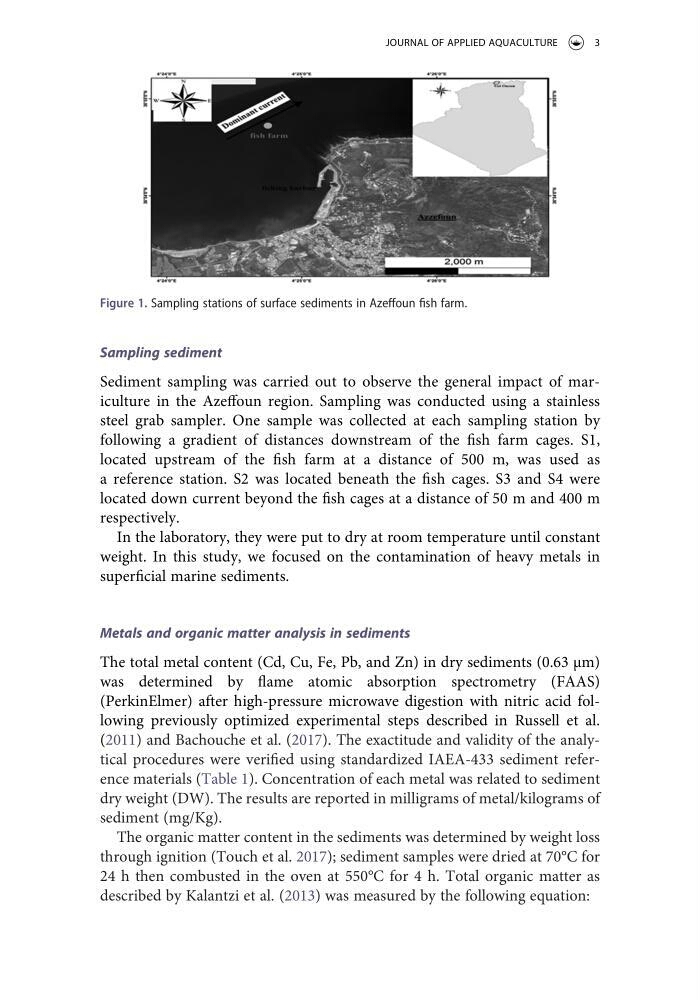
Sediment sampling was carried out to observe the general impact of mariculture in the Azeffoun region. Sampling was conducted using a stainless
steel grab sampler. One sample was collected at each sampling station by
following a gradient of distances downstream of the fish farm cages. S1,
located upstream of the fish farm at a distance of 500 m, was used as
a reference station. S2 was located beneath the fish cages. S3 and S4 were
located down current beyond the fish cages at a distance of 50 m and 400 m
respectively.
In the laboratory, they were put to dry at room temperature until constant
weight. In this study, we focused on the contamination of heavy metals in
superficial marine sediments.
Metals and organic matter analysis in sediments
The total metal content (Cd, Cu, Fe, Pb, and Zn) in dry sediments (0.63 μm)
was determined by flame atomic absorption spectrometry (FAAS)
(PerkinElmer) after high-pressure microwave digestion with nitric acid following previously optimized experimental steps described in Russell et al.
(2011) and Bachouche et al. (2017). The exactitude and validity of the analytical procedures were verified using standardized IAEA-433 sediment reference materials (Table 1). Concentration of each metal was related to sediment
dry weight (DW). The results are reported in milligrams of metal/kilograms of
sediment (mg/Kg).
The organic matter content in the sediments was determined by weight loss
through ignition (Touch et al. 2017); sediment samples were dried at 70°C for
24 h then combusted in the oven at 550°C for 4 h. Total organic matter as
described by Kalantzi et al. (2013) was measured by the following equation:
Figure 1. Sampling stations of surface sediments in Azeffoun fish farm.
JOURNAL OF APPLIED AQUACULTURE
3
Sediment sampling was carried out to observe the general impact of mariculture in the Azeffoun region. Sampling was conducted using a stainless
steel grab sampler. One sample was collected at each sampling station by
following a gradient of distances downstream of the fish farm cages. S1,
located upstream of the fish farm at a distance of 500 m, was used as
a reference station. S2 was located beneath the fish cages. S3 and S4 were
located down current beyond the fish cages at a distance of 50 m and 400 m
respectively.
In the laboratory, they were put to dry at room temperature until constant
weight. In this study, we focused on the contamination of heavy metals in
superficial marine sediments.
Metals and organic matter analysis in sediments
The total metal content (Cd, Cu, Fe, Pb, and Zn) in dry sediments (0.63 μm)
was determined by flame atomic absorption spectrometry (FAAS)
(PerkinElmer) after high-pressure microwave digestion with nitric acid following previously optimized experimental steps described in Russell et al.
(2011) and Bachouche et al. (2017). The exactitude and validity of the analytical procedures were verified using standardized IAEA-433 sediment reference materials (Table 1). Concentration of each metal was related to sediment
dry weight (DW). The results are reported in milligrams of metal/kilograms of
sediment (mg/Kg).
The organic matter content in the sediments was determined by weight loss
through ignition (Touch et al. 2017); sediment samples were dried at 70°C for
24 h then combusted in the oven at 550°C for 4 h. Total organic matter as
described by Kalantzi et al. (2013) was measured by the following equation:
Figure 1. Sampling stations of surface sediments in Azeffoun fish farm.
JOURNAL OF APPLIED AQUACULTURE
3