

.
96
The Last Resource
'
from farther and farther aeld. Large industrial centres in other
parts of the country must also collect supplies from distant, less
populated catchment areas—it is now almost a regular sport for
dissident Welsh'nationalists to blow up a pipe or two taking water
from the hills of North Wales to slake the thirst of Liverpool sixty
to eighty miles away.
'
Speaking at a symposium on nuclear desalination in London in
October 1967, A. F. Rowntree, director of the British Water
Resources Board, forecast that the rst nuclear dual purpose plant
would be in operation in Britain within ten to fteen years. In 1967
the then U.S. Vice—President, Hubert Humphrey, inaugurated the
world’s largest single—unit desalting plant on Key West at the
southern tip of Florida. But at present there is no need for any
widespread use of desalting—better use of existing supplies could
do much to relieve many threats of serious shortages of fresh water.
The whole question of desalination needs to be put into perspec—
tive against the supplies of fresh water which are already available
‘
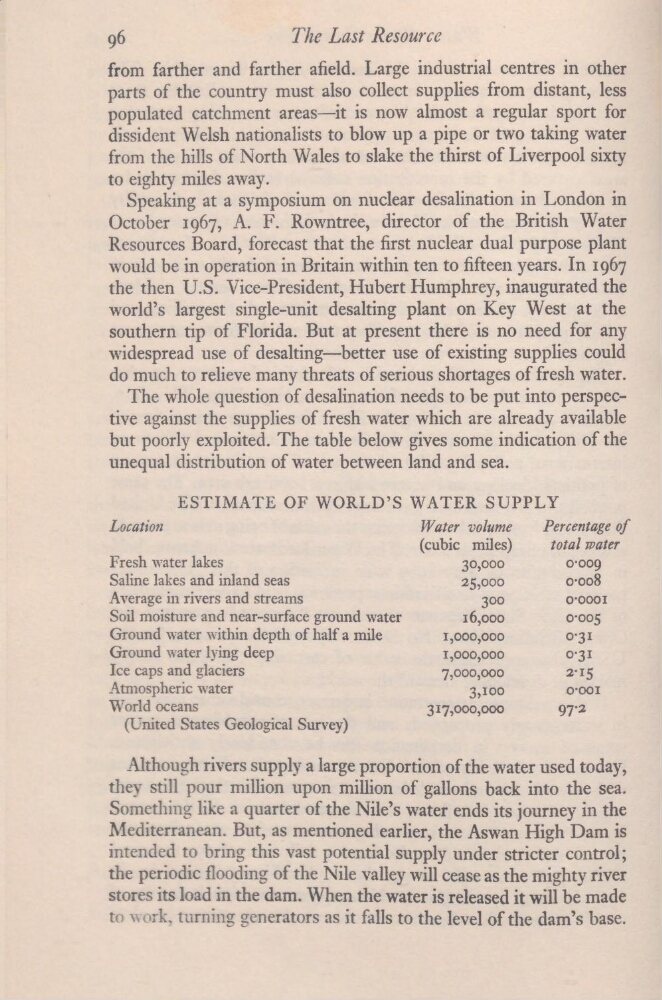
but poorly exploited. The table below gives some indication of the
unequal distribution of water between land and sea.
ESTIMATE OF WORLD’S WATER SUPPLY
Location
Water volume
Peræntage of
(cubic miles)
total water
Fresh water lakes
30,000
0009
Saline lakes and inland seas
25,000
0008
.
Average in rivers and streams
300
o-ooor
,
Soil moisture and near—surface ground water
16,000
0005
Ground water within depth of half a mile
1,ooo,ooo
0-31
Ground water lying deep
1,ooopoo
0-31
Ice caps and glaciers .
7,ooo,ooo
2-15
Atmospheric water
_
3,100
0001
World oceans
317,ooo,ooo
972
(United States Geological Survey)
Although rivers supply a large proportion of the water used today,
they still pour million upon million of gallons back into the sea.
Something like a quarter of the Nile’s water ends its journey in the
Mediterranean. But, as mentioned earlier, the Aswan High Dam is
intended to bring this vast potential supply under stricter control;
the periodic ooding of the Nile valley will cease as the mighty river
stores its load in the dam. When the water is released it will be made
to work, turning generators as it falls to the level of the dam’s base.
96
The Last Resource
'
from farther and farther aeld. Large industrial centres in other
parts of the country must also collect supplies from distant, less
populated catchment areas—it is now almost a regular sport for
dissident Welsh'nationalists to blow up a pipe or two taking water
from the hills of North Wales to slake the thirst of Liverpool sixty
to eighty miles away.
'
Speaking at a symposium on nuclear desalination in London in
October 1967, A. F. Rowntree, director of the British Water
Resources Board, forecast that the rst nuclear dual purpose plant
would be in operation in Britain within ten to fteen years. In 1967
the then U.S. Vice—President, Hubert Humphrey, inaugurated the
world’s largest single—unit desalting plant on Key West at the
southern tip of Florida. But at present there is no need for any
widespread use of desalting—better use of existing supplies could
do much to relieve many threats of serious shortages of fresh water.
The whole question of desalination needs to be put into perspec—
tive against the supplies of fresh water which are already available
‘
but poorly exploited. The table below gives some indication of the
unequal distribution of water between land and sea.
ESTIMATE OF WORLD’S WATER SUPPLY
Location
Water volume
Peræntage of
(cubic miles)
total water
Fresh water lakes
30,000
0009
Saline lakes and inland seas
25,000
0008
.
Average in rivers and streams
300
o-ooor
,
Soil moisture and near—surface ground water
16,000
0005
Ground water within depth of half a mile
1,ooo,ooo
0-31
Ground water lying deep
1,ooopoo
0-31
Ice caps and glaciers .
7,ooo,ooo
2-15
Atmospheric water
_
3,100
0001
World oceans
317,ooo,ooo
972
(United States Geological Survey)
Although rivers supply a large proportion of the water used today,
they still pour million upon million of gallons back into the sea.
Something like a quarter of the Nile’s water ends its journey in the
Mediterranean. But, as mentioned earlier, the Aswan High Dam is
intended to bring this vast potential supply under stricter control;
the periodic ooding of the Nile valley will cease as the mighty river
stores its load in the dam. When the water is released it will be made
to work, turning generators as it falls to the level of the dam’s base.