

Water, Waler Everywhere . . .
81
core’s top surface is scraped and the scrapings are passed into the
melting tank (see gure 7).
The secondary refrigerant process uses a gas which has been
cooled down to the liquid state to freeze the water. The liqueed
gas is added to the salt—water and allowed to evaporate. Again the
heat of evaporation extracted from the salt solution causes some of
the water to freeze. Just as in the direct freezing process the brine/ice
slurry passes on to a separation column, where the ice crystals are
separated from the brine, washed and passed into the melting
chamber. The boiling point of the gas that has been evaporated is
raised by slightly increasing the pressure. It then ows to the
—
melting chamber where it condenses liberating heat which melts the
ice. The water and the remaining liquid gas do not mix and so are
easily separated in a decanting chamber (see gure 7). Using butane
as the secondary refrigerant the freezer and separating column can
be operated at nearly atmospheric pressure, which avoids some of
the expensive problems involved in constructing vacuum chambers
of the type used in direct freezing.
z. Processes using membranes
_
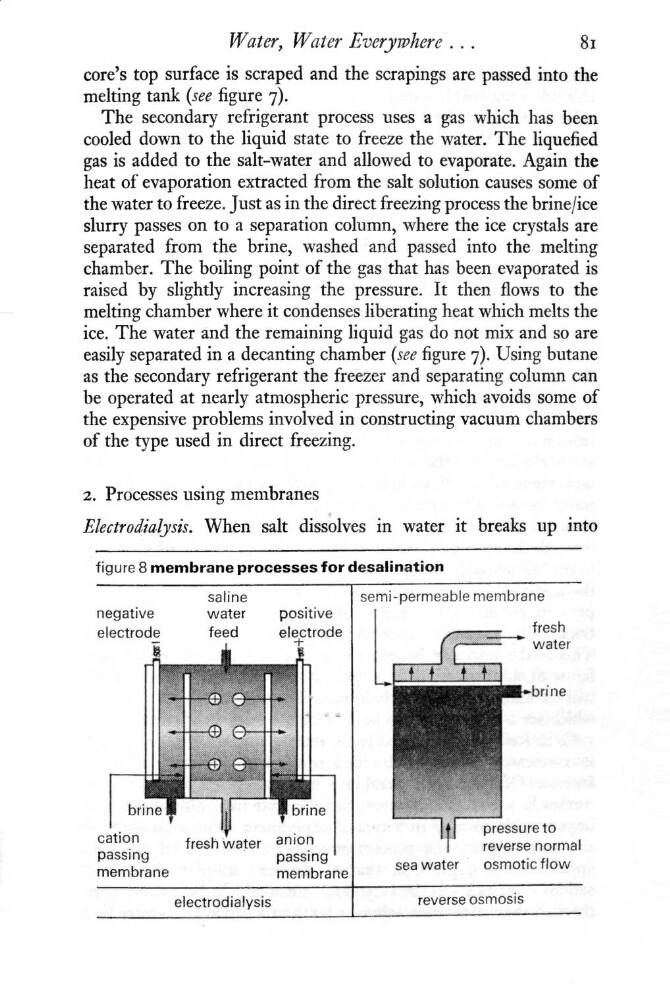
ElectroaÏiabsis. When salt dissolves in water it breaks up into
figure 8 membrane processes for desalination
saline
semi-permeable membrane
negative
water
positive
electrode
feed
electrode
fresh
"
+
water
_
'
”ne
brine
brin'e
.
_
'
pressure ÎO
Ê22329
fresh Water
anron
reverse normal
passrng
.
.
membrane
membrane
sea water
osmotrc flow
electrodialysis
reverse osmosis
81
core’s top surface is scraped and the scrapings are passed into the
melting tank (see gure 7).
The secondary refrigerant process uses a gas which has been
cooled down to the liquid state to freeze the water. The liqueed
gas is added to the salt—water and allowed to evaporate. Again the
heat of evaporation extracted from the salt solution causes some of
the water to freeze. Just as in the direct freezing process the brine/ice
slurry passes on to a separation column, where the ice crystals are
separated from the brine, washed and passed into the melting
chamber. The boiling point of the gas that has been evaporated is
raised by slightly increasing the pressure. It then ows to the
—
melting chamber where it condenses liberating heat which melts the
ice. The water and the remaining liquid gas do not mix and so are
easily separated in a decanting chamber (see gure 7). Using butane
as the secondary refrigerant the freezer and separating column can
be operated at nearly atmospheric pressure, which avoids some of
the expensive problems involved in constructing vacuum chambers
of the type used in direct freezing.
z. Processes using membranes
_
ElectroaÏiabsis. When salt dissolves in water it breaks up into
figure 8 membrane processes for desalination
saline
semi-permeable membrane
negative
water
positive
electrode
feed
electrode
fresh
"
+
water
_
'
”ne
brine
brin'e
.
_
'
pressure ÎO
Ê22329
fresh Water
anron
reverse normal
passrng
.
.
membrane
membrane
sea water
osmotrc flow
electrodialysis
reverse osmosis