

Wars and W ayfarmg
197
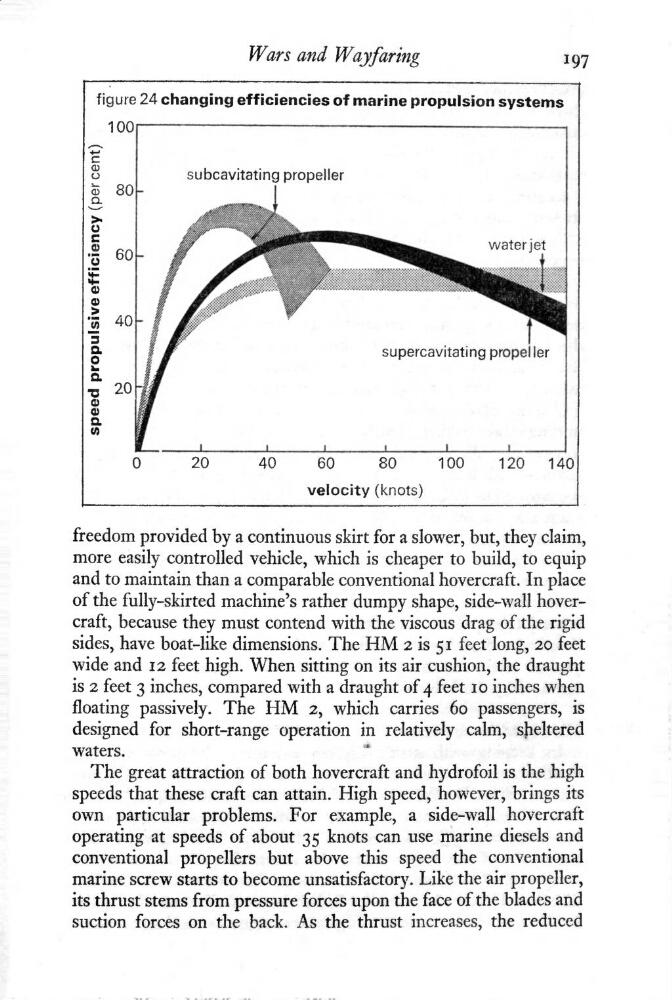
gure 24 changing efciencies of marine propulsion systems
1 00
.
€
0
subcavitating propeller
$
80
&
>
2
.
% 60
water ]8Î
,
. =___
@
°>’
-._7,
40
:
.
-
gsupercavutatmg pr
ler
E.
0
0
:.
W
0
20
40
60
80
100
120
140
velocity (knots)
freedom provided by a continuous skirt for a slower, but, they claim,
more easily controlled vehicle, which is cheaper to build, to equip
and to maintain than a comparable conventional hovercraft. In place
of the fully—skirted machine’s rather dumpy shape, side—wall hover—
craft, because they must contend with the viscous drag of the rigid
sides, have boat—like dimensions. The HM 2 is 51 feet long, 20 feet
wide and 12 feet high. When sitting on its air cushion, the draught
is 2 feet 3 inches, compared with a draught of 4 feet 10 inches when
oating passively. The HM 2, which carries 60 passengers, is
designed for short—range operation in relatively calm, sheltered
waters.
’
The great attraction of both hovercraft and hydrofoil is the high
speeds that these craft can attain. High speed, however, brings its
own
particular problems. For example, a side—wall hovercraft
operating at speeds of about 35 knots can use marine diesels and
conventional propellers but above this speed the conventional
marine screw starts to become unsatisfactory. Like the air propeller,
its thrust stems from pressure forces upon the face of the blades and
suction forces on the back. As the thrust increases, the reduced
197
gure 24 changing efciencies of marine propulsion systems
1 00
.
€
0
subcavitating propeller
$
80
&
>
2
.
% 60
water ]8Î
,
. =___
@
°>’
-._7,
40
:
.
-
gsupercavutatmg pr
ler
E.
0
0
:.
W
0
20
40
60
80
100
120
140
velocity (knots)
freedom provided by a continuous skirt for a slower, but, they claim,
more easily controlled vehicle, which is cheaper to build, to equip
and to maintain than a comparable conventional hovercraft. In place
of the fully—skirted machine’s rather dumpy shape, side—wall hover—
craft, because they must contend with the viscous drag of the rigid
sides, have boat—like dimensions. The HM 2 is 51 feet long, 20 feet
wide and 12 feet high. When sitting on its air cushion, the draught
is 2 feet 3 inches, compared with a draught of 4 feet 10 inches when
oating passively. The HM 2, which carries 60 passengers, is
designed for short—range operation in relatively calm, sheltered
waters.
’
The great attraction of both hovercraft and hydrofoil is the high
speeds that these craft can attain. High speed, however, brings its
own
particular problems. For example, a side—wall hovercraft
operating at speeds of about 35 knots can use marine diesels and
conventional propellers but above this speed the conventional
marine screw starts to become unsatisfactory. Like the air propeller,
its thrust stems from pressure forces upon the face of the blades and
suction forces on the back. As the thrust increases, the reduced