

l
Entry into [mer Space
16 5
l
l‘
.
.
.
°
O
0
®
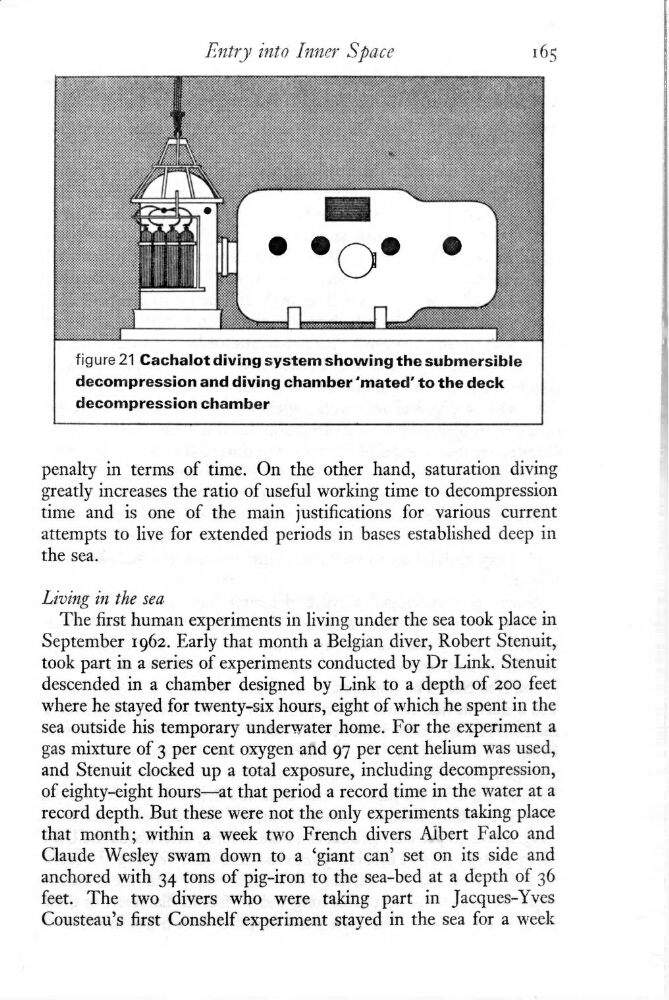
figure 21 Cachalot diving system showing the submersible
decompression and diving chamber 'mated' to the deck
decompression chamber
penalty in terms of time. On the other hand, saturation diving
greatly increases the ratio of useful working time to decompression
time and is one of the main justications for various current
attempts to live for extended periods in bases established deep in
the sea. '
Living in the sea
The rst human experiments in living under the sea took place in
September 1962. Early that month a Belgian diver, Robert Stenuit,
took part in a series of experiments conducted by Dr Link. Stenuit
descended in a chamber designed by Link to a depth of 200 feet
where he stayed for twenty—s-ix hours, eight of which he spent in the
sea outside his temporary underwater home. For the experiment a
gas mixture of 3 per cent oxygen and 97 per
cent helium was used,
and Stenuit clocked up a total exposure, including decompression,
of eighty—eight hours—at that period a record time in the water at a
record depth. But these were not the only experiments taking place
that month; within a week two French divers Albert Falco and
Claude Wesley swam down to a ‘giant can’ set on its side and
anchored With 34 tons of pig—iron to the sea—bed at a depth of 36
feet. The two divers who were taking part in Jacques—Yves
Cousteau’s rst Conshelf experiment stayed in the sea for a week
Entry into [mer Space
16 5
l
l‘
.
.
.
°
O
0
®
figure 21 Cachalot diving system showing the submersible
decompression and diving chamber 'mated' to the deck
decompression chamber
penalty in terms of time. On the other hand, saturation diving
greatly increases the ratio of useful working time to decompression
time and is one of the main justications for various current
attempts to live for extended periods in bases established deep in
the sea. '
Living in the sea
The rst human experiments in living under the sea took place in
September 1962. Early that month a Belgian diver, Robert Stenuit,
took part in a series of experiments conducted by Dr Link. Stenuit
descended in a chamber designed by Link to a depth of 200 feet
where he stayed for twenty—s-ix hours, eight of which he spent in the
sea outside his temporary underwater home. For the experiment a
gas mixture of 3 per cent oxygen and 97 per
cent helium was used,
and Stenuit clocked up a total exposure, including decompression,
of eighty—eight hours—at that period a record time in the water at a
record depth. But these were not the only experiments taking place
that month; within a week two French divers Albert Falco and
Claude Wesley swam down to a ‘giant can’ set on its side and
anchored With 34 tons of pig—iron to the sea—bed at a depth of 36
feet. The two divers who were taking part in Jacques—Yves
Cousteau’s rst Conshelf experiment stayed in the sea for a week